CSB IDs cause of 2016 Pascagoula gas plant explosion
The U.S. Chemical Safety Board (CSB) has released its final report of the June 27, 2016, investigation of an explosion and fire at the Enterprise Products Pascagoula Gas Plant in Pascagoula, MS. The CSB determined that the probable cause was a phenomenon known as thermal fatigue. The CSB also issued recommendations to two trade associations and local emergency responders.
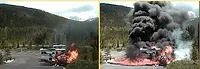
The incident occurred late in the evening on June 27, 2016, when a major loss of containment in a heat exchanger resulted in the release of methane, ethane, propane, and several other hydrocarbons. The hydrocarbons ignited, initiating a series of fires and explosions, which ultimately shut down the site for almost six months.
Other facilities at risk
CSB Interim Executive Kristen Kulinowski said, “More than 500 gas processing facilities operate across the country and the use of similar heat exchangers is common. Extending the life cycle of equipment at these facilities requires more robust inspection protocols. Operators shouldn’t take the risk of waiting to find a leak because, as this case demonstrates, that leak could result in a catastrophic failure.”
The Enterprise Plant receives raw natural gas via a pipeline from the Gulf of Mexico and separates the material into two products: natural gas liquids, which serve as a feedstock to the chemical industry, and a natural gas fuel stream, primarily composed of methane. A key piece of equipment used in the process is a brazed aluminum heat exchanger (BAHX), which allows for the transfer of heat between two different process streams while keeping the streams separate.
About thermal fatigue
The CSB investigation determined that the probable cause of the incident was a failure of the BAHX due to thermal fatigue. The report details how thermal fatigue occurs between aluminum parts of a BAHX. As the exchanger is heated or cooled, the tightly connected parts expand or contract. If the parts change temperatures at sufficiently different rates, the expansion and contraction can be disproportionate. Over time, this process weakens the metal, and ultimately causes cracks, which can lead to the escape of hydrocarbons. Typically, when a leak is found, it can be repaired with minimal expense or consequence before a major loss of containment occurs. Assuming that leaks will be discovered and can be repaired prior to a catastrophic failure is referred to as a “leak-before failure” assumption. Thermal fatigue is a known factor to BAHXs and there is industry guidance on recommended limits for maximum cyclic temperature fluctuations during operation and rates of cooling or heating during startup and shutdown. However, the CSB found this guidance was not robust for the diverse operations and environments where BAHXs operate.
At the Enterprise Gas Plant, process data for the exchangers show that the BAHXs were repeatedly subjected to temperature changes that exceeded industry-recommended practices. This increases stresses on the connections within the heat exchangers as the aluminum parts push against and pull apart from each other. At Enterprise, over a 17-year period, four different BAHX heat exchangers were repaired nine times.
The 2016 incident, as well as four other BAHX failure events at other facilities, illustrate that relying on a leak-before-failure assumption is not adequate. Operators of midstream gas plants need a more robust assessment and risk management plan that considers thermal fatigue to prevent the risk of sudden and catastrophic rupture of BAHX.
Investigator William Hougland said, “A number of midstream gas plant operators have reported that the limits and rates in existing industry guidance may not be realistic. Our report encourages a meaningful dialogue among BAHX manufacturers, gas processors, and repair technicians. The CSB concluded that more realistic and updated guidance is needed to improve the safe use of BAHX.”
The CSB is issuing recommendations to two trade associations, the American Petroleum Institute (API) and GPA Midstream Association, to share information related to failure hazards of BAHXs from thermal fatigue.
The CSB’s report further discusses issues related to emergency response following the incident. Although no off-site property damage was reported, many nearby residents chose to evacuate. After the incident, members of a local community organization expressed concern to the CSB that some residents did not know how to respond. As a result, the CSB recommends a more robust and engaged community alert network—one that includes social media and the ability to expand opportunities to interact with the community throughout an incident.
Today the CSB is also releasing an interactive 3D model of the heat exchanger used at the Enterprise Plant to enhance understanding of how this type of heat exchanger operates and its vulnerability to thermal fatigue.
The CSB is an independent, non-regulatory federal agency whose mission is to drive chemical safety change through independent investigations to protect people and the environment. The agency’s board members are appointed by the President and confirmed by the Senate. CSB investigations look into all aspects of chemical incidents, including physical causes such as equipment failure as well as inadequacies in regulations, industry standards, and safety management systems. For more information, contact public@csb.gov.
Looking for a reprint of this article?
From high-res PDFs to custom plaques, order your copy today!