Innovative respiratory protection protects welders like never before
You’ve come a long way, baby
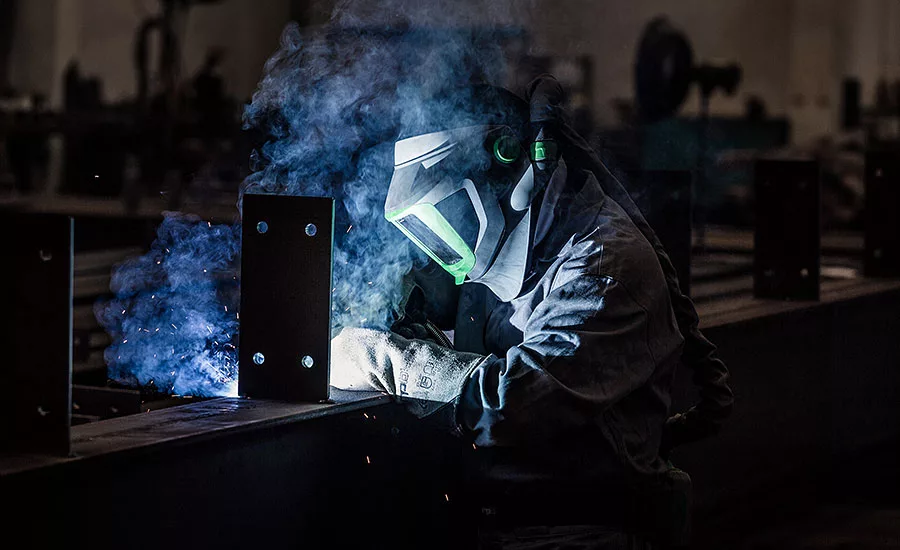
Early welding was dirty work. Welders of the past were exposed to flying sparks, harmful fumes, and high temperatures with very little protective gear. From when welding processes were first used in the Middle Ages to the modern, innovative welding helmets of today, personal protective equipment (PPE) for welding safety has come a long way.
One of the most important pieces of safety gear for today’s welder is the respirator. Innovation and technology have made great advancements, developing respirators that protect welders more than ever before. To fully appreciate the protection provided by respirators today, one must look at the welding safety of the past.
The evolution of welding PPE
Early welding PPE was very basic. Prior to World War II, protection consisted mainly of goggles and simple face shields, leaving welders exposed to harmful UV light, flash burns, charring sparks, and infrared light.
The next major development in welding helmets provided a larger coverage area. These were developed in the 1940s as a response to changes in the welding industry during WWII, when many men left their jobs to fight, leaving large gaps in the industrial workforce. Women stepped forward and - as inexperienced welders - they required a greater level of protection, provided by these modern welding helmets.
Through the 1950s and ’60s, the first plastic and fiberglass hardhats also emerged, along with the first adjustable spectacle and nylon welding helmets.
Eye protection improved in the 1980s with the first fully-functioning auto-darkening welding helmets. Auto-darkening filters (ADFs) darkened lenses automatically when sensors detected bright welding arc. This increased protection from eye damage, including inflamed or burned corneas.
Today, welding respirators have advanced the features of welding helmets and combined them with innovative respiratory protection to fully protect welders both inside and out. However, it wasn’t always so easy. The respiratory protection of the past left much to be desired.
Early respiratory protection
Initial instances of respiratory protection can be traced back to the first century, when the Romans used animal bladder skins to protect mine workers against red lead oxide dust. Inventor Leonardo da Vinci also suggested that sailors could protect themselves from a toxic powder with fine cloths dipped in water, placed over their mouths.
Primitive respirators emerged in the late 1700s, and mainly consisted of a rubberized fabric bag with windows, placed over the wearer’s head and secured around the throat. They required the wearer to carry a tank of air under pressure. The first patent for an air-purifying respirator was granted in the U.S. in 1848 for “Haslett’s Lung Protector” which used one-way clapper valves to filter dust from the air and used moistened wool as the filter.
Further inventions led to the discovery of active charcoal’s ability to capture large volumes of gas, resulting in it becoming the most widely used filter for respirators. Eventually, advances in technology produced early respirators that filtered harmful gases, vapors, and smoke from the air.
Respiratory protection myths
Prior to the establishment of OSHA in the U.S., there were few safety standards and regulations. Little was known – or made clear – about the potentially severe health risks that exposure to welding environments posed. Although those in the industry recognized the potentially harmful substances they were being exposed to, lack of regulation meant welders weren’t necessarily fully informed on or required to use respiratory protection.
This led to some unconventional – yet unfounded – methods of protection. Many welders will be familiar with the old wives’ tale that milk protected them from welding fumes. Drinking milk before welding, some believed, made the body absorb the calcium from the milk, leaving no space for the heavy metals to settle into their body. However, welding fume enters the body via the respiratory system, and milk via the digestive system, so drinking milk has no protective effect.
Other beliefs include that simply holding milk in the mouth during welding acts as a filter. When finished welding, welders would spit out the milk which was, by then, dirty. This method only forced welders to breathe through their noses and offered no protection against welding fume.
The catalyst for change
In 1971, OSHA was established to ensure safe, healthy working conditions by setting and enforcing standards for safety and health protection. One of the first respiratory protection standards was signed into effect in 1974, addressing 13 known carcinogens and requiring employers to implement respiratory protection programs including use of respirators - for every employee under the standard.
Since then, OSHA has set many permissible exposure limits (PELs) and respiratory guidelines around harmful substances that welders are exposed to in the workplace, including welding fume.
Current welding respiratory protection
Respirators of today have come a long way in safety, design, functionality, and comfort. Welders can choose optional, additional safety-enhancing features such as built-in head or hearing protection, ADF lenses, in-helmet communications devices, flip-up visors to easily transition to grinding, side windows for increased peripheral vision, adjustable air flow, climate control, and even lighting accessories.
Loose-fitting respirators also provide a greater area of surface protection than welding helmets alone, as they cover a welder’s entire face and head, which further minimizes exposure to potential spatter burns and UV radiation. As opposed to tight-fitting respirators, which do require a tight seal, those with facial hair or piercings can use loose-fitting respirators without worrying about breaking that seal and leaving themselves exposed.
Thanks to the dedication of health and safety organizations such as OSHA, there has been the need for constantly evolving technology to strive for innovative ways of protecting welders to higher levels, helping them lead healthier, longer lives.
Sources:
- “UNITED STATES DEPARTMENT OF LABOR.” Occupational Safety and Health Administration, www.osha.gov/osha40/timeline.html.Sapp, Mark E. “The Home for A History of Thermal Joining.” Web Site - Brazing Timeline - Years Pre 1900s, www.weldinghistory.org/whfolder/folder/wh1900.html.
- “Does Drinking Milk Protect You from Welding Fume?” Press Release: 2013 MYOB Business Monitor: Cloud & Web-Savvy SMEs Continue to Enjoy Better Business, prwire.com.au/pr/81143/does-drinking-milk-protect-you-from-welding-fume.
- “A Brief History of Welding Safety Equipment - Wayne Oxygen & Welding Supply Co Inc - Waynesboro.” 3 Common Power Tools Used in the Welding Process - VAG Equipment and Materials - Newark | NearSay, nearsay.com/c/405502/242027/a-brief-history-of-welding-safety-equipment.
- “Timeline of OSHA’s 40 Year History.” Occupational Safety and Health Administration, UNITED STATES DEPARTMENT OF LABOR, www.osha.gov/osha40/timeline.html.
- Herris, William P. “How Regulation and Innovation Have Shaped Respiratory Protection.” EHS Today, 13 Apr. 2012, www.ehstoday.com/ppe/respirators/regulation_innovation_shaped.
Looking for a reprint of this article?
From high-res PDFs to custom plaques, order your copy today!