ISHN logo
search
cart
facebook twitter linkedin youtube
  • Sign In
  • Create Account
  • Sign Out
  • My Account
ISHN logo
  • NEWS
    • Today's News
    • Global Safety News
    • Government Regulations
  • PRODUCTS
    • Product Innovations
    • Featured Products
  • TOPICS
    • Environmental Health and Safety
    • Facility Safety
    • Workplace Health
    • Occupational Safety
    • PPE
    • More Topics
  • CONSTRUCTION
  • TECHNOLOGY
  • COLUMNS
    • Best Practices
    • Dave Johnson: What’s going on
    • Editorial Comments
    • Leading Safety
  • MULTIMEDIA
    • ISHN Podcast
    • Videos
    • Cold Stress Education Quiz
    • Webinars
    • White Papers
  • MORE
    • Buyer's Guide
    • Newsletters
    • Convention Companion
    • Polls
    • Events
    • ISHN Store
    • Sponsor Insights
  • EMAGAZINE
    • eMagazine
    • Archived Issues
    • Contact
    • Advertise
  • JOIN TODAY!
Occupational SafetyFacility Safety

Steel curtains block flying debris from hydraulic presses

Striking out
By Carrie Halle
Steel curtains block flying debris from hydraulic presses
May 5, 2020

The potential for catastrophic injury when operating a hydraulic press is great. Its operation requires a worker to feed, position and remove stock in the area under the powerful ram or near the bending point, exposing him or herself directly to danger. Each year an estimated 250,000 industrial workers are struck by ejected debris such as metal chips, nails, broken cutters, blades, tools and dislodged grinding wheels from a variety of different machines.

Because of the tremendous force of a press, parts ejected from it have led to countless serious eye, head, and bodily injuries. Metal fragments, slivers, piece parts and blocks can be dislodged and dispersed at great speed, striking the press operator or bystanders. These types of accidents typically occur when job parts are not aligned properly during setup. As a result, the job part may be squeezed out or ejected when under tremendous load. Stock may also fracture, sending shrapnel into the work area, piercing skin and underlying tissues. Each year an estimated 250,000 industrial workers are struck by ejected debris such as metal chips, nails, broken cutters, blades, tools and dislodged grinding wheels from a variety of different machines.

Role of ejection curtains

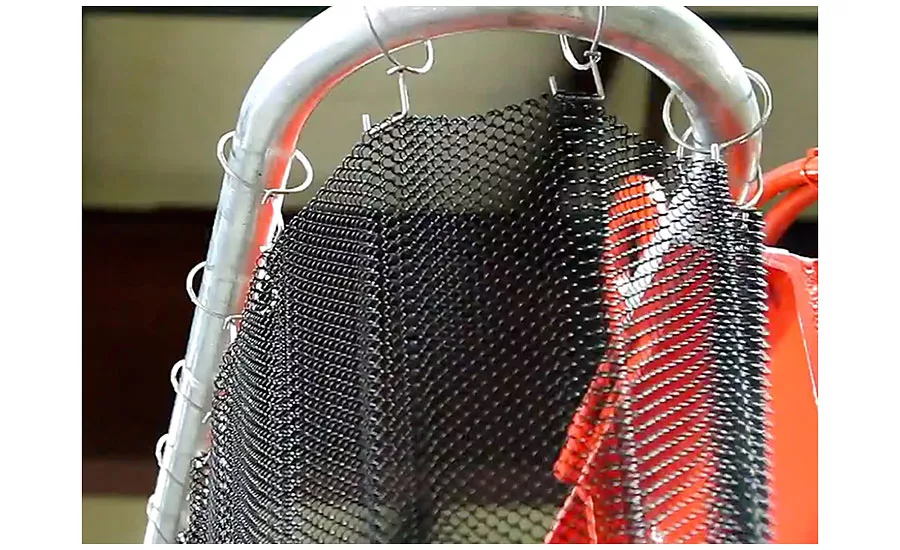
Steel mesh ejection curtains were originally intended to protect people in the vicinity of a bomb blast. Today they have become a safety solution for hydraulic presses, namely Arbor and H-Frame presses. Rather than having a work piece that fractures, slides, rolls or ejects to become a high-speed projectile, the curtain’s interlocking wire coils act as individual springs that absorb kinetic energy, expanding and stretching in a predictive and repeatable way. The holes in the material allow pressure to go through the mesh while stopping or slowing the flying debris by wrapping around it and dropping it to the floor without ricocheting back towards the press, thereby reducing the potential for striking the operator.

Ejection curtains have gained popularity since they offer access during normal operations, as well as for press maintenance. Being mesh, the curtains are flexible and simple to push out of the way during loading, positioning or removing work pieces, unlike with traditional fencing or solid metal barriers. Additionally, the mesh curtain allows visibility while the press is in operation. Curtains are typically secured at the top on a pipe suspension assembly and hang free at both sides and the bottom, providing easy access to the machine.

Methods for risk reduction

Although ejection curtains are not classified as guards, they do act as an awareness barrier for powered presses to reduce exposure to the point of operation and also act as a containment barrier to stop or slow projectiles ejected from the machine. For powered presses, this product meets the ANSI B11.2 ref 8.2.1. “flying objects” clause, pending results of the risk assessment to determine the likelihood and force potential for throwing objects (note, a “shield” does not need to be a hard guard).

Platen presses, stamping presses, transfer presses, and in some cases forging presses require barrier guards or devices, which prevent access to the point of operation over, under, around or through the guard itself. For these applications, an ejection curtain does not meet these criteria as it is a movable barrier and does not have to be in place to operate the press.

Case study

Facility managers at Canada West Harvest Centre are aware of the necessity to install safety guards around machines in order to avoid injuries from pinch points or projectiles.

Canada West Harvest Centre is a CLAAS agricultural dealership, selling and servicing the full line of CLAAS equipment for Southern Saskatchewan. At three separate Canada West Harvest Centre locations, Gray SP-25 heavy-duty shop presses with a 25-ton capacity are utilized to service components of CLAAS agricultural equipment. Canada West Harvest Centre relies on ejection curtains to help protect its machine operators and surrounding personnel.

KEYWORDS: manufacturing welding safety workplace safety

Share This Story

Looking for a reprint of this article?
From high-res PDFs to custom plaques, order your copy today!

Carrie Halle is VP of Marketing and Business Development, Rockford Systems, LLC . Rockford Systems (https://www.rockfordsystems.com)  provides information on how machine safeguarding products can be applied.

Recommended Content

JOIN TODAY
to unlock your recommendations.

Already have an account? Sign In

  • forklift safety

    Exploring the latest technologies in forklift safety

    With more staff and more stock in warehousing now more...
    Facility Safety
    By: Josh Cramer
  • welding

    All about welder’s flash or arc eye

    A flash burn is a painful inflammation of the cornea,...
    Environmental Health and Safety
  • dangerous jobs

    The 10 most dangerous jobs in the U.S.

    On-the-job deaths have been rising — hitting the highest...
    Construction Industry Safety and Health
    By: Benita Mehta
Manage My Account
  • eMagazine Subscriptions
  • ISHN Newsletter & Other Newsletter Alerts
  • Online Registration
  • Manage My Preferences
  • Subscription Customer Service

More Videos

Sponsored Content

Sponsored Content is a special paid section where industry companies provide high quality, objective, non-commercial content around topics of interest to the ISHN audience. All Sponsored Content is supplied by the advertising company and any opinions expressed in this article are those of the author and not necessarily reflect the views of ISHN or its parent company, BNP Media. Interested in participating in our Sponsored Content section? Contact your local rep!

close
  • man wearing the the Sundström SR200 Full Face Mask Respirator
    Sponsored byOHD

    5 Fit Testing Mistakes That Could Cost You

  • This image shows Magid AcuSpex polarized blue mirrored safety glasses.
    Sponsored byMagid Glove and Safety

    Construction PPE Guide: What Crews Need for Each Task

  • lone worker in confined space
    Sponsored byAlphasense Ltd.

    GET THE LEAD OUT of your Safety Oxygen Sensors!

Popular Stories

SpaceX 7 launch

OSHA Investigating Fatal Fall at SpaceX Starbase

Worker Impairment

How to Tell When a Co-Worker is Impaired? A Safety Pro’s Challenge

Automated loading dock equipment

After March 2026 Rivian Death, Safety Managers Reassess Loading Dock Systems Under OSHA's Warehouse Emphasis Program

top 10 most dangerous jobs

Poll

Seasonal Readiness

With the federal heat stress prevention rule on the horizon, which area of your safety program needs the most attention?
View Results Poll Archive

Products

Surviving an OSHA Audit A Management Guide, 2nd Edition

Surviving an OSHA Audit A Management Guide, 2nd Edition

See More Products

ISHN Podcasts

Related Articles

  • Radiation, fumes, burns & flying debris: Pick the best welding protection

    See More
  • Brenneman debris injury risks.jpg

    Preventing flying debris accidents: Strategies for minimizing facial injury risks

    See More
  • Protect yourself and your family from debris smoke

    See More

Related Directories

  • MetroVac/ Metropolitan Vacuum Cleaner Co. Inc.

    Air Force Blaster Industrial Personnel Blow Off System Model B3-IND Industrial & Personnel Blow off Systems The safest way to keep clean from dust and debris in any workplace. The American-Made Blaster is the ultimate way to keep your personnel clean and safe in any workplace.
×

Become a Leader in Safety Culture

Build your knowledge with ISHN, covering key safety, health and industrial hygiene news, products, and trends.

JOIN TODAY
  • RESOURCES
    • Advertise
    • Contact Us
    • Directories
    • Manufacturing Division
    • Store
    • Want More
  • SIGN UP TODAY
    • Create Account
    • eMagazine
    • Newsletters
    • Customer Service
    • Manage Preferences
  • SERVICES
    • Marketing Services
    • Reprints
    • Market Research
    • List Rental
    • Survey/Respondent Access
  • STAY CONNECTED
    • LinkedIn
    • Facebook
    • YouTube
    • X (Twitter)
  • PRIVACY
    • PRIVACY POLICY
    • TERMS & CONDITIONS
    • DO NOT SELL MY PERSONAL INFORMATION
    • PRIVACY REQUEST
    • ACCESSIBILITY

Copyright ©2026. All Rights Reserved BNP Media, Inc. and BNP Media II, LLC.

Design, CMS, Hosting & Web Development :: ePublishing