Avoid these mistakes when writing LOTO procedures
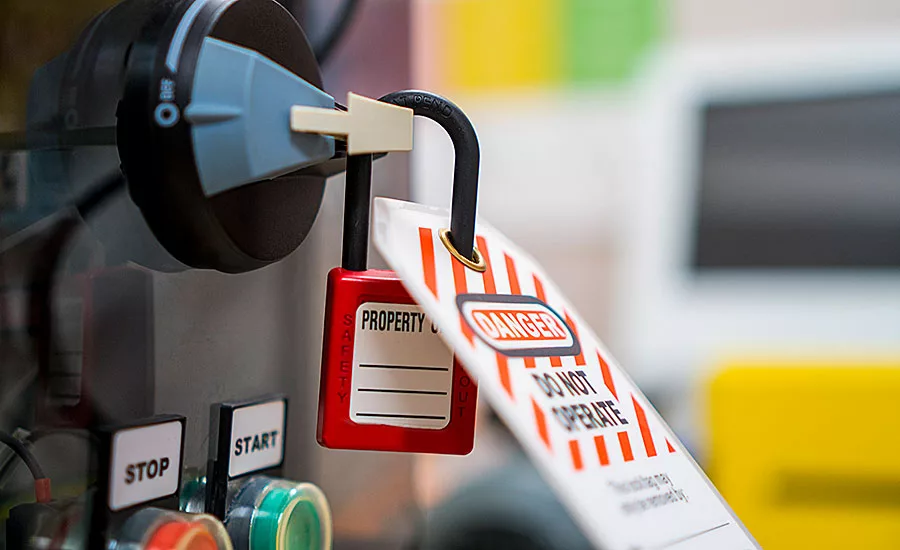
Maintenance activities guarantee the availability, reliability and safety of production equipment. While performing their maintenance roles, technicians are exposed to hazardous energy sources or unexpected starting up of equipment. These conditions increase the risk of injury or death. To prevent such accidents, companies devise machine-specific lockout tagout (LOTO) procedures. They contain mandatory safety guidelines to be observed during maintenance. LOTO procedures are primarily limited to maintenance operations. However, they are crucial for selected production activities where safety devices or guards are missing or are bypassed.
Developing robust LOTO procedures demands adherence to OSHA guidelines. However, some organizations make the following common mistakes when creating and implementing these procedures.
Ambiguity of procedures
LOTO procedures describe a series of activities that includes the pre-maintenance shutdown, isolation from an active energy source, locking out/tagging and start-up after service. These procedures vary from one equipment or facility to the other. For instance, a pulp and paper industry has several conveyor belts similar to those in a grain handling or bakery facility. LOTO procedures for these facilities can’t be the same since plant layouts and processes vary significantly. Organizations are likely to adopt generalized LOTO procedures that contain mixed-up steps or use complex engineering jargon. It creates confusion and increases the meantime to repair, negatively affecting production cycles.
For equipment connected to an energy source, it is mandatory to disconnect it before maintenance. Its representation adopts a statement like “Disconnect machinery from the power source.” Although it sounds correct, it fails to describe all the sources and controls of hazardous energy. Equipment may store energy in thermal, gravitational, mechanical or hydraulic forms.
When formulating LOTO procedures, companies need to perform a full audit of production equipment, focusing on available safety devices, energy sources and storage and start-up warning systems. Afterwards, the company utilizes the information to draft a comprehensible procedure using simple terms with a free-flowing hierarchy.
Inadequate machine-specific procedures
Creating LOTO programs for blended production equipment can be challenging. A one-for-all program is usually applicable to similar machinery. Such is a risky undertaking as equipment may be connected to diverse energy sources or contain slight technological variations. Generalized LOTO procedures do not provide sufficient information to guide maintenance technicians during the maintenance process. They provide limited access to procedural guidelines on how to:
- Shut down specific equipment and isolate them from energy sources
- Identify the correct locations for placing logout devices
- Verify safety lockouts and tagging.
Addition or modification of production assets or processes requires an immediate update of LOTO procedures. Though the additional equipment may be similar or clustered in one location, their energy sources and controls vary. With machine-specific LOTO procedures, the technicians can promptly identify unique attributes of each asset, lessening the troubleshooting and repair time.
Failure to include training and inspection timelines
Most facilities exclude inspection and training timelines in their LOTO documents. Ideally, an inspection must be performed annually by an authorized employee who writes a report and stores a copy of it. Regular LOTO training extends to maintenance technicians, temporary (contracted) workers and production employees present during maintenance. It is necessary for creating awareness and ensuring that the procedures are understandable and implementable.
The document has to detail the mode of training. In most industrial setups, the trainers are fond of using group meetings or digital slides to convey the policies to staff members. A better way to instil confidence and ascertain the comprehension of these procedures is by supervising the actual implementation in real-time. It improves individual and group assessment to determine the efficiency of LOTO procedures. While this is a suitable training and evaluation strategy, it is a commonly overlooked and undocumented process.
When writing LOTO procedures, companies fail to indicate training schedules, the intensity of hazardous energy and the minimum implementation requirements. Most facilities do not list the specific inspectors responsible for monitoring adherence to LOTO procedures. Most documents lack templates for collecting reviews from technicians, certifying and filing inspection records.
Excluding minor maintenance activities from the LOTO program
Organizations tend to exclude minor maintenance activities like lubrication, tool change or clearing process jams from LOTO procedures. These activities may not require the de-energization of machinery provided the employees are protected from hazardous energy sources or moving parts.
Most companies fail to define the exact scope of minor maintenance operations. They do not provide metrics for quantifying the intensity of maintenance tasks. Another common mistake is the failure to identify and detail substitutions for locking out equipment and protecting employees during minor maintenance operations.
The success of a LOTO program depends on the clarity of procedures, ease of understanding and specific delegation of lockout tagout activities to authorized personnel. When developing machine-specific LOTO procedures, the employer should not stop at general lockout guidelines. Instead, they should include enforcement measures, review tools and a record-keeping strategy to capture complaints, feedback and audit reports. Integrating these procedures in CMMS solutions improves accessibility to information and increases safety awareness among maintenance technicians.
Looking for a reprint of this article?
From high-res PDFs to custom plaques, order your copy today!