When seconds count: Making eyewash stations accessible, responsive and safer
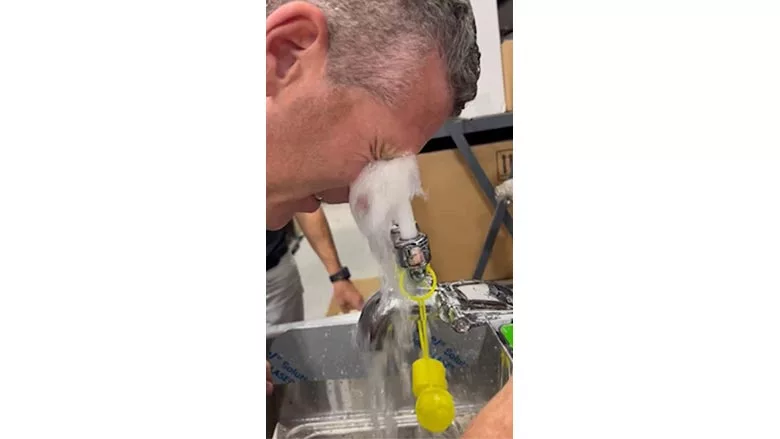
Credit: Chicago Faucets
Every day in machine shops, areas in plants and processing facilities using caustic chemicals, locations handling dust, quality assurance areas, and research labs looms the possibility for those who work in these places of damage to their eyes, regardless of engineering controls, goggles, and face shields.
Over the years, these places have taken on this threat to their workers by providing emergency eyewash stations to flush out debris and chemicals. Recent advances in plumbed permanent eyewash stations provide more accessibility, responsiveness and the assurance of clean water are improving the odds of workers walking away from these accidents with their eyes with minimal eye damage.
When an eye emergency happens, time matters
Fully functional eyesight can impact a worker's employability. Roughly 20,000 eye injuries threaten workers' eyesight every year and impact workers, their families, and businesses. OSHA puts the costs to companies at $300 million in medical treatment, worker compensation, and lost productivity.
The ability to reach the nearest eyewash station minimizes the effects of debris and chemical splashes on the eye. It lets workers flush out hazardous substances quickly to prevent or mitigate injury. When exposure of the eye to dust, foreign objects, or solutions occurs, there is a moment when panic and disorientation make finding the eyewash station difficult while the injury becomes worse. That is why eyewash units equipped with a single-action one-push activation handle are popular, it is the simplest way to operate the eyewash. When something hits the eye, they can feel for the handle and instantly push it away.
Regulations ensure worker eye safety
ANSI/ISEA Z358.1-2014 American National Standards for Emergency Eyewash) sets the standard for emergency eyewash equipment in manufacturing facilities and laboratories. It is the standard providing proper installation and use guidelines.
OSHA created regulations to set and enforce eye safety and health standards. Regulation 29 CFR 1910.151(c), "requires the employer to provide suitable facilities for quick drenching or flushing of the eyes and body when employees may be exposed to injurious corrosive materials.”
The ADA focuses on issues related to disability access, so it may not directly apply to the installation of eyewash stations. However, when planning the location of emergency equipment, consider accessibility for all employees, including those with disabilities.
Access is crucial
The ability to reach the nearest eyewash station is vital because hazardous materials can quickly cause serious injury. The standard for access is that employees should be able to reach an eyewash station within ten seconds, during which ANSI calculates an employee can travel 55 feet. Beyond that time, a minor injury can become significant and cause permanent visual impairment.
Among other considerations, eyewash stations should be near areas where employees handle hazardous materials or debris and are exposed to fumes. The pathway to the eyewash station should be clear of obstructions.
The eyewash station should be well-lit and have visible signage. Since these stations handle splashing water, avoid installing them near electrical equipment.
Responsiveness is critical when seconds count. The single-action, one-push activation handle provides quick and effective emergency response. ANSI requires that it be capable of being activated in under one second, via a stay-open ball valve that allows for hands-free rinsing.
To determine how many are needed in a facility it really depends on the number of exposure points and employees facing the risk. By conducting a safety inspection and using the ANSI ten-second rule one can calculate the ideal number of emergency eyewash stations needed to comply with OSHA standards.
Making the most of out of space
Fusing a touchless or manual faucet and an eyewash unit can effectively alleviate space issues in manufacturing plants and laboratories. Combining both functions into a single fixture optimizes space utilization for access.
Dual functionality: Workers can access the faucet for regular tasks and an eyewash station for emergencies—all within a space-saving combination fixture. The compact design also facilitates that a functioning faucet is where it is needed whether it be manual or touchless. Operating the lever for an ADA-compliant manual faucet must take no more than five pounds of force to turn on the fitting. While a touchless faucet with the eyewash simplifies the on feature with instant hands-free usage of the faucet.
In the plant or processing facility, hands can be grimy, gritty, or greasy. A touchless faucet enhances hygiene, minimizes contact with the fixture. The hands-free faucet also reduces the risk of cross-contamination in a laboratory and manufacturing environment. Moreover, sensor faucets can be easily managed via mobile phone to enable the facilities crew to monitor and flush touchless faucets easily.
Convenience and accessibility: The combination of emergency eyewash and faucet promotes convenience by providing quick access to both a faucet and an eyewash station in proximity. These eyewash stations meet the needs of the manufacturing process and are located according to the ANSI/ISEA Z358.1-2014 and OSHA guidelines for effectiveness in emergencies.
Cost-effective solution: Teaming up touchless or manual faucet and eyewash functions into a single unit is a cost-effective solution. It eliminates separate installations and saves on equipment costs and installation expenses.
Adaptability to different settings: These new design eyewash stations have options for new construction or retrofit. They can be adapted to various settings within the plant or in the laboratories. Their versatility makes them suitable for different environments with diverse space constraints. If there is an existing faucet for handwashing, it can be easily updated with a retrofit version of the combination eyewash and faucet to ensure that essential safety equipment is readily available.
Easy integration with existing infrastructure: The compact faucet and eyewash in one can be designed for easy integration with existing plumbing infrastructure, making it suitable for new installations and retrofitting existing spaces.
Options for water control
Including an ASSE 1071 certified thermostatic valve with ball stops and a gauge for eyewash units and faucets is a comprehensive solution that enhances the tepid water delivery system's control, monitoring, and adaptability. This provides specific functionality and ease of use:
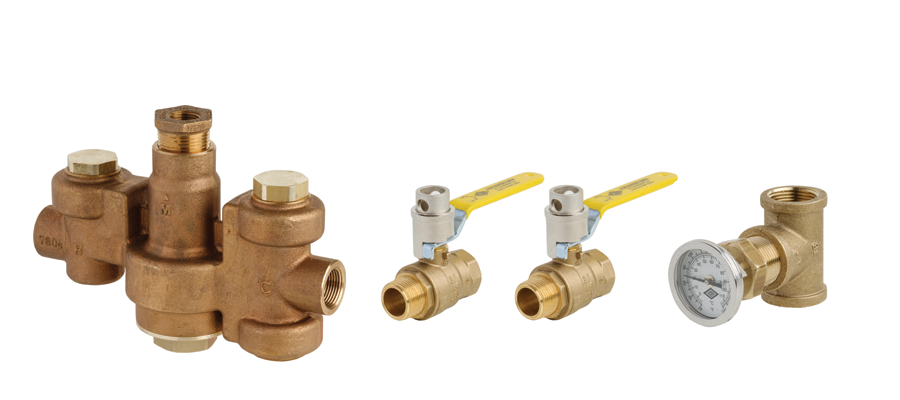 Flow control: Ball stops are valves that control the flow of water. Including ball stops in conjunction with a thermostatic valve allows lab and plant managers to precisely control the tepid water flow rate. This is particularly useful for adjusting the water flow to meet the specific needs of an emergency.
Temperature monitoring: The gauge provides a visual indication of water temperature. It monitors the water to ensure it remains within the tepid range, providing additional control and oversight to maintain safety compliance.
Eyewash stations must be inspected, tested, and verified weekly to ensure proper functioning, as required by ANSI/ISEA standards, with more in-depth evaluations conducted throughout the year. It’s crucial to keep a record of all inspections and maintenance checks performed on the eyewash stations. Failing to maintain appropriate and adequate safety equipment can result in costly penalties and, more importantly, life-altering injuries.
In today’s competitive job market, where retaining skilled workers is a priority, companies are increasingly recognizing the importance of providing a safe work environment. Ensuring the safety and well-being of employees, particularly when it comes to protecting their eyes, not only boosts morale but also serves as a powerful recruitment tool. It is imperative for facility and operations management to ensure compliance and confirm that all equipment is effectively optimized to provide the highest level of protection for their workforce.
Looking for a reprint of this article?
From high-res PDFs to custom plaques, order your copy today!