Breathe Easy: Understand the Role Dust Collectors Play in Maintaining Safe Industrial Facilities

Wide-pleated filter media.
Photo: Camfil APC
As an EHS professional in manufacturing, your expert recommendations help stakeholders when selecting dust collection systems that affect indoor air quality and ensure regulatory compliance.
Industrial dust collection systems are key for controlling airborne particulates, reducing occupational exposure risks and maintaining compliance with OSHA, EPA and NFPA regulations. Unlike central vacuum systems or portable dust control units, a dust collector is designed for large-scale dust control across entire facilities or specific processes. Collectors mitigate risks associated with combustible dust, occupational exposure, environmental exhaust and product cross-contamination.
There is no one-size-fits-all in dust collection, and effective systems are sized according to specific process requirements including: the type of dust generated, proposed location of the dust collector, airflow and static pressure requirements, and industry-specific safety requirements.
In this article, we’ll explore the most common types of industrial dust collection systems, then examine key features which help to ensure clean air and safe operation.
Cartridge Dust Collectors
Cartridge-style dust collectors are very popular due to flexibility in design, versatility, and ease of use and maintenance. These systems use filter cartridges packed with pleated nonwoven fabric, called media, which traps dust and fumes as air passes through them. Cartridge collectors can be located either indoors, if they meet NFPA specifications, or outdoors.
Baghouses
Baghouses work a lot like cartridge dust collectors, but they’re built to handle heavier loading or large particulate. Traditionally baghouses incorporate long fabric bags to trap dust particles as air moves through them. Just like cartridge collectors, baghouses utilize a pulse cleaning system to shake dust loose by deforming the filter bags. Baghouses are usually too tall to be located indoors.
Wet Scrubbers
Wet scrubbers use liquid, typically water, to intercept and capture airborne particulates. This equipment can be particularly effective in environments where collected particulate is large or jagged (which might damage traditional filter media) or in areas where explosion protection options are limited. Wet scrubbers have advantages in preventing combustible dust events but often require additional permitting for waste disposal.
Filter Media Options and Design Considerations for Cartridge Dust Collectors
In dry dust collection applications using cartridge dust collectors, two principal types of primary filter media are commonly used: cellulose-based blends and synthetic materials.
Cellulose media offers a cost-effective solution suitable for general-purpose dry particulate filtration. It performs well in many environments and can handle moderately elevated temperatures.
Spunbond media consists entirely of synthetic fibers, often enhanced with silicone, and delivers superior durability, especially in processes involving moisture, solvents or elevated heat. Their synthetic composition allows spunbond filters to retain their structural integrity under challenging operating conditions.
To further boost performance, both media types can undergo specialized treatments. These enhancements may improve attributes such as electrostatic discharge control, flame retardancy, water resistance and the capture of ultra-fine or nanoparticulate matter.
However, media selection isn’t the only determinant of filter efficiency. The design and construction of the cartridge itself are critical. Ideally, the filter should feature pleats that are evenly spaced and sufficiently wide, ensuring a consistent airflow and allowing dust to be released effectively during pulse cleaning cycles. Overly compact pleating restricts airflow and traps dust particles, reducing the system’s cleaning efficacy and increasing energy usage, all of which shorten the cartridge’s operational life.
For facilities that require enhanced particulate emission control, dust collectors can incorporate integrated safety monitoring filters (iSMFs) within the same equipment footprint, reducing the need for a separate, detached housing. When fitted with HEPA-grade media, these secondary filters, sometimes called after-filters, capture any particles that might escape the primary filtration stage due to leaks. Beyond improving air quality, iSMFs also contribute to safety by acting as passive explosion mitigation devices. In the event of an explosion within the collector, they help to contain the flame front, protect personnel and limit potential equipment damage.
Dust Containment Strategies for Controlling Hazardous Dust Exposure
Facilities managing hazardous or potent dust should implement containment solutions. Preventing employee exposure to hazardous dust during equipment maintenance is critical, and in most scenarios a combination of physical containment and operational isolation is necessary to safeguard personnel and maintain process integrity.
In most scenarios a combination of physical containment and operational isolation is necessary to safeguard personnel and maintain process integrity.
To manage the risks effectively, facilities often rely on engineered containment mechanisms such as bag-in/bag-out (BIBO) filter change systems and sealed discharge liners on hoppers. When these systems are properly engineered and validated through surrogate testing, they can provide robust protection against worker exposure and eliminate the threat of contamination across neighboring operations or production lines.
Surrogate testing plays a key role in validating these systems, especially in industries like pharmaceuticals or specialty chemicals where the dust involved can be highly toxic or reactive. This process involves using a representative substitute material to simulate the behavior and characteristics of the actual substance handled in production. By mimicking real-world or worst-case conditions, surrogate testing enables facilities to evaluate containment performance without exposing personnel or equipment to unnecessary risk.
Typically, surrogate trials are coordinated between in-house EHS teams, third-party test labs and the dust collection equipment provider. Surrogate testing is usually conducted by the equipment supplier, so it is important to ask for the test results when determining containment solutions for dust collectors.
Do not compromise on containment performance. Always insist on complete and current surrogate test data for BIBO and liner systems, and steer clear of vendors who are unable, or unwilling, to furnish these critical validation records.
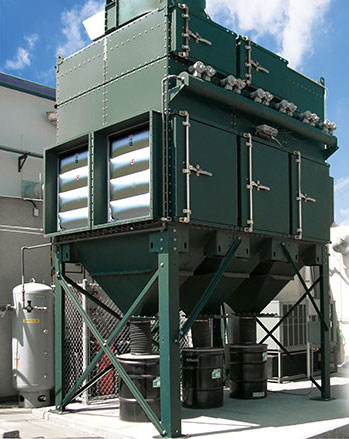
Industrial dust collector with explosion vents. Photo: Camfil APC
Explosion Protection for Dust Collectors
An area of safety that continues to evolve is combustible dust. While combustible dust explosions may occur in various places throughout a facility, the dust collection system is one of the most significant areas of risk due to its nature of collecting dust (fuel), providing an oxygen-rich mixture, suspending the mixture via pulse cleaning, and confining the mixture in the strong housing. The only remaining element needed is either heat or some sort of spark. Mitigating this hazard requires NFPA-compliant protection technologies, which are generally classified into passive and active systems.
Passive systems are designed to respond to the rising pressure wave in the form of explosion vents, flameless vents and mechanical isolation devices. In equipment that is protected by passive devices, when an explosion occurs, it will run its full and natural course with fast-rising pressures, heat and flame. Explosion vents, when properly sized, will open at a set pressure and direct the blast into a safe area, thereby reducing risk to personnel, equipment and facilities. NFPA 69 requires isolation of interconnected equipment so that if an explosion occurs in one area, it does not propagate to other equipment, limiting risk. Mechanical valves respond to a pressure wave that precedes the flame front and will physically close and lock the isolation device, ending propagation.
Active protection systems focus on early detection and intervention. Using fast-acting sensors and suppression technology, these systems detect an event within milliseconds after ignition and suppress the growing deflagration, preventing escalation. These systems can include chemical isolation, chemical suppression and fast-acting valves.
Given the complexity of explosion protection, partnering with an experienced vendor is critical. Your equipment provider should help you navigate NFPA standards, local codes and requirements from your authority having jurisdiction (AHJ), ensuring a complete and compliant solution. Be cautious of manufacturers who oversimplify these risks, offer only limited safety features or leave responsibility solely in your hands. These are red flags that could compromise safety and compliance.
Summing It Up
As an EHS professional, your insight is essential to aligning dust control solutions with the unique demands of your facility, city and state. By understanding the strengths and limitations of equipment and suppliers, you can play a pivotal role in mitigating risks and hazards such as OELs and combustible dust explosions. Equipped with this knowledge, you’re better positioned to advocate for solutions that meet standards and elevate the overall safety and environmental health of your workplace.
Looking for a reprint of this article?
From high-res PDFs to custom plaques, order your copy today!