Research-Driven Helmet Technology Reducing Head Injuries
Mips’ focus on education drives innovation
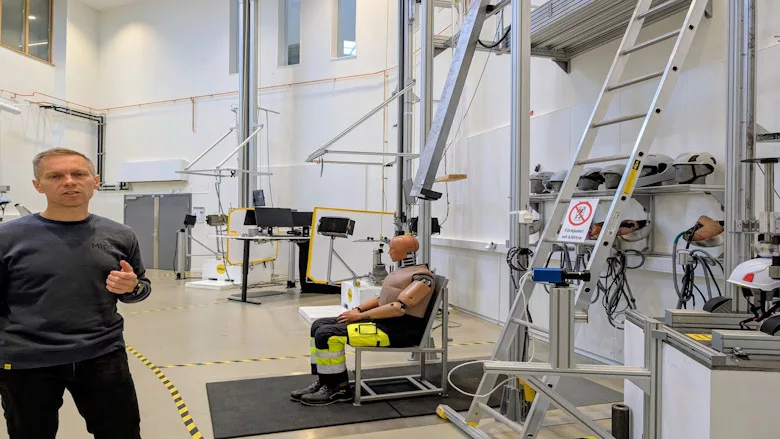
Marcus Seyffarth, Head of Implementation at Mips, shows how the company tests their helmet technology using a variety of real-world methods in their in-house test lab.
Technology company Mips got its start in sports helmets, partnering with cycling, motocross and other high-impact athletic brands. The Swedish company specializing in helmet-based safety and brain protection technology has been expanding its industrial safety reach. They found many similarities between sports-related hazards and injuries and industrial workers.
I recently had the opportunity to visit the Mips helmet test laboratory near Stockholm in Sweden. The relatively new facility includes four test machines and tools designed to mimic real-world impact scenarios. The lab has conducted over 150,000 simulations and 95,000 tests, with seven dedicated staff members, said Marcus Seyffarth, Head of Implementation at Mips.
The Mips (Multi-directional Impact Protection System) safety system is designed to add protection against rotational motion that can be transferred to the head during an angled or oblique impact. Rotational motion is a common cause of concussions and more severe brain injuries. The technology is the result of over 25 years of research, starting in 1995 with a Swedish brain surgeon, Hans von Holst, and an engineer at the KTH Royal Institute of Technology in Stockholm.
Vision for safer helmet across all industries
Max Strandwitz, Mips CEO, offered some more details about the company and how they operate.
ISHN: Mips is an "ingredient brand," licensing its technology to other helmet manufacturers rather than making its own helmets. Why did the company decide to pursue this business model, and what are its key advantages and disadvantages?
Strandwitz: Mips chose the ingredient brand model very deliberately. Rather than manufacturing our own helmets, we license our safety system to helmet brands globally. Our mission is to be leading the world towards safer helmets. By not selling directly to consumers, we get to work with some of the world’s most well-known helmet brands, and this way, we believe we can get our technology to more consumers.
As an ingredient brand, we work closely with our partners to bring both our products and sustainability efforts to the market. We put a lot of effort into ensuring we support our partners in a way that makes both parties successful.
ISHN: What is Mips' long-term vision for the company?
Strandwitz: Our long-term vision is simple: reduce head injuries and save more lives. To achieve this, Mips is committed to offering solutions based on industry-leading science and research. Each year we aim to invest about 5% of our net sales into research, working with acclaimed universities and institutes, and using our state-of-the-art test lab to ensure our solutions remain at the forefront of the industry.
We continue to see a need for awareness and education when it comes to head protection. Firstly, because rotational motion is still not recognized properly as a risk to workers, secondly because safety helmets and hardhats have been underdeveloped for years. We see some advancements in the market, but we believe there’s more that could be done, and as a company, Mips can be part of that journey.
ISHN: What do you see as Mips' key competitive advantage?
Strandwitz: When Mips was founded, no one really talked about the dangers of rotational motion and its role in many head injuries. In time, others have understood what we’ve been working on for decades, and that is of course an advantage for us. Our 30 years of research and development, rooted in science, has helped us become a market leader in helmet-based safety. As an ingredient brand, our business model is scalable and our technology available. While some competitors offer solutions in a limited number of helmet models or categories, Mips serve a broad range of brands across a variety of segments, from bicycling to equestrian, motorcycling to construction sites. Our expertise and science-based approach is something both consumers and brands trust, and that we are very proud of.
Focus on sustainability
ISHN: Sustainability is a key part of Mips' corporate strategy, with ambitious goals for using recycled materials and reducing emissions. How do you ensure that these sustainability initiatives are integrated into the business?
Strandwitz: Sustainability is fully integrated into our business model and the entire organization because we see it as a shared responsibility, not a competitive advantage. We take an open-source approach, believing that if the industry moves forward together, we will see true progress.
Every new technology developed at Mips is created with sustainability in mind. We want to utilize sustainable production processes and materials across all of our solutions to reduce our environmental impact, with the ambition of making our products fully circular. But this has to also be achieved without compromising safety. While we are encouraged by the progress we have made so far, we hold ourselves to very high standards and are committed to continuing the hard work needed to reach our goals.
The evolution of smart helmets
ISHN: How do changes in industry regulations and various global safety standards impact Mips' business and product development?
Strandwitz: As awareness grows about the importance of protecting against rotational motion, we are seeing more regulatory bodies in both the U.S. and in Europe focus on updating safety standards to reflect this. These developments validate the work we have already been doing, which is encouraging and gives us confidence knowing that we are on the right path.
Today, more than 150 helmet brands around the world integrate the Mips safety system into their helmets. As standards continue to evolve, which we encourage and support, we still believe they are the baseline and not the finish line. To us it is important to stay curious and continue to innovate, ensuring we live up to our mission of leading the world towards safer helmets.
ISHN: What do you expect to see next when it comes to head protection technology?
Strandwitz: I believe safety helmets and the related standards are going in the right direction, and that we will see further improvements in coming years. We’re now also starting to see conventional hard hats being replaced by more advanced helmet designs for protection and comfort. Looking further ahead, there’s the evolution of smart helmets and connectivity that will open new possibilities for monitoring, communication, and prevention.
Looking for a reprint of this article?
From high-res PDFs to custom plaques, order your copy today!