Understanding 5 Leadership Styles and the Cultures They Create

Photo credit: kali9 / E+ / Getty Images Plus
Leaders should care deeply about their people, no question. But in the world of EHS, caring can drift into something unintended when it is not paired with courage, standards, and accountability. Blake and Mouton (1985) described this as the 1,9 leadership style: a high concern for people and their feelings, paired with low concern for production, structure, and expectations. On the surface, it feels positive and supportive, yet beneath that comfort, the organization may drift toward increased tolerance for at-risk behaviors and greater exposure to high-energy hazards.
A 1,9 leader often wants harmony above all else. They want to be seen as supportive, steady, kind, and approachable. They hope that if people feel valued, morale will remain high and safety performance will naturally follow. The problem emerges when caring becomes the primary or only leadership strategy. Leaders who adopt a soft 1,9 approach hesitate to correct unacceptable actions, avoid difficult conversations, and soften expectations to keep the peace. They equate accountability with “unkindness” and “conflict with a lack of care.” Over time, patterns of avoidance shape the entire culture.
This cultural drift creates a workplace where standards bend easily, expectations are negotiable, and consequences are inconsistent. Deviations that should be addressed early are largely overlooked. Supervisors hesitate to intervene because they are pressured, internally or culturally, to “be nice” or that may be a part of their personality. Procedures exist, but alignment becomes optional. The culture feels friendly and comfortable, yet it becomes dangerously risk-acceptant. Ambiguity replaces clarity, and comfort replaces accountability. Over time, the organization drifts without people fully realizing it.
Despite these challenges, 1,9 leaders do bring essential strengths. They build genuine connections with their teams. People feel supported and psychologically safe. Communication tends to be respectful and open. Workers trust that the leader cares about them as individuals. These are powerful positives in any culture. However, without the counterbalance of expectations, courage, and accountability, these strengths do not prevent harm. When caring is not paired with boundaries, high-energy hazards become more dangerous because early warning signs are ignored.
The Leadership Types
To understand how caring intersects with culture, it helps to look at all five leadership types on the Managerial Grid (Figure 1), adapted from the seminal work of Blake & Mouton.
Figure 1. Adaptation of Blake and Mouton’s Managerial Grid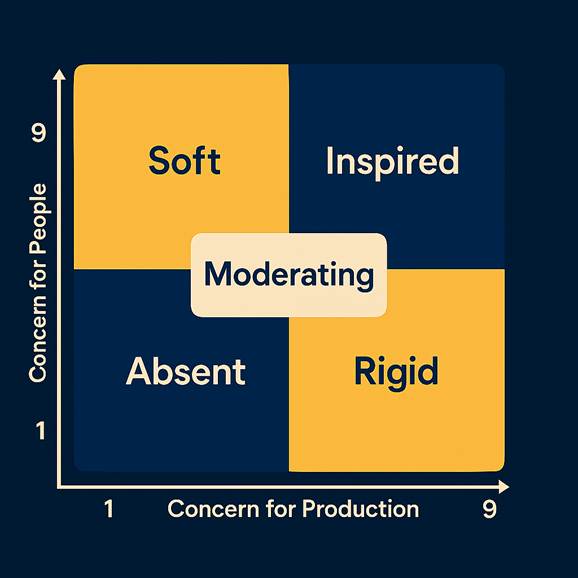
- Soft (1,9): This is the over-caring, harmony-first style. Leaders avoid conflict and soften expectations to maintain comfort with others. Safety conversations are friendly but ineffective. People feel cared about but are not protected from risk. High-energy situations go unchallenged because leaders do not want to upset anyone.
- Absent (1,1): This is disengaged leadership. The leader shows low concern for both people and production. Workers feel unsupported and unprotected. Hazards go unaddressed. Improvement stalls. Trust declines and risk grows.
- Rigid (9,1): This culture is compliance-heavy and people-light. Leaders strictly enforce rules but lack empathy. Results overshadow relationships. People may follow procedures, but they often hide near-misses or fatigue, which increases the risk of SIFs. The fear-based climate shuts down open and necessary communications.
- Moderating (5,5): This is the middle-of-the-road style. Expectations exist but are inconsistently enforced. Leaders avoid extremes and aim to maintain balance. Nothing is terrible, but nothing is excellent. Over time, this moderation can lead to drift because risks are not consistently challenged.
-
Inspired (9,9): This is the ideal culture - engaged, accountable, compassionate, and disciplined. Leaders pair empathy with structure and connection with safe production.
They hold people accountable because they care. Workers feel valued and protected, and SIF precursors are managed early, often, and consistently.
The most misunderstood risk is the Soft (1,9) culture. Because it feels positive, warm, and people-focused, leaders and organizations sometimes fail to see how dangerous it can become over time. When leaders prioritize emotional comfort over physical safety, drift grows quietly. Small shortcuts become normal. People take liberties based on familiarity, not disciplined control. High-energy hazards, line-of-fire exposures, stored energy, moving machinery, suspended loads, and high-pressure systems all require immediate intervention, not gentle hints.
Caring Differently
A simple example illustrates this. In one facility, a well-liked operator had a habit of stepping briefly inside a partially energized machine. Supervisors noticed but did not intervene. He was experienced, careful, and trusted. Leaders didn’t want to “make a big deal” out of it or damage the relationship. Over time, newer employees followed his example. Eventually, an unexpected mechanical movement pinned a worker’s arm, causing a life-altering SIF. Investigators found the behavior was widely known and tolerated. The culture was caring, but not courageous! Emotional protection replaced physical protection.
This pattern is not rare. Many SIF events do not result from dramatic negligence but from everyday shortcuts that became normalized because leaders did not intervene early. A 1,9 leadership style and culture allows these shortcuts to take root. Leaders who avoid tough conversations inadvertently increase risk in ways they never intended.
The solution is not to care less, but to care differently. True care and concern include the courage to intervene — to risk damaging the relationship. High concern for people must remain central, but it must be paired with clarity, boundaries, and consistent intervention. Leaders who step into discomfort show deeper care than those who avoid it. They protect people physically, not just emotionally. This balanced leadership approach creates a 9,9 culture defined by empathy and expectations, warmth and accountability.
The most effective safety leaders do not avoid hard conversations. They initiate them because they value their people. They understand that the most respectful action is not to maintain comfort but to maintain life and health. Emotional support is essential, but it cannot replace disciplined attention to high-energy hazards and abating risk. When leaders blend compassion with courage, the culture becomes safer, trust deepens, and the organization becomes more resilient.
A mature safety culture is built on courageous, balanced leadership — not on comfort alone. That’s how organizations move away from the 1,9 drift and build a future defined by protection, performance, and genuine care.
Source
Blake, R. R., & Mouton, J. S. (1985). The managerial grid III: The key to leadership excellence. Gulf Publishing.
Looking for a reprint of this article?
From high-res PDFs to custom plaques, order your copy today!


