Safety Product Innovations
The Silent Menace: Argon's Simulators Turn Invisible Risks into Manageable Realities
There’s something quietly unsettling about atmospheric hazards. Unlike fire, you can’t see them. Unlike a sudden earthquake, you don’t feel them coming, sometimes the first hint is already too late. So, if you ever wonder how responders keep their cool when the air itself becomes the enemy, read on.
Around 15 people die each year in confined spaces across the UK, a figure consistently cited in industry and safety literature. In maritime settings, the risks are equally persistent: investigations over the past decade continue to highlight recurring failures in pre-entry testing, continuous monitoring and rescue planning. These aren’t freak occurrences; they’re predictable failures in systems where training often amounts to reading from textbooks and imagining what a gas detector might say. It’s one thing to read about chemical leaks, atmospheric hazards or radiation scares; quite another to train for them realistically without inviting disaster.
In this context, as the UK faces more complex civil and military challenges, companies like Argon Electronics are playing a steadily growing role, becoming increasingly more important. With a UK heritage dating back to 1987, Argon develops simulators that allow teams to train for CBRNe (chemical, biological, radiological, nuclear and explosives) and HazMat incidents without exposure to real agents. Their equipment supports training across emergency services, maritime organizations and defense establishments, a role that places them firmly within the UK’s wider safety and preparedness architecture.
Picture an engineer entering an enclosed cargo hold, or a firefighter about to step into a confined space after a spill. The instruments they depend on, multi-gas monitors, photoionization detectors, oxygen meters and combustible gas readers, form the backbone of their situational awareness. Argon’s simulators are designed to replicate the behavior of this kit with high fidelity. Handheld devices respond as their real-world counterparts do, but operate through safe training proxies rather than live gases.
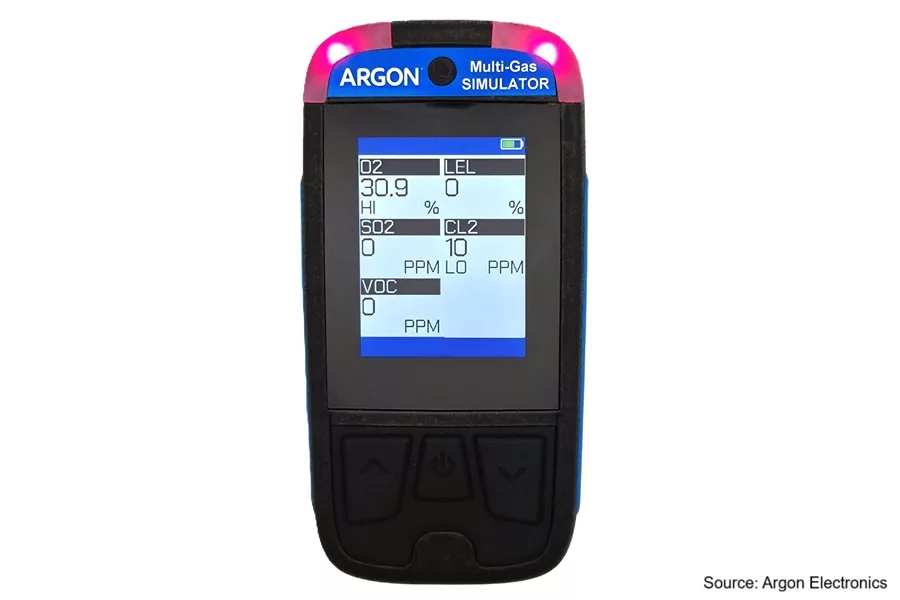
Argons’ Generic MultiGAS-SIM handheld simulator, introduced publicly in 2025, mirrors the look, feel and operation of a multi-gas detector, including button presses and screen layouts. It runs on standard AA batteries, requires no calibration gases and can pair with an instructor’s app via Bluetooth for real-time oversight. The aim is accurate, instrument-level simulation that reflects what frontline responders genuinely rely on.
Felipe Arrighi, director of business development at Argon, says, “We created the MultiGAS-SIM to fill gaps in confined space training for toxic industrial chemicals, informed by our chemical warfare expertise. Ultrasound mimics vapor dispersion effectively, identifying issues like unsealed entries. It replicates various gases, densities, and oxygen drops securely, enabling authentic practice of operational intricacies.”
This design removes many of the logistical burdens associated with using real detectors in training, consumable gases, regular sensor replacements and the need for controlled environments. Because the system uses simulated signals rather than hazardous materials, training can be carried out almost anywhere: indoors, outdoors, in confined spaces or large open areas. Argon’s wider ecosystem, including Long Range Vapor Source (LRVS) emitters and options such as PlumeSIM for complex multi-hazard scenarios, allows instructors to escalate from simple leak simulations to large-scale CBRNe training events.
“In a key 2025 NATO exercise, the MultiGAS-SIM exhibited high fidelity. Teams navigated hypoxic undergrounds and mixed lab contaminants. Real-time readings revealed overlooked flaws. Its understated realism heightened focus, exposing hidden weaknesses,” Arrighi explains. What matters most is the realism these tools enable. Atmospheric hazards are often subtle, invisible and fast-changing, and effective training needs to capture that.”
The consequences of missed cues are well documented. In 2014, at Goole Docks, three people died aboard the cargo vessel Suntis when oxygen levels dropped to about 5–6% in a hold, an atmosphere so depleted that it caused immediate collapse with no warning. In 2020, an incident in West Yorkshire saw a welder and a colleague overcome by argon gas during work inside a vessel, demonstrating how odorless asphyxiants can accumulate unnoticed. More recently, maritime reports from 2025 have described fatalities linked to carbon monoxide generated during the heating of Coconut Fatty Acid Distillate in a cargo tank. Across these cases, investigations identify the same themes: insufficient atmospheric testing, poor ventilation and unstructured rescue attempts that turn workers and emergency responders into secondary victims.
Simulated training environments allow teams to experience these hazards safely, oxygen depletion, toxic spikes, vapor movement and stratification, and to learn how readings shift in response to decisions made under pressure. This helps bridge the gap between textbook knowledge and real-world performance, especially in major exercises where multiple agencies must work together under realistic conditions.
“Early feedback from response teams suggests their skills have improved, they’re keeping a closer eye on gas levels instead of just reacting when alarms go off. Compared with older training methods, this feels like real progress. Users say the simulations are realistic enough to let them make quick, independent decisions under pressure, even without actual alarms,” adds Arrighi.
In the end, the value of Argon’s work lies in its insistence that safety cannot be theoretical. As risks across industry, maritime operations and civil defense become more interconnected, accurate simulation becomes not a luxury but a foundation. These tools are not a ‘nice to have’; they exist so that crews can make sound decisions when the margin for error disappears. And if the coming years bring new challenges, as they surely will, organizations that invest in realism, competence and disciplined practice will be far better prepared than those that only trust to luck.
Argon Electronics
https://www.argonelectronics.com/
Looking for a reprint of this article?
From high-res PDFs to custom plaques, order your copy today!