The Progression Problem: Why Safety Programs Stall and How to Move Workers Forward

Photo credit: NanoStockk / Getty Images Plus
Most workplace injuries do not happen because workers don't know the rules. They happen because knowing the rules and following them are two very different things. This distinction is where most safety programs quietly break down, and where safety leadership most often gets stuck.
The gap between awareness and action is not a training problem, but instead a culture problem. Culture problems always require a different set of tools than a refresher training course or a revised work procedure.
To address it effectively, safety leaders need to recognize where each worker stands, not where the training records say they should be. Employers must understand the progression that plays out in virtually every workplace, from workers who cannot identify a hazard, to those who see it and proceed anyway, to those who act safely by reflex as a part of their daily job.
Stage One: Consciously Unsafe
The first stage is the most visible and daunting in a workplace. Workers in this stage recognize a hazard, understand the risk, and choose to accept it anyway, ignoring the procedure or safety rule. This is the experienced employee who does a quick equipment repair without a lockout/tagout because “it will only take a minute”, the crew that skips wearing PPE because “nothing bad has happened yet”, or the supervisor who looks the other way because “the job is behind schedule.”
This is also the stage that most frustrates EHS professionals, partly because it cannot be solved with more information. Further, the EHS professional cannot solve this alone. The worker already has the necessary information, they’ve simply chosen (or been allowed) to ignore it. What is missing is the motivation to act on it, which stems from an organizational culture that reinforces safe behavior over productivity pressure.
At this stage, leadership response matters more than policy. Workers who see that corners cut at the top are tolerated or praised have no rational to take the extra time to do it the right way. The lever here is not training. It is accountability, modeled consistently from the top down, combined with an honest look at what the organization is unintentionally rewarding.
Stage Two: Unconsciously Unsafe
The second stage is often more difficult to address, because the worker does not see the risk at all. This stage is not described as complacency; it is a genuine gap in hazard recognition. The worker operating in this stage is not choosing to take a risk, they simply do not perceive one.
This pattern often shows up with newer workers or those who have transferred into an unfamiliar task environment. Long-tenured employees can also develop blind spots, particularly around normalized hazards such as the risks that have always been there and have never caused an incident.
Addressing this stage requires training and observation-based programs that educate and correct. Even micro-trainings, such as toolbox talks, are a great way to ensure hazards remain top of mind. Stage two requires a supervisory culture where stopping to point out a hazard is a routine part of the job, rather than a signal that something went wrong.
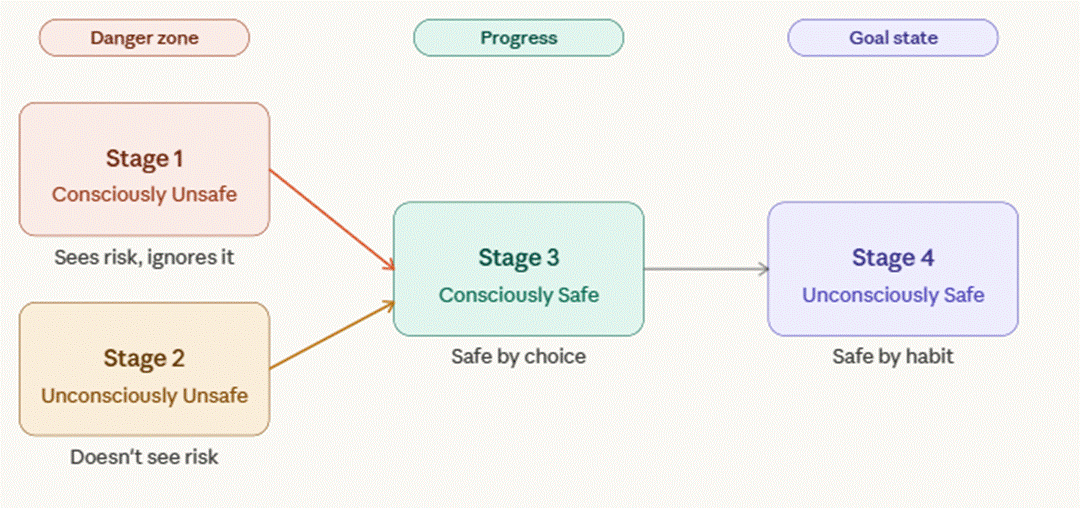
Stage Three: Consciously Safe
By the third stage, the worker can see the hazard and is making a deliberate choice to act safely. This is a meaningful shift, as it represents genuine competence and a functioning safety mindset. This stage does, however, still require effort to sustain and improve. Failure to hold the line here often leads to the organization reversing to stage one. In stage three, the worker is making a conscious decision each time they engage in a process, which means the behavior is still vulnerable to fatigue, distraction, time pressure, and the everyday erosion of habit.
Workers at this stage benefit most from positive reinforcement. This includes recognizing and rewarding the safe behaviors from supervisors and peers. The goal at this stage is to reduce the initial friction of safe behavior until it no longer requires active thought.
Stage Four: Unconsciously Safe
The fourth stage is what every safety program is ultimately trying to build, a workforce where safe behaviors are the baseline. Cultures that make it here show this is simply how the work gets done. Not just because the rules say so or someone is watching, but this is how our employees operate on every shift every day.
A company cannot train its way to stage four; it must be a cultural shift. It results from consistent accountability and reinforcement over time, from organizational norms that make safe behaviors the path of least resistance, and repetition that safety expectations are no longer in competition with other business priorities. Making it to this stage shifts a company toward World Class safety performance.
Workers at stage four become a resource for ongoing success. Credible peer voices influence their counterparts far more effectively than any formal safety program. Identifying them and giving them authority in the process is a critical component of a strong safety culture and is one of the highest leverage moves available to safety leadership.
The Leadership Implication
The failure of most safety programs is not a failure of content. It is a failure of diagnosis and recognition of a stuck safety culture. If every worker is treated as if they are at the same stage, the outcome is extremely ineffective. Training dollars are spent on workers who already know the material and it becomes seen as a form of punishment. Enforcement energy is directed at workers who are not actually choosing to be unsafe. The workers who are making the right calls every day receive no feedback signal to reinforce their safe behavior.
The progression from consciously unsafe to unconsciously safe is not automatic. It does not simply happen because a safety program exists. It happens because safety leaders understand in what stage their culture is and respond to that reality with the right tools at the right time.
Throughout this transition, employees will notice proactive observations replacing reactive investigations, targeted conversations replacing blanket stand-downs, positive reinforcement replacing punitive training modules, and safety being upheld by the company as a way of doing business.
The end goal of safety leadership is not to create a workforce that follows the rules when someone is watching. It’s to create a workforce that does not need to be watched.
Looking for a reprint of this article?
From high-res PDFs to custom plaques, order your copy today!