Mental Health Awareness Linked to Workplace Safety Initiatives
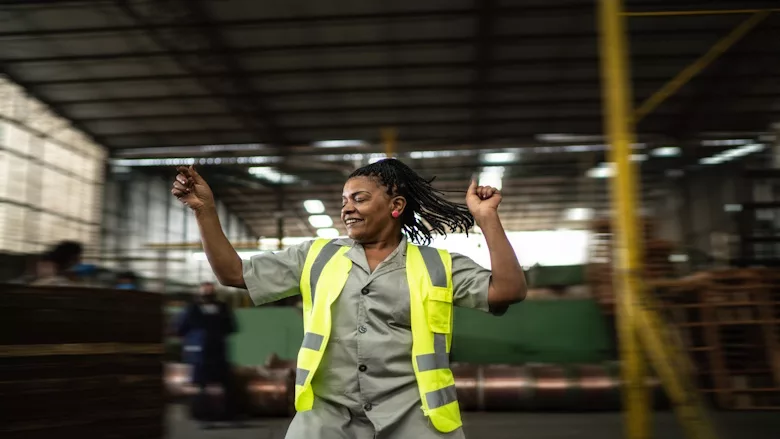
As May is Mental Health Awareness Month, Clare Epstein, General Manager, Commercial at Vector Solutions, spoke to ISHN about why mental health is so important as part of workplace safety initiatives.
ISHN: Many leaders still view mental health as an HR or "benefits" issue. How does treating mental health as a core safety initiative change the way people think about mental health?
Epstein: When mental health is positioned as an HR or benefits issue, it often becomes something that’s addressed reactively or only during specific moments like open enrollment or awareness campaigns. But on a job site, risk doesn’t operate that way.
Treating mental health as a core safety initiative reframes it as something that directly impacts day-to-day operations, just like fall protection or hazard reporting. It shifts the mindset from “this is optional support” to “this is part of how we keep people safe.”
In construction, where workers face suicide rates twice that of the general population and five times more deaths than jobsite injuries, the connection is clear. Mental health isn’t separate from safety, it’s part of the same risk landscape.
ISHN: What are the most common examples of where leaders feel stuck regarding mental health, and how does training help them move from recognizing a red flag to actually intervening?
Epstein: The biggest place leaders get stuck is the gap between awareness and action. They may notice something is off – a worker is withdrawn, missing shifts, or behaving differently – but they don’t know what to do next.
That tracks with what we found in our State of Frontline Safety Leadership in Construction research: 71% of construction supervisors said they had been approached by a worker about personal issues such as mental health or substance use. At the same time, 64% worry that saying the wrong thing could make a worker’s situation worse.
Those findings point to two common barriers: fear of saying the wrong thing and lack of clear protocols for how to respond. Training helps close that gap by giving leaders a clear framework for what to look for, how to start a supportive conversation, and where to direct someone for support.
It takes something that feels ambiguous and turns it into a structured, repeatable process, similar to how we train for physical safety risks.
ISHN: Could you share an example of what practical training looks like today? How is it different from the traditional classroom-style awareness sessions?
Epstein: Traditional training tends to focus on awareness – definitions, statistics, and general guidance. That’s important, but it doesn’t prepare someone for what actually happens on a job site.
When developing Vector’s construction suicide prevention training, we focused on making those real jobsite moments more concrete: a foreman noticing changes in a worker’s behavior, a crew member expressing that they feel overwhelmed or hopeless, or a manager deciding whether to wait, check in, report, or intervene. What matters is helping supervisors prepare for the moments that do not come with a script. The training uses practical scenarios, clear response steps, and examples that reflect construction culture, including the TASC (Thinking Actively in a Social Context) method, so learners can understand how to recognize warning signs, start a supportive conversation, and connect someone to the right resources before they are in a difficult moment.
Practical training today is much more scenario-based. It puts supervisors in real-world situations, such as noticing a change in behavior or being approached by a worker, and walks them through how to respond step by step.
It also emphasizes skills, not just knowledge:
- How to have a nonjudgmental conversation
- How to de-escalate
- How to connect someone to resources
The goal isn’t to turn supervisors into mental health professionals, but to give them the confidence to act in the moment and guide someone to the right support.
ISHN: In a fast-paced environment like a job site, long training sessions aren't practical. How can teams use short-form, mobile-accessible training to keep mental health top-of-mind?
Epstein: On a job site, training has to meet people where they are. We’re seeing a shift toward short-form, mobile-accessible training that can be delivered in minutes, not hours. That allows teams to reinforce key concepts regularly instead of relying on a single annual session.
For example:
- Quick refreshers before a shift: supervisors can pull up 2–3 minute modules or toolbox talks on a mobile device to reinforce key topics at the start of the day.
- QR codes on equipment or in common areas: linking directly to short videos, safety tips, or checklists employees can access in the moment, without having to search through a full LMS.
- Just-in-time learning: delivering targeted content right when it’s needed, helping employees apply what they’ve learned in real time rather than trying to recall information from a past session.
This kind of delivery model makes it easier to keep any priority, whether it’s safety, compliance, or mental health, visible and actionable as part of the daily workflow, rather than something employees revisit once a year.
ISHN: If a leader notices a worker is struggling, what tools can they use immediately on-site?
Epstein: The most important tools aren’t complex, but they need to be reinforced through training.
First is observation: recognizing changes in behavior, mood, or performance. Supervisors are often the first to notice when something isn’t right.
Second is conversation: checking in with a worker in a way that’s direct, supportive, and nonjudgmental. Even a simple “I’ve noticed you seem off — how are you doing?” can open the door.
Third is connection: knowing where to direct that individual, whether that’s an employee assistance program, a hotline, or another support resource.
What makes this effective is having those steps clearly defined ahead of time. When leaders know what to do, they’re much more likely to act. That is why our training emphasizes simple, repeatable response steps, including the TASC method, as well as clear guidance on resources such as EAP (Employee Assistance Program) information, crisis contacts, internal escalation steps, or other support channels leaders can use in the moment.
ISHN: Are you seeing any sort of move toward standardized protocols for psychological “hazards” in construction?
Epstein: Yes, and it’s a critical shift. Just like physical hazards, mental health risks need clear, documented processes. Our research found that 38% of construction leaders lack documented protocols for addressing personal or mental health issues raised by crew members, which shows why standardization matters. Without clear protocols, supervisors are left relying on personal judgment, which can lead to inconsistent outcomes across job sites.
We’re seeing more organizations begin to formalize escalation pathways, documentation processes, and defined response steps. This reduces uncertainty for supervisors and helps organizations manage risk more consistently.
ISHN: When a company successfully integrates mental health into its safety culture, what leading indicators should they be looking for to measure the effectiveness of their training?
Epstein: A few key indicators stand out:
- Increased willingness to report concerns or ask for help
- More consistent use of support resources
- Greater supervisor confidence in handling sensitive situations
Organizations also start to see changes in behavior, more open conversations, earlier intervention, and stronger team cohesion. Importantly, the focus should extend beyond tracking incidents to measuring engagement with the systems and support structures that help prevent them in the first place.
Our research also reinforces the connection between structured training and stronger outcomes, and why those leading indicators matter. Ninety-three percent of supervisors said structured supervisor training leads to fewer safety incidents, and 91% said it improves crew satisfaction and morale. That connection is important because effective mental health training should show up not only in lower incident risk, but also in how comfortable people feel raising concerns, using support resources, and looking out for one another on the job.
ISHN: How does modern training help dismantle that old mental health stigma of “tough it out”?
Epstein: Stigma often comes from uncertainty and lack of understanding. Modern training helps by normalizing mental health as part of everyday safety conversations. In construction, that matters because the same mindset that encourages people to push through difficult conditions can also make it harder to speak up when they need support. When supervisors are trained to talk about it in a straightforward, practical way, it becomes less abstract and less stigmatized.
It also reinforces that asking for help is not a weakness, which is an integral part of staying safe and being able to do your job effectively. Over time, that repetition, through training, conversations, and leadership behavior, starts to shift the culture.
ISHN: As we are currently in Mental Health Awareness Month, what is the one thing you want safety professionals in construction to understand about the link between mental health and physical job site accidents?
Epstein: Mental health and physical safety are deeply connected. When someone is distracted, fatigued, or dealing with stress or substance use, their risk of injury increases. It affects focus, decision-making, and reaction time, all of the things that keep people safe on a job site.
So the takeaway is simple: If you’re not addressing mental health, you’re not fully addressing safety. Mental Health Awareness Month is a great moment to start the conversation, but the real impact comes from embedding that mindset into daily operations.
Looking for a reprint of this article?
From high-res PDFs to custom plaques, order your copy today!