The trouble with hearing protectors
Why, according to the Centers for Disease Control (CDC), is NIHL the most common occupational illness in North America? And why does NIOSH say "we are seeing more hearing loss than we would expect if (hearing conservation) programs were effective"?
Shift in strategy
There are many contributing causes to the epidemic of hearing loss described by NIOSH, CDC and WHO. Exposure to ototoxic chemicals, off-the-job exposure to things like boom cars, firearms, and more create damage to hearing every day. One of the key factors in industry, however, was the shift in the 1980s away from noise reduction as a hearing loss prevention strategy, and the move to reliance on what we know today as hearing conservation.This change, codified in the 1983 Hearing Conservation Amendment, permits substitution of hearing conservation (consisting primarily of noise monitoring, audiometric testing and hearing protection) for noise control. The assumption was that this combination of hazard assessment, personal protective equipment and medical surveillance would provide the worker the same protection from hearing loss as noise reduction, but at substantially lower cost.
The net result has been the continued hearing loss cited above. What role do hearing protectors play in this saga? Why have they not prevented the hearing loss we thought they would?
Unrealistic expectations
Hearing protection devices (HPD) sold in the U.S. must be evaluated for performance. The evaluation procedure is described by the EPA and references a consensus standard from 1974. While the standard has been updated regularly, the citation in the regulation has not - and there is no one home in the EPA noise office to consider an update.The result is that the noise reduction rating (NRR) reported for HPD is based on an idealized laboratory protocol, where test subjects receive audiograms with and without the devices in place; these results are compared to determine how much protection the device is providing. Conditions in the test lab are optimized to provide the highest attenuation possible from the device with no consideration for comfort or ease of use.
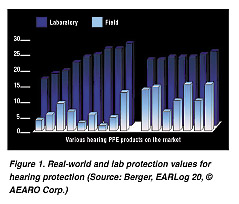
What happens when these devices enter the real world? Figure 1 reflects a comparison of the NRR lab values and field studies to demonstrate how devices work in practice. Note that not only are the real-world values far lower than the lab values, but there is no correlation - higher NRR does not equate with higher real-world protection, making OSHA's arbitrary 50-percent derating unrealistic. Two key factors may pertain here.
Comfort and overprotection
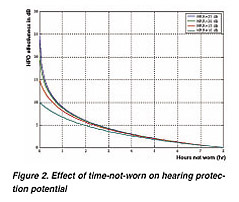
As with most PPE, comfort is essential to effective use. While several approaches have been considered to assess comfort, it is not currently a consideration in HPD evaluation.An uncomfortable HPD is more likely to be removed while in noise. Even brief periods of unprotected time can have significant implications for the worker. Figure 2 demonstrates the effect of removing a hearing protector while in noise. To use Figure 2, locate the NRR of the protector under evaluation on the vertical axis and draw a line across to the appropriate "time not worn" line to find the net effect. Even HPD with a nominal NRR of 25 dB, if removed for a total of an hour per day in noise, can yield no better than about 9 dB of net protection. Wearing HPD at all times when exposed to noise is essential to hearing loss prevention.
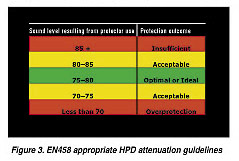
Often workers remove their hearing protectors to better hear their machines, or to better understand verbal or similar auditory communications. This can be an indication of overprotection - the HPD simply provides too much protection for the environment. European Union Guideline EN458 gives us some insight as to how much protection is appropriate (Figure 3). A protected ear canal sound level of greater than 85 entails risk of hearing loss; a level of less than 70 is a barrier to communication and audibility. This 15 dB range is the target for effective, appropriate hearing protection.
The vast majority of noise exposures in U.S. industry are less than 95 dBA TWA. All that's needed is a reliable 10 dB of protection to protect in that environment. Are high NRR devices removed by workers to compensate for overprotection?
What to do?
A variety of HPD manufacturers and hearing health professionals are taking these issues to heart. New methods are evolving to permit relatively simple individual testing of earplugs in the field. The Fit-Chek(tm) system (http://www.dosebusters.com) uses a combination of headphones over earplugs and computer technology to assess the performance of HPD for individual workers. In addition, the evaluation process helps make workers aware of fitting techniques that improve the effectiveness of their HPDs.Some manufacturers have introduced HPD designed to provide a high fidelity sound with reduced or limited attenuation, making the HPD more "natural sounding" and addressing the overprotection issue. Certain products (such as the Bilsom NST and EAR UltraTech or HiFi from Aearo) are designed to provide sufficient attenuation for the vast majority of workplace noise environments, while allowing enough high-frequency through to make the perceived sound more natural.
New technology from Sonomax combines a personal, custom fit earplug with software-driven fitting procedures that detail and document the fit of the devices, the amount of protection the individual worker obtains from the HPD and the appropriate selection of dampers to adjust the devices to the workers' noise exposure and hearing ability.
Hearing protection can and should be a critical aspect of hearing loss prevention programs in industry and elsewhere. Careful selection and fitting, and appropriate attention paid to the workers and the HPD they use can yield significant benefits in preserving the ability of workers to hear.
Remember, the best hearing protector is the one that will be consistently used in noise.
Looking for a reprint of this article?
From high-res PDFs to custom plaques, order your copy today!


