Gas Detection
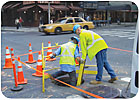
They’re small, tight and have limited ventilation or air movement. As a result, confined spaces provide a dangerous gathering place for gases and vapors to accumulate. If you’re not careful, such accumulation can often reach explosive or lethal concentrations. This is why spaces must be evaluated by air monitoring to determine if it is safe for workers to enter and do their work.
OSHA regulations mandate that all employees entering a permit-required confined space (PRCS) must be instructed as to the nature of the hazards involved (19210.146(h)(1)). Atmospheric testing is required to evaluate the air in the confined space, verify that conditions for entry are acceptable, and continuously monitor to ensure conditions remain acceptable.
The rule outlines the order of testing:
1. Test for oxygen first because most combustible gas meters are oxygen-dependent and will not provide reliable readings in oxygen-deficient atmospheres; then
2. Test for flammable gases and vapors because the threat of fire or explosion is both more immediate and life threatening (in most cases); and then
3. Test for toxic air contaminants.
Today’s air monitoring instruments — small, compact and durable — make continuous monitoring during confined space entry practical for oxygen levels, combustibility and several toxic gases. Direct-reading instruments (DRIs) provide information about the atmosphere directly to the user without the need for laboratory analysis while providing warning of a dangerous condition as it arises.
Instruments now come equipped with as many as five different sensors installed. These multigas meters provide readings from all the sensors at the same time.
The following overview of the main types of sensors used in DRIs for confined space entry is summarized from a leading industry reference, “Confined Space Entry and Emergency Response,” (Wiley & Sons Publishing, 2006)1.
Oxygen sensors
Oxygen sensors are basic electrochemical sensors in which oxygen in the atmosphere passes through a permeable barrier and interacts with an electrolyte solution and electrodes to create an electric current. Specifically, oxygen reacts with a sensing electrode in potassium hydroxide solution and electrons are released. These electrodes migrate to a counter electrode and an electrical current is produced that is directly related to the amount of oxygen in the atmosphere.
Oxygen meters display readings as percent oxygen (by volume) in air. OSHA considers an atmosphere hazardous if the oxygen concentration drops below 19.5 percent or rises above 23.5 percent in air. These instruments are among the simplest meters to operate and read. Keep in mind that the electrolyte in the sensor can be neutralized when exposed to acid gases, such as carbon dioxide in exhaled air. Other chemicals may also poison the sensor, and oxidizers may cause an artificially high reading. If the instrument is used in a space that contains such chemicals, it should be calibrated afterward to ensure proper functioning.
Combustible-gas sensors
Combustible or flammable gases and vapors are measured with instruments that are commonly known as combustible-gas indicators (CGIs). The most common types of sensors used in CGIs include:
Catalytic sensor — Most CGIs use a form of catalytic sensor to detect the presence of a potentially flammable atmosphere.
Thermal conductivity sensors — These are used mainly to measure high concentrations of gas or vapor and report the results as percent gas in air.
Metallic oxide semiconductor sensors — A type of solid-state sensor, MOS sensors consist of two electrodes and a heating element embedded in a ceramic bead that is coated with a metal oxide semiconductor. The sensor surface is heated, and the semiconductor material absorbs atmospheric oxygen, establishing a baseline conductivity through the sensor. As a combustible gas contacts the bead and reacts with the absorbed oxygen, this changes the conductivity of the sensor. As the gas leaves, the conductivity returns to normal. The change in conductivity indicates the amount of gas or vapor present.
Chemical-specific sensors
Toxic atmospheres are perhaps the most challenging in confined space testing because they can be so varied. Each chemical must be measured individually and compared to the appropriate exposure limit or IDLH (immediately dangerous to life and health) level.
Direct-reading instruments that monitor toxic gases and vapors may be chemical-specific or broad-range survey instruments. If a few, well-identified chemicals are expected, instruments specific for those chemicals provide the most accurate readings. If the actual or potential gases or vapors have not been identified, broad-range survey instruments should be used.
Chemical-specific instruments will measure the concentration of a specific chemical in the space and generally ignore other chemicals. These instruments are used to measure toxic chemicals in low concentrations.
A variety of instruments are available to measure the concentration of specific chemicals in the air, the most common of which include:
- Carbon monoxide
- Hydrogen sulfide
- Ammonia
- Chlorine
- Formaldehyde
- Carbon dioxide
- Oxides of nitrogen
- Hydrogen cyanide
- Sulfur dioxide
Survey instruments, which include photoionization detectors (PIDs) and flame ionization detectors (FIDs), use sensor technologies that respond to many different chemicals. They give one reading that is the total response to all of the detectable chemicals present. Survey instruments are useful when trying to determine if any of a number of possible chemicals is present.
Reference 1 “Confined Space Entry and Emergency Response,” Veasey, D.A., Craft McCormick, L., Hilyer, B.M., Oldfield, K.W., Hansen, S., Krayer, T.H., Wiley & Sons Publishing, 2006
Looking for a reprint of this article?
From high-res PDFs to custom plaques, order your copy today!