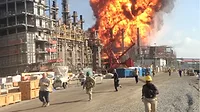
Owners' engineering educational gap contributed to 2007 fatal explosion and fire (9/18)
The massive December 2007 explosion and fire at T2 Laboratories in Jacksonville was caused by a runaway chemical reaction that likely resulted from an inadequate reactor cooling system, investigators from the U.S. Chemical Safety Board (CSB) said in a final draft report.
Concluding that T2 did not recognize all of the potential hazards of the process for making a gasoline additive, the report calls for improving the education of chemical engineering students on reactive chemical hazards. The explosion and fire on December 19, 2007, killed four T2 employees and injured four others. In addition, 28 people working at nearby businesses were injured when building walls and windows blew in.
“This is one of the largest reactive chemical accidents the CSB has investigated,” said Chairman John Bresland. “We hope our findings once again call attention to the need for companies to be aware of how to control reactive chemical hazards.” In 2002 the CSB completed a study of reactive chemical hazards, which identified 167 accidents over a two-decade period and made recommendations to improve reactive chemical safety.
The CSB found that although the two owners of the company had undergraduate degrees in chemistry and chemical engineering, they were nonetheless likely unaware of the potential or the consequences of a runaway chemical reaction.
The accident occurred during T2’s production of MCMT, a gasoline additive, which the company manufactured in batches using a 2500-gallon reactor. On the day of the accident T2 was producing its 175th batch of the chemical when operators reported a cooling problem.
Investigation Supervisor Robert Hall, PE, said, “Despite a number of near-misses during earlier production efforts, the T2 production team failed to recognize the underlying runaway reaction hazard associated with its manufacturing process.”
The draft report on the T2 Laboratories explosion calls on the American Institute of Chemical Engineer s (AIChE) and the Accreditation Board for Engineering and Technology (ABET) to work together to include reactive chemicaleducation in baccalaureate chemical engineering curricula across the county.
The CSB noted that most baccalaureate chemical engineering curricula in the U.S. do not specifically address reactive hazard recognition or management.
Chairman Bresland said, “It’s important that chemical engineers recognize and are aware of the proper management of reactive hazards.”
“Our recommendations aim to address the gap in the chemical engineering curriculum. If future chemical engineers are given the proper educational tools, they will be able to more fully comprehend the hazards that exist during a chemical manufacturing process.”
Chemical testing by the CSB found that the recipe used by T2 created two exothermic, or heat-producing, reactions; the first was an intended part of producing MCMT but the second, undesired reaction occurred if the temperature went above 390ºF, slightly higher than the normal production temperature. The cooling system likely malfunctioned due to a blockage in the water supply piping or a valve failure. The temperature and pressure inside the reactor began to rise uncontrollably in a runaway chemical reaction. At 1:33 pm, approximately ten minutes after the initial cooling problem was reported, the reactor burst and its contents exploded.
Concluding that T2 did not recognize all of the potential hazards of the process for making a gasoline additive, the report calls for improving the education of chemical engineering students on reactive chemical hazards. The explosion and fire on December 19, 2007, killed four T2 employees and injured four others. In addition, 28 people working at nearby businesses were injured when building walls and windows blew in.
“This is one of the largest reactive chemical accidents the CSB has investigated,” said Chairman John Bresland. “We hope our findings once again call attention to the need for companies to be aware of how to control reactive chemical hazards.” In 2002 the CSB completed a study of reactive chemical hazards, which identified 167 accidents over a two-decade period and made recommendations to improve reactive chemical safety.
The CSB found that although the two owners of the company had undergraduate degrees in chemistry and chemical engineering, they were nonetheless likely unaware of the potential or the consequences of a runaway chemical reaction.
The accident occurred during T2’s production of MCMT, a gasoline additive, which the company manufactured in batches using a 2500-gallon reactor. On the day of the accident T2 was producing its 175th batch of the chemical when operators reported a cooling problem.
Investigation Supervisor Robert Hall, PE, said, “Despite a number of near-misses during earlier production efforts, the T2 production team failed to recognize the underlying runaway reaction hazard associated with its manufacturing process.”
The draft report on the T2 Laboratories explosion calls on the American Institute of Chemical Engineer s (AIChE) and the Accreditation Board for Engineering and Technology (ABET) to work together to include reactive chemicaleducation in baccalaureate chemical engineering curricula across the county.
The CSB noted that most baccalaureate chemical engineering curricula in the U.S. do not specifically address reactive hazard recognition or management.
Chairman Bresland said, “It’s important that chemical engineers recognize and are aware of the proper management of reactive hazards.”
“Our recommendations aim to address the gap in the chemical engineering curriculum. If future chemical engineers are given the proper educational tools, they will be able to more fully comprehend the hazards that exist during a chemical manufacturing process.”
Chemical testing by the CSB found that the recipe used by T2 created two exothermic, or heat-producing, reactions; the first was an intended part of producing MCMT but the second, undesired reaction occurred if the temperature went above 390ºF, slightly higher than the normal production temperature. The cooling system likely malfunctioned due to a blockage in the water supply piping or a valve failure. The temperature and pressure inside the reactor began to rise uncontrollably in a runaway chemical reaction. At 1:33 pm, approximately ten minutes after the initial cooling problem was reported, the reactor burst and its contents exploded.
Looking for a reprint of this article?
From high-res PDFs to custom plaques, order your copy today!