"A global supply chain of death traps"
Tragedies will continue "until workers' health and safety actually come first"
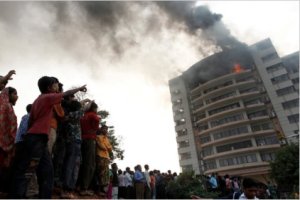 Statement from the Maquiladora Health and Safety Support Network (MHSSN) on the Bangladesh factory fires and what’s needed to prevent them. This appears as a “Letter from the Coordinator” in the December 2012 issue of the MHSSN newsletter, Border/Line Health & Safety.
Words fail at times like this – another garment factory fire in Bangladesh; 112 dead and 150 injured; another round of despair and anguish for the workers and their families; another round of denials by international garment brands that they bear any responsibility; another round of promises by the brands and their contractors that they will “do better” while refusing to acknowledge that it is their “profits first and foremost” production system that has led to fire after fire after fire.
At least 600 garment workers have been killed – with hundreds more injured, some disabled for life – in factory fires in Bangladesh since 2006. In September 2012, 289 garment workers were killed in a garment factory fire in Pakistan, with scores more injured.
Causes of the factory fires
Yet everyone knows exactly the cause of these fires: large quantities of poorly kept flammable materials; damaged or overloaded electrical systems; absent or completely inadequate fire suppression equipment; and non-existent or unimplemented emergency action and evacuation plans. But the people who control these supply chains – the brands – refuse to take any meaningful action to keep from regularly killing the people who make their products and their profits.
The root cause of these fires is a supply chain that places priority on the brands’ “iron triangle” of the lowest price/the highest quality/the fastest delivery from contractors; at the same time that contractors are provided with ever-shrinking, razor-thin profit margins by the brands; while government regulation is made meaningless by corruption and lack of resources; and garment workers are so desperate for work that they cannot refuse any job, no matter how dangerous. Corporate greed and corruption literally kill.
| As long as the OHS profession allows these charlatans to profit from meaningless certifications and the resulting worker deaths, the profession will bear an inescapable measure of responsibility. |
The garment industry’s global supply chain of death-traps is a crisis for all involved – a crisis for workers, for contract manufacturers, for international brands, for governments in the developing world, for the ever-expanding “corporate social responsibility” (CSR) industry, and for the occupational health and safety profession. See the extended “Quotes of the Month” for the perspective of each level of the supply chain.
- It is a crisis for workers because they are forced by poverty and hunger to go to work every day knowing that they may be burned alive.
- It is a crisis for the contractor manufacturers who are denied by their brand clients the resources needed to upgrade their facilities, pay decent wages and still make an “acceptable” profit – so they take “unacceptable risks” with the lives and livelihoods of their work force.
- It is a crisis for the brands because their reputations are, or should be, in tatters, and there will come a point when their customers will think twice about buying their products and any employees with a conscience will look for another employer.
- It is a crisis for governments in the developing world where more and more of the world’s consumer products manufacturing is being done as they lack the resources (human, financial and technical) and the political will to protect their own citizens.
- It is a crisis for CSR because the endless factory fires are proof positive that “corporate social responsibility” is a fake and fraud – all the codes of conduct, all the “independent” monitors, all the “social audits,” and all the CSR consultants and conferences have failed completely in the global garment industry.
- It is a crisis for the occupational health and safety profession because it is being drawn into “certifying” working conditions in global supply chains. The Pakistani garment factory that killed 300 workers had been “certified” as safe by Social Accounting International auditors. Apple supplier Foxconn, whose factories have had aluminum dust explosions immediately after inspections, boasted of “certification” under the OHSMS 18000 scheme.
As long as the OHS profession allows these charlatans to profit from meaningless certifications and the resulting worker deaths, the profession will bear an inescapable measure of responsibility. There is a growing recognition of this, such as the statement released by the American Society of Safety Engineers (ASSE) after the Bangladesh fire.
“It’s not enough to condemn local factory owners for these conditions and to expect long term change,” declared Thomas Cecich, CSP, CIH, Vice President for Professional Affairs and chair of the Center for Safety and Health Sustainability. “The corporations that source supply chain products, as well as their stakeholders, have tremendous power to influence the conditions in which supply chain workers operate.”
Fires will continue to occur unless...
As our Network has pointed out repeatedly for many years, the factory fires and unsafe/unhealthy conditions in garment, electronics, and toy supply chains will continue unabated unless two things happen:
(1) the near-universal “sweatshop business model” described above must change so that life safety issues and workers’ health and safety actually come first in deeds as well as in damage-control public relations statements; and
(2) workers must be incorporated into plant-level health and safety programs, and be authorized, trained and empowered to play a meaningful role in identifying and correcting hazards – without reprisals and discrimination by their employers.
Perhaps the only ray of hope in this bleak panorama is the effort by a coalition of Bangladesh unions and international workers’ rights organizations – outlined in our July 2012 newsletter [hyperlink] – to establish an independent, competent fire safety program that would be transparent, involve workers as key actors, and actually inspect and require hazard correction in garment factories.
The Gap goes its own way
Four brands are required to initiate the project in Bangladesh. Two have signed on – PVH (Tommy Hilfiger, Calvin Klein and other brands) and the German brand Tchibo – but two more are needed. In September, after almost a year of negotiations, The Gap pulled out of talks and declared that it would set up its own program without almost all the elements of the program agreed to by PVH and Tchibo.
One way to remember the latest dead and injured in Bangladesh, and try to prevent more deaths, is to join with others around the world in demanding that the international brands step up to the plate with the proposed fire safety plan. Specifically you can add your voice in a campaign to convince The Gap to make good on its promises via the international letter campaign at www.cleanclothes.org/urgent-actions/gap-appeal .
For further information and background on the factory fires, please see:
- Clean Clothes Campaign: http://www.cleanclothes.org/news/bangladesh-factoryfire- brands-accused-of-criminal-negligence
- Garrett Brown, Corporate Social Responsibility; What is it good for? http://mhssn.igc.org/CSR_BangladeshFires_ISHN_May2011.pdf
- Garrett Brown, Fashion Kills: Industrial Manslaughter in the global supplychain: http://mhssn.igc.org/EHSToday_FashionKills_Sept2010.pdf
Quotes of the Month from the Bangladesh factory fire
“I won’t believe Walmart entirely if they say they did not know of this at all. That is because even if I am subcontracted for a Walmart deal, those subcontracted factories still need to be certified by Walmart. You can skirt the rules for one or two odd times if it is for a very small quantity, but no decent quantity of work can be done without the client’s knowledge and permission.”
- Annisul Huq, former president of the Bangladesh Garment Manufacturers and Exporters Association, quoted by Reuters news service on November 28, 2012.
“The buyers write to us to improve working conditions. We asked them to raise prices by 25 cents per clothing unit that would go to workers’ welfare. They refused, citing the financial downturn in their countries.”
- Mikail Shiper, a senior official in Bangladesh’s Ministry of Labor and Employment, quoted in “Bangladesh: How rules went astray,” The Wall Street Journal
“It was my fault. But nobody told me that there was no emergency exit, which could be made accessible from outside. Nobody even advised me to install one like that, apart from the existing ones. I could have done it. But nobody ever suggested I do it.”
- Factory owner Delwar Hossain quoted in the Dhaka, Bangladesh, The Daily Star newspaper, November 29, 2012
“These factories should be shut down, but who will do that? Any good government inspector who wants to act tough against such rogue factories would be removed from office. Who will take that risk?”
-Kalpona Akter, Executive Director of the Bangladesh Center for Worker Solidarity
“These factories should be closed, but it is not an easy task. We need to follow a protracted legal battle. Always there is pressure because the owners are influential. They can manage everything.
-anonymous Dhaka fire official quoted in “Bangladesh Factory Where Dozens Died Was Illegal,” Associated Press, December 7, 2012
“We want the owner to reopen the factory as soon as possible or pay us a few months of salary because we have nowhere else to go right at this moment”
-Hasan, a worker who escaped the fire
”I need to recover soon. I need money immediately. We want at least four months of salary to just get by now and by this time, we will look for jobs in other factories. Otherwise, I have to go back to my village, where I have nothing to do.”
- Dipa Akter, the 19-year-old worker who injured her led escaping the fire and who has worked at the factory for three years. BBC News, November 30, 2012.
Looking for a reprint of this article?
From high-res PDFs to custom plaques, order your copy today!