Threat-detection monitors score big public safety points at Detroit World Series’ games
|
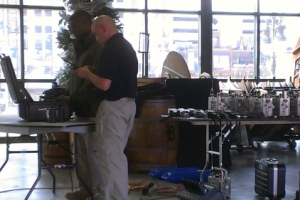
| Local, state and federal officials coordinated threat-detection monitoring at the 2012 World Series in Detroit. Officials replaced sensors and calibrated the instruments before deploying them at Comerica Park. Courtesy photo. |
While few were aware of it, sports fans in Detroit attending the 2005 Super Bowl XL, or the Major League Baseball All-Star game that same year, or the two 2012 World Series’ games held at Comerica Park in October had an added layer of protection to thwart anyone from concealing dangerous industrial chemicals or deploying the likes of a “dirty bomb.” Such monitoring for potentially toxic gas, radiation or biological releases – in addition to a range of other proactive security tactics designed to keep people safe – is often done at large events, where big crowds and extensive media coverage can make these settings a high-visibility target.
These are just three of the high-profile venues protected by the Detroit Fire Department in Michigan, which often works in cooperation with state and federal authorities, since the department purchased its advanced wireless gas-detection monitoring system in 2004. The system is capable of detecting a range of chemical gases, flammable vapors and radiation that could be used to terrorize attendees at an indoor or outdoor event.
Like many fire and HazMat departments worldwide, Detroit Fire did its planning in advance of the events to ensure the site was safe and secure. That includes coordinating with multi-jurisdictional agencies, including neighboring departments offering assistance, the U.S. Federal Bureau of Investigation (FBI), which has venue protection as part of its chartered mission, and other agencies.
“We definitely take a proactive approach to keeping the public safe at these high-profile events,” said Sgt. Erik Carrington, a Detroit Fire HazMat expert who was part of the department’s threat-detection monitoring efforts during the 2012 World Series between the San Francisco Giants and the hometown Detroit Tigers. For security reasons, Carrington declined to reveal other city events where threat-detection monitoring is deployed.
Detroit Fire uses the same wireless monitoring technology used to help secure presidential inaugurations or to establish safe perimeters around HazMat incidents or spills. The system can provide commanders with continuous, real-time information, such as exposure levels that get logged wirelessly. These systems are tied to network monitoring software that gives an operations or command center an overview of the system status using a mapped overlay of the facility. Additional software can be added to track gas or vapor plumes, which provides early detection for first responders to alert or evacuate people who are in harms’ way.
Monitoring Threats Wirelessly
At the World Series championship games in Detroit, wireless monitoring was performed for a broad range of threats, including gas, radiation and biological elements, reports Carrington.
Chemical dispersements – often considered the biggest threat, say experts, because of the wide availability of some industrial chemicals – was performed using RAE Systems’ AreaRAE multi-gas detectors and monitoring software. U.S. military personnel, environmental agencies and consultants, and HazMat experts worldwide have long relied on the wireless AreaRAE, which can be equipped with a broad range of sensors. First responders often use the system as a frontline detector for public-venue protection applications.
“We believe wireless monitoring is one of the best things around nowadays,” says Carrington. “It enables us to cover a broad area, it’s simple to deploy and it helps maximize our limited manpower resources.”
These systems give commanders and safety professionals greater information and control for quickly identifying dangerous substances, making on-the-spot decisions and coordinating information with other units or agencies in real time. Wirelessly enabled instruments from RAE Systems enhance the communication capabilities of first responders, enabling joint operations at the local, state, and federal levels, and for information sharing between on-scene commercial and government agencies. Advances in secure Internet access and the ability to get data onto the Internet from almost anywhere have made these real-time interactions possible.
Securing the Stadium
For the Detroit Fire team and the other agencies involved, work began in the days leading up to the World Series as the championship games wound down in San Francisco then moved to Detroit. Incoming shipments to the stadium – from souvenirs and equipment to toilet paper – were screened using handheld gas detectors, such as RAE Systems’ MultiRAE, in addition to monitoring loading docks to ensure the fumes from idling diesel trucks did not create an unsafe environment. Park entrances were all monitored including vendors, employees, VIPs, media, and the players and team staff.
Thirty-two AreaRAE monitors were equipped with sensors for gamma radiation, lower explosive limit (LEL) vapors, volatile organic compounds (VOCs) and two other undisclosed sensors. These units were inconspicuously placed in strategic areas throughout Comerica Park that also optimized the radio transmission back to the onsite operations center. The units were placed and the system was up and running in about an hour, says Carrington.
On game days, the status on each of the monitors – which were placed throughout the complex – was overseen on a map of the stadium on a computer at the operation’s center. “If you have an alarm, the software can pinpoint the area so we can concentrate in that area until we find the individual or product,” Carrington says.
The detectors didn’t alarm during the games, but the Detroit team has had hits in the past with readings for higher-than-normal radiation. During those incidents, it was discovered the individuals had recently undergone medical stress tests using barium, a radioactive material.
Dimitri Pervolarakis of Argus-Hazco, a detection instrumentation safety company, provided support by helping the Detroit team set up the AreaRAE detectors by doing maintenance calibration and sensor replacements.
“The Detroit team has used this system before, so some of what we covered was review,” says Pervolarakis. “The City of Detroit really has a good group of responders who know what it takes to protect its citizens and visitors attending these big, attention-grabbing games and events.”
Tools of Situational AwarenessFirst responders, security organizations and government agencies help keep multiple thousands of attendees safe at a wide range of major events – from NASCAR and the Super Bowl to presidential debates and inaugurations – using RAE Systems’ wireless atmospheric gas- and radiation-detection systems. The company’s wireless AreaRAE, MultiRAE, and other gas- and radiation-detection instruments deploy quickly and connect to its ProRAE Guardian safety system software to provide an early warning system for public-safety threats, such as a dirty bomb or the release of toxic industrial chemicals (TICs) or materials (TIMs). Wireless remote monitoring provides key advancement by allowing response teams to monitor venues from up to two miles (3.2km) away. It also uses the Internet to transmit information in real time to remote experts as needed or to other stakeholders. Source: RAE Systems’ book “Wirelessly Networked Chemical & Radiation Detection Systems.” |
Looking for a reprint of this article?
From high-res PDFs to custom plaques, order your copy today!


.webp?t=1721257160 "download (1).jpg")