Is your confined space rescue team prepared for the worst?
Preparations for entering these spaces come in many forms. First is properly preparing your confined space entry team (Authorized Entrants, Attendants, and Entry Supervisors) by providing proper training and equipping them with appropriate PPE, communications and management’s support. Another is preparing the permit space for safe entry by eliminating or controlling known or potential hazards. These preparations are all logical and well comprehended by most PRCS program administrators.
|
|
Confined Space Types Chart |
The preparation often misunderstood (or inadequately addressed) is PRCS rescue. One reason is that most confined space program administrators don’t have a background in confined space rescue procedures, especially if there is a need for “entry rescue” if non-entry rescue is infeasible. The need for sometimes complex rescue techniques and the use of specialized equipment required for safe entry rescue is indeed difficult to evaluate unless the evaluator has a strong background in the field.
How skilled is the team?
I have witnessed first-hand rescue teams performing very well in rehearsed and scripted demonstrations. However, some of these are more of a “dog and pony show” than a true demonstration of the team’s capabilities. I’ve also seen rescue teams tasked with performing very complex confined space rescues during actual emergencies or during a “no-notice” evaluation with outstanding results. The level of a rescue team’s capabilities in terms of training, teamwork, equipment, performance under pressure, and all factors that would provide the best outcome is critical during actual confined space emergencies. I have seen it run the spectrum — from top notch as good as it gets, to the team is not only a hazard to the victim(s) but a hazard to themselves as well.
Therefore, one of the most important preparations for a complete PRCS entry program is a thorough evaluation of prospective and selected rescue teams to ensure an appropriate level of capability for the worst-case situation. In fact, OSHA not only requires the rescue team practice for the worst-case event based on the representative types of spaces, but also for all confined space types to which they may be summoned. This includes rescue from an elevated structure if necessary.
Resources for evaluating rescue teams
A great starting point for “evaluating” a prospective confined space rescue team can be found in OSHA 1910.146-Appendix F. However, unless the confined space administrator knows the right questions to ask of the team or knows a great deal about proper rescue procedures, the evaluation may not reveal a true picture of the team’s capabilities. The performance demonstration must confirm that the team is indeed capable of providing safe and effective rescue for the site’s worst-case confined space rescue scenario.
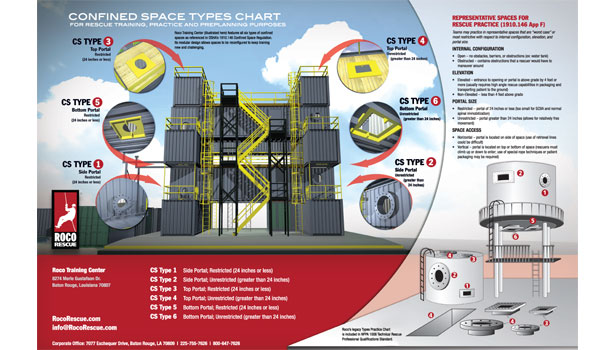
Another helpful tool is a “Confined Space Types Chart” that can be used in identifying potential worst-case situations for a responding rescue team.
Taking advantage of OSHA’s 1910.146 Appendix F guidance and the “Confined Space Types Chart” will arm the confined space program administrator with tools to adequately vet a prospective or selected rescue team. These same tools can be used to determine appropriate “training levels” for the confined space rescue team as well.
For example, with “Confined Space Types 1-6,” you’ll notice that for each pairing of numbers, CS Types 1 & 2 are “side entry” portals; Types 3 & 4 are “top entry” portals; and Types 5 & 6 are “bottom entry” portals. Then, for portal dimensions, the odd numbers (Types 1, 3 and 5) are more restricted portals that are less than 24-inches in diameter. The even numbers (Types 2, 4 and 6) are portals greater than 24 inches.
Why is it important to consider these confined space types and portal sizes when evaluating the rescue team? Well, it has to do with the rescue team’s ability to get in and out of the portal with any required PPE — most likely affecting the need for airline respirators versus backpack SCBAs — and also the need to get a packaged victim out of the space. Generally, a rigid Stokes type litter will not fit through a portal that is 24 inches or less, especially once the victim is loaded into the litter.
The internal configuration of the space also has to be evaluated to determine if any obstacles would impede rescue or limit the types of patient packaging that may be required. Does the internal configuration require the need for rigging directional pulleys inside the space? Are there any other training or equipment shortfalls? There are many other internal physical configuration considerations such as sharp edges, sensitive equipment, exposed leading edges, hot surfaces, limited patient packaging and more.
Then, elevated locations must be considered. Is the portal elevated above grade by four feet or more? It’s one thing to provide rescue from the confined space only to find out that the rescue team is ill-equipped or does not possess the skills required to safely move the victim to ground level. This often requires specialized training and techniques in order to maneuver a packaged victim over handrails, or to statically load the lowering system without causing a shock load to the rope system or to the victim, or in providing an attendant or tag lines to guide the rescue package through or around any obstacles.
Effective evaluation is essential
Whether it’s an in-house rescue team, a team of municipal emergency responders, or a third-party contracted rescue team, simply hearing the rescue team “talk the talk” is only the beginning of the evaluation process. It is essential to confirm that they can also “walk the walk.” That’s why it is so important for the evaluator to have a solid technical rescue background or be qualified to effectively use the tools described in this article. These tools will help provide the right questions for a program administrator to ask.
Looking for a reprint of this article?
From high-res PDFs to custom plaques, order your copy today!