OSHA & fire code liquid classifications take different directions
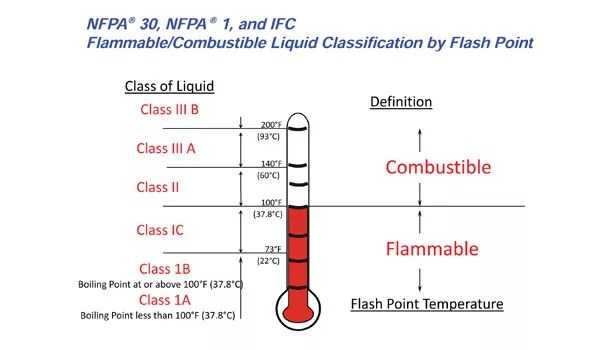
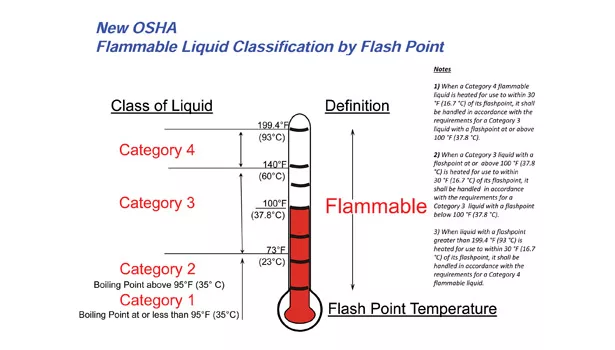
This article will address the classification of flammable and combustible liquids according to the fire codes, and compare it against the new OSHA categories of flammable liquids.
The United States Government published the final rule for implementation of GHS on March 26, 2012. The final rules require product manufacturers to adopt the standard by June 1, 2015, and product distributors to adopt the new standard by December 1, 2015. Workers must receive training by December 1, 2013.
While OSHA finalized the new GHS rule, they also amended 29 CFR1910.106 and 1926.152, effective May 26, 2012, to include a renewed definition of flammable liquids. They dropped the term “combustible” liquids altogether, calling all liquids with a flashpoint under 199°F (93°C) “flammable” liquids. These terms, known since OSHA’s beginning in the early 70’s, were now revised as U.S. Labor law. Note: CFR 30 of the Mine Safety and Health Administration has not revised its definition.
What about the fire codes?
States and municipalities across the U.S. have adopted NFPA® 30 Flammable and Combustible Liquids Code, NFPA® 1 Fire Code, and IFC International Fire Codes© as the foundation for laws and ordinances governing flammable and combustible liquids. Currently, the fire codes maintain their original definition of flammable and combustible liquids.
Here’s how the classification of flammable and combustible liquids in these fire codes compares to the classification of flammable liquids in OSHA Labor Law:
The following from NFPA 30 on the classification of flammable and combustible liquids is representative in all the fire codes:
4.3* Classification of Liquids. Any liquid within the scope of this code and subject to the requirements of this code shall be classified in accordance with this section.
4.3.1 Flammable liquids, as defined in 3.3.30.2 and 4.2.3, shall be classified as Class I liquids and shall be further sub classified in accordance with the following:
(1) Class IA Liquid — Any liquid that has a flash point below 73°F (22.8°C) and a boiling point below 100°F (37.8°C)
(2) Class IB Liquid — Any liquid that has a flash point below 73°F (22.8°C) and a boiling point at or above 100°F (37.8°C)
(3) Class IC Liquid — Any liquid that has a flash point at or above 73°F (22.8°C), but below 100°F (37.8°C)
4.3.2 Combustible liquids, as defined in 3.3.30.1 and 4.2.2, shall be classified in accordance with the following:
(1) Class II Liquid — Any liquid that has a flash point at or above 100°F (37.8°C) and below 140°F (60°C)
(2) Class III Liquid — Any liquid that has a flash point at or above 140°F (60°C)
(a) Class IIIA Liquid — Any liquid that has a flash point at or above 140°F (60°C), but below 200°F (93°C)
(b) Class IIIB Liquid — Any liquid that has a flash point at or above 200°F (93°C)
The following is from the new OSHA CFR 29 1910.106 and is repeated in 1910.126:
1910.106(a)(19)
Flammable liquid means any liquid having a flashpoint at or below 199.4°F (93°C). Flammable liquids are divided into four categories as follows:
Category 1 shall include liquids having flashpoints below 73.4°F (23°C) and having a boiling point at or below 95°F (35°C).
Category 2 shall include liquids having flashpoints below 73.4°F (23°C) and having a boiling point above 95°F (35°C).
Category 3 shall include liquids having flashpoints at or above 73.4°F (23°C) and at or below 140°F (60°C).
When a Category 3 liquid with a flashpoint at or above 100°F (37.8°C) is heated for use to within 30°F (16.7°C) of its flashpoint, it shall be handled in accordance with the requirements for a Category 3 liquid with a flashpoint below 100°F (37.8°C).
Category 4 shall include liquids having flashpoints above 140°F (60°C) and at or below 199.4°F (93°C).
When a Category 4 flammable liquid is heated for use to within 30°F (16.7°C) of its flashpoint, it shall be handled in accordance with the requirements for a Category 3 liquid with a flashpoint at or above 100°F (37.8°C).
1910.106(a)(19)(v)
When liquid with a flashpoint greater than 199.4°F (93°C) is heated for use to within 30°F (16.7°C) of its flashpoint, it shall be handled in accordance with the requirements for a Category 4 flammable liquid.
Obvious differences are:
1) OSHA made obsolete the term “combustible” and now refers to all liquids as “flammable”. Lost is the delineation where flammable liquids (Class I) were liquids having a flash point in normal (≤100˚F) operating temperatures, and combustible liquids with temperatures had raised in a storage condition, or in a process, to within their flash point (≥100˚F) and volatile.
2) While most the relative temperature benchmarks in both classifications remain similar, the boiling point of liquids dividing Class 1A & 1B, now Category 1 & Category 2, is now 95°F (35°C) for labor law while in the fire codes it remains at 100°F (37°C) between Class 1A & 1B. Under U.S. Labor Law, liquid pentane is now less volatile and allowed larger maximum containers size. As an example, now pentane can be stored in a 5-gallon safety can. Previously, OSHA limited pentane to a 2-gallon safety can. Also pentane is allowed up to 120 gallons outside of an inside safety-storage room, or safety cabinet by OSHA. Before changing the definition of flammable liquids, only 25 gallons were allowed in these conditions.
3) Class III B liquids are no longer classified in U.S. Labor Law vs. fire codes. OSHA mentions these liquids:
1910.106(a)(19)(v) When liquid with a flashpoint greater than 199.4°F (93°C) is heated for use to within 30°F (16.7°C) of its flashpoint, it shall be handled in accordance with the requirements for a Category 4 flammable liquid.
But under OSHA there is no longer any concern about the risk of storing these liquids in the event of a fire. Fire codes still show consideration for the risk these liquids present. Ethylene glycol, with a flashpoint of 232°F, is an example of a Class III B liquid that could contribute to a fire.
4) U.S. Labor Law is now communicated as Category 1, 2, 3 & 4, whereas fire codes are Class IA, IB, IC, II, IIIA, & IIIB. Imagine the danger if you are speaking of Category 2 and someone misinterprets this as Class II. When speaking of a liquid’s category or classification, it is crucial to announce you are quoting OSHA (U.S. Labor Law), so not to confuse the listener with fire codes. Miscommunication could be deadly.
5) Previously, it was easy to quote OSHA; when transferring liquids between containers for all flammable liquids or all Class I liquids, the containers had to be grounded or bonded. Now under OSHA you must carefully say when transferring fluids all Category 1 or 2 flammable liquids, or Category 3 flammable liquids with a flashpoint below 100°F (37.8°C), the containers must be grounded or bonded. While awkward to say, nothing has really changed. One addition in OSHA’s code could be interpreted to apply to bonding and grounding:
1910.106(a)(19)(iv) Category 4 shall include liquids having flashpoints above 140°F (60°C) and at or below 199.4°F (93°C). When a Category 4 flammable liquid is heated for use to within 30°F (16.7°C) of its flashpoint, it shall be handled in accordance with the requirements for a Category 3 liquid with a flashpoint at or above 100°F (37.8°C).
For optimum safety, containers should be grounded or bonded for all liquids transferred within 30°F (16.7°C) of their flashpoint. OSHA would then offer the same concern as our neighbors under the National Fire Code of Canada.
Communicate clearly
There is no doubt the GHS of Classification and Labeling of Chemicals was a very important step for the U.S. and the world. The divide in the classification of flammable liquids between U.S. Labor Law and fire codes in the U.S., however, could be the root of miscommunication and potentially result in an accident. It is an important challenge to all that we choose our words carefully and prepare the listener as we discuss the definition of flammable liquids, or flammable and combustible liquid classifications. Since SDS and package labels are in transition, this requires careful attention by personnel to avoid misinterpretation.
We spoke with Bob Benedetti, NFPA staff liaison to the committee responsible for developing the Flammable and Combustible Liquids Code, NFPA 30 to learn his thoughts. He too expressed concern about possible confusion.
Looking for a reprint of this article?
From high-res PDFs to custom plaques, order your copy today!