Choking on an overdose of credentials?
The EHS field is not fully defined in scope and function
Confused?
|
|
Be sure of someone’s knowledge and capability if you need to rely upon them. |
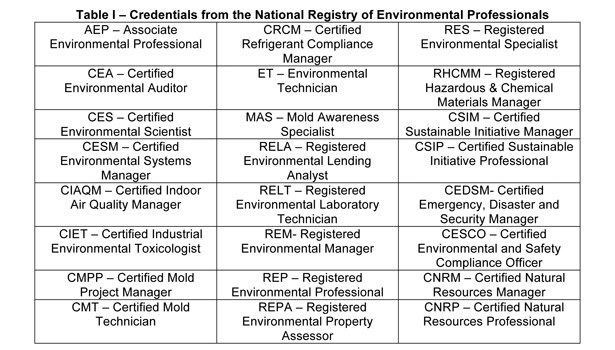
We barely scratched the surface of credentials available to people who practice in the occupational safety, health and environmental field. For a profession that claims most members are generalists there are a dizzying amount of specialist credentials. Table I (on page 20) provides the credentials offered by the National Registry of Environmental Professionals.
Beyond the big three
The big three credentials — CSP, CIH, and CHMM — are the hallmark for the profession. But the demand for specialist credentials may have no end. A decade ago there were more than 300 specialist credentials in the EHS field. It is impossible to get an accurate count today because new credentials pop up frequently. The recent Food Safety Modernization Act, for example, prompted the National Environmental Health Association to create the new CCFS (Certified in Comprehensive Food Safety) credential.
Who are we?
The EHS profession has yet to be fully defined in scope and function. This is especially true as occupational safety and health expands to overlap with public health and safety, and where each domain falls under the huge umbrella of environmental health.
Turf wars
The Bureau of Labor Statistics lumps industrial hygienists and sanitarians together. The occupation/public fence that once separated IH and sanitarian work is being dismantled. Part of the reason is academic preparation in the safety, health and environmental sciences allow for easy transition onto other turf.
Food safety, for example, is not a stretch for someone who worked as an IH. The National Environmental Health Association, founded in 1937, that supports the sanitarian profession offers the Healthy Homes Specialist Credential (HHS). It shouldn’t be too difficult for an HHS who addresses radon, asbestos, lead and other IAQ hazards in the home to transition to IH work.
The main reason for turf wars? Organizations such as ASSE and AIHA all claim the environment as part of what their members do. An IH can do safety work and a safety pro can do IH work and everyone wants a piece of the environmental action. So we get competition where an IHMM may boast that a Certified Dangerous Goods Professional (CDGP) trumps an NREP RHCMM credential (see Table I). And so on.
Market factors
EHS pros stand a much better chance of being hired, promoted and obtaining pay raises if they have specialized credentials. Because I have the CSP, CIH, and CHMM, I am biased toward them. Any specialized EHS credential, however, may be better than none for employment opportunities.
On the surface the competition among credentials is to distinguish credibility for the individual and consumer. The real competition, however, is about marketing the credential for profit. There is a substantial sum of money to be made by organizations that develop, promote and maintain EHS credentials.
A danger exists in making credentials attractive to obtain and not slip into the diploma mill category. Diploma mills flourish because degrees are easy to obtain. Get caught using a diploma mill degree and your good reputation and job may be lost. There are pubic lists for diploma mills but not yet for sub-standard or bogus EHS credentials. That day may come, however. What happens then if a tainted EHS credential puts a blemish on your reputation? If you are going to obtain EHS credentials, make sure they are credible for the long run.
Downplay the credential
If you obtain a specialized credential, boast about it to employers but not among your peers. Peers with competing credentials may challenge your knowledge and damage your reputation. Based on my experience, CIHs often challenge the knowledge of the myriad of IAQ credential holders. Don’t play the “who knows what more” game.
Some credentials are revered and there can be outward distain for someone who holds a competing or sound-alike credential. For example, the DABT (Diplomat American Board of Toxicology) credential is often revered for what it takes — often an earned doctoral degree — to obtain. A Certified Industrial Environmental Toxicologist (see Table I) that only requires a BS degree and three years of experience with limited testing should be considerate when they cross paths with a DABT.
Limit the credentials
One specialized EHS credential is good. Two is better. And three is best. We all know after basic academic knowledge is obtained, all it takes is time and money to gather up any number of credentials. When someone lists numerous credentials, particularly on a business card, it gives the appearance of an over-the-top attempt to demonstrate credibility.
Question the credential
There are too many EHS credentials to ferret out the good and bad. This is particularly true for employers and consumers. A credential should not be a free pass for expected knowledge among peers. Caveat emptor – buyer beware for all concerned parties.
On the other side of the coin, EHS pros may be highly credible in what they do without a standard or specialized credential. Again, be sure of someone’s knowledge and capability if you need to rely upon them.
Overdose
Market forces don’t appear capable of weeding out the EHSE credentials that should not survive. Demand for new specialized credentials is always on the horizon. With no centralized oversight of all credentials, some may slip into notoriety and taint the entire batch. Eventually the profession might overdose on its hundreds of specialized credentials.
Looking for a reprint of this article?
From high-res PDFs to custom plaques, order your copy today!