Combustible dust explosion and fire case studies
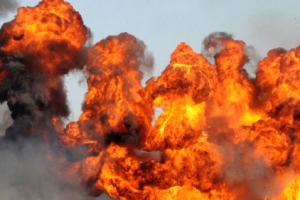 Organic Dust Fire and Explosion: Massachusetts (3 killed, 9 injured)
In February 1999, a deadly fire and explosion occurred in a foundry in Massachusetts. OSHA and state and local officials conducted a joint investigation of this incident. The joint investigation report indicated that a fire initiated in a shell molding machine from an unknown source and then extended into the ventilation system ducts by feeding on heavy deposits of phenol formaldehyde resin dust.
A small primary deflagration occurred within the ductwork, dislodging dust that had settled on the exterior of the ducts. The ensuing dust cloud provided fuel for a secondary explosion which was powerful enough to lift the roof and cause wall failures. Causal factors listed in the joint investigation report included inadequacies in the following areas:
- Housekeeping to control dust accumulations;
- Ventilation system design;
- Maintenance of ovens; and,
- Equipment safety devices.
Organic Dust Fire and Explosion: North Carolina (6 killed, 38 injured)
In January 2003, devastating fires and explosions destroyed a North Carolina pharmaceutical plant that manufactured rubber drug-delivery components. Six employees were killed and 38 people, including two firefighters, were injured.
The U.S. Chemical Safety and Hazard Investigation Board (CSB), an independent federal agency charged with investigating chemical incidents, issued a final report concluding that an accumulation of a combustible polyethylene dust above the suspended ceilings fueled the explosion. The CSB was unable to determine what ignited the initial fire or how the dust was dispersed to create the explosive cloud in the hidden ceiling space. The explosion severely damaged the plant and caused minor damage to nearby businesses, a home, and a school. The causes of the incident cited by CSB included inadequacies in:
- Hazard assessment;
- Hazard communication; and
- Engineering management.
The CSB recommended the application of provisions in National Fire Protection Association standard NFPA 654, Standard for the Prevention of Fire and Dust Explosions from the Manufacturing, Processing, and Handling of Combustible Particulate Solids, as well as the formal adoption of this standard by the State of North Carolina.
Organic Dust Fire and Explosion: Kentucky (7 killed, 37 injured)
In February 2003, a Kentucky acoustics insulation manufacturing plant was the site of another fatal dust explosion.
The CSB also investigated this incident. Their report cited the likely ignition scenario as a small fire extending from an unattended oven which ignited a dust cloud created by nearby line cleaning. This was followed by a deadly cascade of dust explosions throughout the plant. The CSB identified several causes of ineffective dust control and explosion prevention/mitigation involving inadequacies in:
- Hazard assessment;
- Hazard communication;
- Maintenance procedures;
- Building design; and,
- Investigation of previous fires.
Metal Dust Fire and Explosion: Indiana (1 killed, 1 injured)
Finely dispersed airborne metallic dust can also be explosive when confined in a vessel or building. In October 2003, an Indiana plant where auto wheels were machined experienced an incident which was also investigated by the CSB.
A CSB news release told a story similar to the previously discussed organic dust incidents: aluminum dust was involved in a primary explosion near a chip melting furnace, followed by a secondary blast in dust collection equipment.
Combustible-Dust Explosions Prompt Calls for More Oversight
After an explosion at an Imperial Sugar Co. factory in Georgia killed 14 workers and injured dozens in 2008, U.S. officials promised rules for handling the well-known workplace hazard that caused it: combustible dust.
Six years later, there has been little change. Now, as investigators continue to explore the possibility that dust could have caused the collapse of a feed mill in Omaha, Neb., this past January, OSHA is again delaying efforts to make good on that promise, according to an article in The Wall Street Journal.
Three first at metal powder plant (5 killed)
Source: The Center for Public Integrity
Small fires were a part of the job at the Hoeganaes Corp. metal powder plant 30 miles northeast of Nashville.By early 2011, some workers later told investigators, they had become practiced in beating down the flames with gloved hands or a fire extinguisher.
The company’s own product fueled the fires. Scrap metal rolls into the rust-colored plant on the town’s industrial periphery and is melted, atomized and dried into a fine iron powder sold to makers of car parts.Sometimes, powder leaked from equipment and coated ledges and rafters.Under the right conditions, it smoldered.
Wiley Sherburne, a 42-year-old plant electrician, sometimes told his wife how this dust piled up everywhere, she recalled. On quieter weekend shifts, he said he could hear the telltale popping sound of dust sparking when it touched live electricity.
In the early morning of January 31, 2011, Sherburne was called to check out a malfunctioning bucket elevator that totes dust through the plant. Near his feet, electrical wires lay exposed. When the machine restarted, the jolt knocked dust into the air. A spark — likely from the exposed wires, investigators later concluded — turned the dust cloud into a ball of flame that engulfed Sherburne and a co-worker.
“He’s burned over 95 percent of his body,” doctors told Sherburne’s wife, Chris, when she arrived at the Vanderbilt University Medical Center’s burn unit. “He’s not going to live.” Her husband died two days later.
The fires at the Hoeganaes plant were not over. Another struck in March, then a third in May. In all, five workers died in accidents that shook this small community.Each man left behind a wife and children.One had four children under 11.Another became a grandfather the day before an explosion caused fatal burns.
“You have to consider all those fires as close calls for something that could kill somebody,” the board’s chairman, Rafael Moure-Eraso, said in an interview. “Hoeganaes is precisely the case in point.”
At the Gallatin plant, periodic small dust fires ignited in certain areas, investigators found. Some employees told state inspectors they put out blazes once or twice a month; others said the fires came about once a week.
Because the fires had done little damage, workers had come to accept them as part of the job, investigators found.
2011 was not the first time Hoeganaes had experienced the deadly potential of its iron dust. The May accident in particular bore “striking similarities” to one that occurred in 1992 at the company’s plant in Riverton, N.J., said the CSB’s lead investigator, Johnnie Banks.
Twenty years later, Jeffrey Richardson remembers that accident well. It left him with third-degree burns covering 97 percent of his body. He has one ear and one hand, though it has no fingers. His body is covered with skin grown in a lab; it heals slowly and tears easily.
“They said my foot and my eyelids were the only place where I wasn’t burned,” he recalled recently. “I still to this day have a nurse come every day to dress wounds that I still have ongoing.”
As in the May 2011 accident, a hydrogen explosion shook the building, and burning dust fell from the rafters. Richardson recalls it covering him as he struggled to find an escape route. “I could hear it sizzling and cracking,” he said.
Looking for a reprint of this article?
From high-res PDFs to custom plaques, order your copy today!