ISHN logo
search
cart
facebook twitter linkedin youtube
  • Sign In
  • Create Account
  • Sign Out
  • My Account
ISHN logo
  • NEWS
    • Today's News
    • Global Safety News
    • Government Regulations
  • PRODUCTS
    • Product Innovations
    • Featured Products
  • TOPICS
    • Environmental Health and Safety
    • Facility Safety
    • Workplace Health
    • Occupational Safety
    • PPE
    • More Topics
  • CONSTRUCTION
  • TECHNOLOGY
  • COLUMNS
    • Best Practices
    • Dave Johnson: What’s going on
    • Editorial Comments
    • Leading Safety
  • MULTIMEDIA
    • ISHN Podcast
    • Videos
    • Cold Stress Education Quiz
    • Webinars
    • White Papers
  • MORE
    • Buyer's Guide
    • Newsletters
    • Convention Companion
    • Polls
    • Events
    • ISHN Store
    • Sponsor Insights
  • EMAGAZINE
    • eMagazine
    • Archived Issues
    • Contact
    • Advertise
  • JOIN TODAY!
Facility Safety

Lessons learned:

Western Australia's Mines go fatality-free in 2012

By Rick Duley BSc(Hons)
June 12, 2014

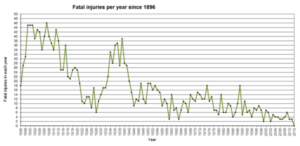
2012 saw Western Australian Mining go fatality-free — the first time in over a century of records. In fact, the industry fell only a few days short of making it two years in a row.  Sadly there have been four fatalities since that golden run. Compare today’s performance to the figures from the '40s and '50s when the accident rate in the industry was around two fatalities per thousand employees per year.  At current employment levels this would mean some 200 fatalities per year. Clearly, something good has happened.

Western Australia mining statistics

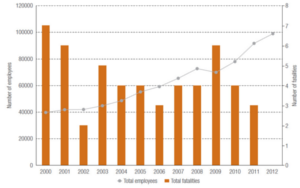
(Fatal Accidents in the Western Australian Mining Industry 2000-2012: What lessons can we learn? (2014). Perth WA :  Department of Mines and Petroleum. page 4)
Western Australia mining statistics
Source: WADMP 2013

Variations in the bar chart to the left might give the impression that progress is erratic, but bear in mind that it is relatively simple to have, for example, one accident in which six people die. That would create a spike in a graph which would otherwise show a steady average of around four fatalities per annum. One of the problems of researching this field is that sample sizes are too small for rigorous statistical analysis.  (Great!  We like it that way!) All one can do is take visual inference from graphs such as this.

 What we see is a continuing fall in the fatality rate despite an overall increase in employment in the industry. Many factors may be involved in this improvement. Enabling (non-prescriptive) legislation, and the ongoing mechanization of the industry would be the two candidates for top reason. Safety legislation in Australia, based on the concepts underpinning the Robens' report in the UK (1972), envisages workers and management working together to equal or better practices defined or suggested by the state. Employers are simply required to "…so far as is practicable, provide and maintain at a mine a working environment in which that employer’s employees are not exposed to hazards…" (Mines Safety and Inspection Act, 1994, sect. 9(1)). How they do so is left up to the employers.

It sounds simple enough.  Is it over-simplified?

No. It is working! So, if it is working, what can we learn from it? In response to that question, Western Australia's Department of Mines and Petroleum has just released a new report entitled, "Fatal Accidents in the Western Australian Mining Industry 2000-2012: What lessons can we learn?"

This report looks first at causal factors ranging from the day of the week and the time of the day to how long the supervisor had been in the mine. Then it considers other critical factors at the time of the fatality including variation from manufacturers’ recommendations and inrush situations.  Finally, it seeks areas of improvement — things management (including the OSH people) might look at with a view to making the workplace safer.

Fatal Accidents is available on-line at http://www.dmp.wa.gov.au/documents/Reports/RP_FatalAccidentsMINING_2000-12.pdf

KEYWORDS: mining industry serious injuries & fatalities (SIFs)

Share This Story

Looking for a reprint of this article?
From high-res PDFs to custom plaques, order your copy today!

Duley is a free-lance Safety Advisor working in construction and mining in the Pilbara, Murchison, and Kimberley areas of Western Australia. He has been involved in OSH since its very foundation in Australasia first qualifying in New Zealand in 1983. CONTACT INFORMATION: Rick Duley  rickduley@gmail.com - http://rickduley.webs.com - aussie : 0409 106 049 - o'seas : +61 409 106 049 - skype  : rickduley

Recommended Content

JOIN TODAY
to unlock your recommendations.

Already have an account? Sign In

  • forklift safety

    Exploring the latest technologies in forklift safety

    With more staff and more stock in warehousing now more...
    Workplace Training Strategies
    By: Josh Cramer
  • welding

    All about welder’s flash or arc eye

    A flash burn is a painful inflammation of the cornea,...
    Environmental Health and Safety
  • dangerous jobs

    The 10 most dangerous jobs in the U.S.

    On-the-job deaths have been rising — hitting the highest...
    Construction Industry Safety and Health
    By: Benita Mehta
Manage My Account
  • eMagazine Subscriptions
  • ISHN Newsletter & Other Newsletter Alerts
  • Online Registration
  • Manage My Preferences
  • Subscription Customer Service

More Videos

Sponsored Content

Sponsored Content is a special paid section where industry companies provide high quality, objective, non-commercial content around topics of interest to the ISHN audience. All Sponsored Content is supplied by the advertising company and any opinions expressed in this article are those of the author and not necessarily reflect the views of ISHN or its parent company, BNP Media. Interested in participating in our Sponsored Content section? Contact your local rep!

close
  • man wearing the the Sundström SR200 Full Face Mask Respirator
    Sponsored byOHD

    5 Fit Testing Mistakes That Could Cost You

  • This image shows Magid AcuSpex polarized blue mirrored safety glasses.
    Sponsored byMagid Glove and Safety

    Construction PPE Guide: What Crews Need for Each Task

  • lone worker in confined space
    Sponsored byAlphasense Ltd.

    GET THE LEAD OUT of your Safety Oxygen Sensors!

Popular Stories

Automated loading dock equipment

After March 2026 Rivian Death, Safety Managers Reassess Loading Dock Systems Under OSHA's Warehouse Emphasis Program

chemical safety

It Was Just Sugar: Catastrophic Safety Failures in Louisville

psychology in the workplace

Most Workplaces Measure Psychological Safety, Ignoring Psychosocial Risks

top 10 most dangerous jobs

Poll

Seasonal Readiness

With the federal heat stress prevention rule on the horizon, which area of your safety program needs the most attention?
View Results Poll Archive

Products

Surviving an OSHA Audit A Management Guide, 2nd Edition

Surviving an OSHA Audit A Management Guide, 2nd Edition

See More Products

ISHN Podcasts

Related Articles

  • Western Australian resources industry makes year without fatality

    See More
  • They achieved the impossible

    See More
  • Heat, hydration, and heavyweight horrors

    See More
×

Become a Leader in Safety Culture

Build your knowledge with ISHN, covering key safety, health and industrial hygiene news, products, and trends.

JOIN TODAY
  • RESOURCES
    • Advertise
    • Contact Us
    • Directories
    • Manufacturing Division
    • Store
    • Want More
  • SIGN UP TODAY
    • Create Account
    • eMagazine
    • Newsletters
    • Customer Service
    • Manage Preferences
  • SERVICES
    • Marketing Services
    • Reprints
    • Market Research
    • List Rental
    • Survey/Respondent Access
  • STAY CONNECTED
    • LinkedIn
    • Facebook
    • YouTube
    • X (Twitter)
  • PRIVACY
    • PRIVACY POLICY
    • TERMS & CONDITIONS
    • DO NOT SELL MY PERSONAL INFORMATION
    • PRIVACY REQUEST
    • ACCESSIBILITY

Copyright ©2026. All Rights Reserved BNP Media, Inc. and BNP Media II, LLC.

Design, CMS, Hosting & Web Development :: ePublishing