ISHN logo
search
cart
facebook twitter linkedin youtube
  • Sign In
  • Create Account
  • Sign Out
  • My Account
ISHN logo
  • NEWS
    • Today's News
    • Global Safety News
    • Government Regulations
  • PRODUCTS
    • Product Innovations
    • Featured Products
  • TOPICS
    • Environmental Health and Safety
    • Facility Safety
    • Workplace Health
    • Occupational Safety
    • PPE
    • More Topics
  • CONSTRUCTION
  • TECHNOLOGY
  • COLUMNS
    • Best Practices
    • Dave Johnson: What’s going on
    • Editorial Comments
    • Leading Safety
  • MULTIMEDIA
    • ISHN Podcast
    • Videos
    • Cold Stress Education Quiz
    • Webinars
    • White Papers
  • MORE
    • Buyer's Guide
    • Newsletters
    • Convention Companion
    • Polls
    • Events
    • ISHN Store
    • Sponsor Insights
  • EMAGAZINE
    • eMagazine
    • Archived Issues
    • Contact
    • Advertise
  • JOIN TODAY!
Today's Safety NewsOccupational SafetyFacility Safety

Hot work accident kills worker in Mississippi

Another severely injured
August 28, 2014

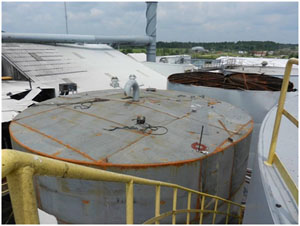
hot work“Telltale signs” of microbial activity were found by investigators in a storage tank that exploded earlier this year, killing a contract worker and severely injuring another. The July 28 incident at the the Omega Protein facility in Moss Point, Mississippi involved hot work being done on or near a tank containing eight inches of a slurry of water and fish matter known as “stickwater,” which was thought to be nonhazardous.

The explosion blew the lid off the 30-foot-high tank. CSB investigators commissioned laboratory testing of the stickwater and found telltale signs of microbial activity in the samples, such as the presence of volatile fatty acids in the liquid samples and offgassing of flammable methane and hydrogen sulfide.

No combustible gas testing was done on the contents of the tank before the hot work commenced.

Hot work danger not limited to oil & gas industry

“This tragedy underscores the extreme importance of careful hot work planning, hazard evaluation, and procedures for all storage tanks, whether or not flammable material is expected to be present,” said CSB Chairperson Rafael Moure-Eraso. “Hot work dangers are not limited to the oil, gas, and chemical sectors where flammability hazards are commonplace.”

Moure-Eraso described three serious hot work incidents investigated by the CSB—all with fatalities—involving hot work on tanks of biological or organic matter. At the Packaging Corporation of America (PCA), three workers were killed on July 29, 2008, as they were performing hot work on a catwalk above an 80-foot-tall tank of “white water,” a slurry of pulp fiber waste and water.  CSB laboratory testing identified anaerobic, hydrogen-producing bacteria in the tank.  The hydrogen gas ignited, ripping open the tank lid and sending workers tumbling to their deaths.

Potato waste not benign

On February 16, 2009, a welding contractor was killed while repairing a water clarifier tank at the ConAgra Foods facility in Boardman, Oregon. The tank held water and waste from potato washing; the CSB investigation found that water and organic material had built up beneath the base of the tank and decayed through microbial action, producing flammable gas that exploded.

“Mixtures of water with fish, potatoes, or cardboard waste could understandably be assumed to be benign and pose little safety risk to workers. It is vital that companies, contract firms, and maintenance personnel recognize that in the confines of a storage tank, seemingly non-hazardous organic substances can release flammable gases at levels that cause the vapor space to exceed the lower flammability limit. Under those conditions, a simple spark or even conducted heat from hot work can prove disastrous.

DuPont hot work reforms a "positive example"

“I urge all companies to follow the positive example set by the DuPont Corporation, after a fatal hot work tragedy occurred at a DuPont chemical site near Buffalo, New York. Following CSB recommendations from 2012, DuPont instituted a series of reforms to hot work safety practices on a global basis, including requirements for combustible gas monitoring when planning for welding or other hot work on or near storage tanks or adjacent spaces.

“Combustible gas testing is simple, safe, and affordable. It is a recommended practice of the National Fire Protection Association, The American Petroleum Institute, FM Global, and other safety organizations that produce hot work guidance. Combustible gas testing is important on tanks that hold or have held flammables, but it is equally important—if not more so—for tanks where flammables are not understood to be present. It will save lives.”

More resources:

http://www.csb.gov/e-i-dupont-de-nemours-co-fatal-hotwork-explosion/

http://www.csb.gov/packaging-corporation-storage-tank-explosion/

http://www.csb.gov/seven-key-lessons-to-prevent-worker-deaths-during-hot-work-in-and-around-tanks/

http://www.csb.gov/motiva-enterprises-sulfuric-acid-tank-explosion/

http://www.csb.gov/partridge-raleigh-oilfield-explosion-and-fire/

KEYWORDS: CSB investigation hazardous materials workplace accidents

Share This Story

Looking for a reprint of this article?
From high-res PDFs to custom plaques, order your copy today!

Recommended Content

JOIN TODAY
to unlock your recommendations.

Already have an account? Sign In

  • forklift safety

    Exploring the latest technologies in forklift safety

    With more staff and more stock in warehousing now more...
    Workplace Training Strategies
    By: Josh Cramer
  • welding

    All about welder’s flash or arc eye

    A flash burn is a painful inflammation of the cornea,...
    Environmental Health and Safety
  • dangerous jobs

    The 10 most dangerous jobs in the U.S.

    On-the-job deaths have been rising — hitting the highest...
    Transportation Safety
    By: Benita Mehta
Manage My Account
  • eMagazine Subscriptions
  • ISHN Newsletter & Other Newsletter Alerts
  • Online Registration
  • Manage My Preferences
  • Subscription Customer Service

More Videos

Sponsored Content

Sponsored Content is a special paid section where industry companies provide high quality, objective, non-commercial content around topics of interest to the ISHN audience. All Sponsored Content is supplied by the advertising company and any opinions expressed in this article are those of the author and not necessarily reflect the views of ISHN or its parent company, BNP Media. Interested in participating in our Sponsored Content section? Contact your local rep!

close
  • man wearing the the Sundström SR200 Full Face Mask Respirator
    Sponsored byOHD

    5 Fit Testing Mistakes That Could Cost You

  • This image shows Magid AcuSpex polarized blue mirrored safety glasses.
    Sponsored byMagid Glove and Safety

    Construction PPE Guide: What Crews Need for Each Task

  • lone worker in confined space
    Sponsored byAlphasense Ltd.

    GET THE LEAD OUT of your Safety Oxygen Sensors!

Popular Stories

SpaceX 7 launch

OSHA Investigating Fatal Fall at SpaceX Starbase

dust explosion

Tennessee OSHA Issues Record $3.1M Fine After Deadly Explosion at Munitions Plant

roofing dangerous jobs Getty.jpg

OSHA Finds Florida Roofing Company Willfully Exposed Workers to Safety Hazards After Worker’s Fatal Fall

top 10 most dangerous jobs

Poll

Seasonal Readiness

With the federal heat stress prevention rule on the horizon, which area of your safety program needs the most attention?
View Results Poll Archive

Products

Surviving an OSHA Audit A Management Guide, 2nd Edition

Surviving an OSHA Audit A Management Guide, 2nd Edition

See More Products

ISHN Podcasts

Related Articles

  • Crane accident kills worker in NYC

    See More
  • Drainage shaft accident kills worker

    See More
  • Accident kills worker on Taiwan set of Martin Scorsese film

    See More

Related Directories

  • SafetyLine Lone Worker

    SafetyLine Lone Worker helps companies monitor the status of workers who are remote, alone, or working in hazardous situations. We are an automated check-in monitoring and emergency notification service. SafetyLine uses its communications infrastructure to ensure that workers have comprehensive monitoring, 24/7, without the need for costly monitoring centers.
  • Safe Site Check In LLC

    Make Jobsite Management Easy(™). Safe Site Check In saves jobsite safety, super, project, and cost managers hours a day including: Digital badging, onboarding & training, Safety screening, Daily log creation Safety JSA, EAP, SDS Project management integration, Subcontractor management, Remote site monitoring, Worker profiles, Incident investigations.
×

Become a Leader in Safety Culture

Build your knowledge with ISHN, covering key safety, health and industrial hygiene news, products, and trends.

JOIN TODAY
  • RESOURCES
    • Advertise
    • Contact Us
    • Directories
    • Manufacturing Division
    • Store
    • Want More
  • SIGN UP TODAY
    • Create Account
    • eMagazine
    • Newsletters
    • Customer Service
    • Manage Preferences
  • SERVICES
    • Marketing Services
    • Reprints
    • Market Research
    • List Rental
    • Survey/Respondent Access
  • STAY CONNECTED
    • LinkedIn
    • Facebook
    • YouTube
    • X (Twitter)
  • PRIVACY
    • PRIVACY POLICY
    • TERMS & CONDITIONS
    • DO NOT SELL MY PERSONAL INFORMATION
    • PRIVACY REQUEST
    • ACCESSIBILITY

Copyright ©2026. All Rights Reserved BNP Media, Inc. and BNP Media II, LLC.

Design, CMS, Hosting & Web Development :: ePublishing