Historically, December has been a particularly tragic month in U.S. coal mining.
Considered the worst mining accident ever, explosions at West Virginia’s Monongah Nos. 6 and 8 in 1906 claimed 362 lives.
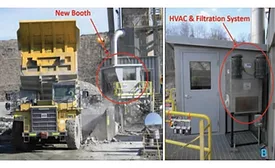
In the 1960s cartoon The Flintstones, Stone Age man Fred Flintstone worked in a quarry while sitting in the open booth of a rock-crusher machine. Presumably, the animators based Fred’s booth on the open designs typical of the 1960s. If they had created it in the 2000s, however, Fred’s booth would have looked vastly different, notwithstanding the fact that his booth was atop a brontosaurus.
When I learned about the dangers of silica dust in medical school in the 1970s, at the beginning of my career in occupational medicine, I thought silica dust was only of historical interest, or a hazard for just a few especially vulnerable workers with unscrupulous employers.
Scientists at the National Institute for Occupational Safety and Health (NIOSH) have developed a novel technique that makes it possible to measure silica dust quickly and easily at the mine site. Silica dust exposure can causes silicosis, an irreversible, but preventable, occupational lung disease.
A new study at the National Institute for Occupational Safety and Health (NIOSH) underscores the importance of anticipating respiratory disease, including black lung disease and loss of lung function, in former coal miners to allow them to receive an appropriate diagnosis and medical care.
Responding to a complaint of unsafe working conditions, OSHA inspectors observed employees at an Illinois metal fabricating shop over-exposed to noise and dust hazards while manually powder coating metal products in two of the company’s paint booths.
The Kimberly-Clark Professional KleenGuard A45 Liquid and Particle Protection Surface Prep and Paint Apparel are ideal for use in surface preparation and paint application areas where isocyanate1 and chromate dust protection is mandated.
An Elk Grove Village-based company is facing fines of nearly $45,000 for exposing workers to various respiratory and electrical hazards, according to OSHA.
OHSA’s Hazard Alert discusses the health hazards associated with hydraulic fracturing and focuses on worker exposures to silica in the air. It covers the health effects of breathing silica, recommends ways to protect workers, and describes how OSHA and NIOSH can help. Workers and employers need to be aware of the hazard that silica dust poses.