Most falls happen on the same level resulting from slips and trips, according to the Canadian Centre for Occupational Health and Safety (CCOHS).
Slips happen where there is too little friction or traction between the footwear and the walking surface. According to the CCOHS, common causes of slips are:
New construction safety training legislation establishes a program to provide equal access to construction site safety training (SST) for workers in New York City. This training is in addition to existing federal, state and local requirements.
On May 7-11, the construction industry celebrates its commitment to safety on the jobsite and beyond as part of an industry-wide education and awareness event, Safety Week.
During Safety Week, construction companies take the opportunity to thank their employees for their commitment to safety.
Follow electrical safety procedures to prevent electrical hazards. Electricity used in welding is available as:
single phase, 120 Volts (V) or 240 V; and
triple phase 575 V in Canada and 480 V in the USA.
During 2014, the Bureau of Labor Statistics (BLS) reported that approximately 357,400 welders, cutters, solderers, and brazers were employed. Welders and those who perform welding-related activities are susceptible to many occupational hazards, particularly to their ocular and respiratory health.
Organizations such as the American Conference of Governmental Industrial Hygienists (ACGIH®) and OSHA offer safety guidelines to help employers and workers avoid welding hazards. Employers should ensure all workers have an opportunity to comply with the following important guidelines in the workplace:
There are a wealth of resources available for helping raise awareness of fall hazards and how to abate them. From lesson plans to fact sheets to safety posters – in a variety of languages – employers who feel that they need some additional information can find it online.
Here are some of those resources:
NIOSH: Campaign to Prevent Falls in Construction -
Infographics by NIOSH and CPWR
The North Dakota Safety Council has put together information about (29 CFR 1926, Subpart M), the general construction fall protection rule, which may come in handy when you’re planning or conducting a Safety Stand-Down.
The guide includes:
Who the rule covers (most construction workers except those inspecting, investigating, or assessing workplace conditions prior to the actual start of work or after all work is done).
Employers looking for training materials for their Safety Stand-Down may want to use some of them many safety videos available to them. Here are some: A worker leaves his fall harness in his truck and doesn’t want to take the time to go and get it. Fall Protection Can Save Your Life from WorkSafeBC dramatizes the consequences of not wearing fall protection -- and why wearing it is the right choice every time.
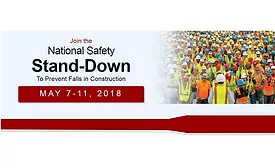
A Safety Stand-Down is a voluntary event for employers to talk directly to employees about safety.
How to conduct a Safety Stand-Down
Companies can conduct a Safety Stand-Down by taking a break to have a toolbox talk or another safety activity such as conducting safety equipment inspections, developing rescue plans, or discussing job specific hazards.