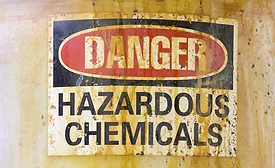
Five years after a catastrophic ammonium nitrate explosion in West, Texas killed 15 persons, destroyed much of the city, and launched reforms in the way the federal government oversees the safety of the nation’s chemical facilities, EPA Administrator Scott Pruitt last week told us that he cares more about the concerns of the chemical industry than he does about the millions of Americans living in the shadow of hazardous chemical facilities.
Air pollution is a serious – and seemingly overwhelming -- public health problem, yet changes that individuals can make could help them both avoid some of the effects of harmful pollutants and reduce the level of toxins in the environment.
That’s according to the American Lung Association (ALA) and Dr. Eric Presser, a thoracic surgeon and author of An Empowering Guide to Lung Cancer: Six Steps to Taking Charge of Your Care and Your Life.
A new NIOSH web page addresses concerns related to potential occupational exposures of healthcare workers to illicit fentanyl. The agency’s recommendations, which cover work practices, training, personal protective equipment, and decontamination of clothing, are intended for possible exposures to fentanyl that originated from sources outside of a healthcare facility—for example, from the surrounding community.
Major chemical incidents can be prevented by applying process safety management principles. Process safety management (PSM) is the control of process hazards in order to prevent process-related injuries and incidents. The CSB has conducted seven investigations with 26 resulting recommendations relating to improving state and federal process safety management programs.
The U.S. Chemical Safety Board (CSB) investigation team that deployed to the April 26, 2018, explosion at the Husky Energy oil refinery in Superior, Wisconsin. This is a brief update of the CSB’s ongoing work: The CSB investigation team arrived in Superior the evening of April 26 and to date has photo-documented a large percentage of the refinery.
A direct final rule issued by OSHA on May 4 “clarifies” several provisions of the agency’s beryllium standard for general industry, the agency announced in a press release. The provisions addressed in the rule concern processes, operations, or areas where workers may be exposed to materials containing less than 0.1 percent beryllium by weight; the definitions of the terms “beryllium work area,” “emergency,” “dermal contact,” and “beryllium contamination”; disposal and recycling; and dermal exposure to materials that contain at least 0.1 percent beryllium by weight.
A growing range of wearable monitors may help people lead stronger, smoother lives, but MIT's newest device is looking to save them--specifically, by alerting soldiers when toxic gases are around.
Researchers from MIT's Swager Group developed the small chemical sensors to detect toxic gases in trace amounts using adapted carbon nanotubes, and are working to put this technology in wireless-friendly form for field use as soon as possible.
1. Get the Person to Fresh Air
Move the person away from carbon monoxide area.
If the person is unconscious, check for injuries before moving.
Turn off carbon monoxide source if you can do so safely.
Among hazardous chemicals and substances handled in industry, gases are often the most dangerous. In addition to being harder to contain than liquids or solids, many gases are invisible and odorless, forcing workers to rely on sensors and meters to detect leaks.
Last week’s fatal accident in Florida involving an electrical vehicle is being investigated by the National Transportation Safety Board (NTSB), which is giving special attention to how emergency responders – including firefighters and tow truck operators -- dealt with the electric vehicle battery fire that followed the crash.