An OSHA investigation into a worker’s partial thumb amputation has resulted in safety citations and thousands of dollars in proposed fines against his employer. The injury occurred when the employee was clearing a jam on a bag sealing machine.
Fewer than half of all employers required to send their injury and illness information into OSHA last year sent in the information. “The Occupational Safety and Health Administration was expecting about 350,000 summaries to be submitted by Dec. 31, the agency numbers provided to Bloomberg Environment March 7 show. Instead, employers required to participate submitted 153,653 reports, OSHA said.”
Longer-term prescribing of opioids causes substantially longer duration of temporary disability among workers with work-related low back injuries, according to a new study from the Workers Compensation Research Institute (WCRI). Temporary disability is time that workers spend away from work recovering from their work-related injuries.
Jim manages a manufacturing plant that makes office furniture using plywood and other engineered wood products. Their worksite takes worker safety seriously, and is interested to know if the rate of severe injuries they are experiencing is high compared to injuries occurring at other office furniture manufacturing plants.
When it comes to ladder safety, there’s a difference between three-point control and the traditional three-point contact rule. Three-point control is a climbing method that involves always using three or four limbs distributed over three or four locations for reliable support. Three-point contact involves simply coming into contact with the ladder at three points without necessarily requiring a reliable hand grip for support.
Falls are one of the most common causes of death for ironworkers. But they also risk injuries from steel beam or reinforced concrete wall collapses, "struck-by" injuries from falling or swinging objects, and contact with live electrical lines.
That’s a good bit of risk for an average $45,000 salary.
Patients older than 18 years of age who suffered falls from ladders over a five and a half year period were identified for a study. Of 27,155 trauma patients, 340 (1.3%) had suffered falls from ladders. The average age was 55 years, with a male predominance of 89.3%. Average fall height was 9.8 ft. Increasing age was associated with a decrease in the mean fall height, an increase in the mean Injury Severity Score, and higher likelihood of hospital admission.
Analysis of data from three surveillance systems showed that in 2011, work-related ladder fall injuries (LFIs) resulted in 113 fatalities, an estimated 15,460 nonfatal injuries that involved more than one day away from work, and an estimated 34,000 nonfatal injuries treated in emergency departments. Workers who are male, Hispanic, older, self-employed, work in smaller establishments, and work doing construction and extraction or installation, maintenance, and repair experience higher LFI rates.
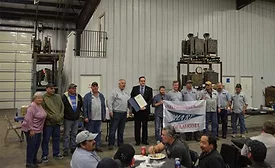
Working around molten metals at temperatures of 1,300 to 1,600 degrees Fahrenheit, employees of T&L Foundry in Glenpool, Oklahoma load metal melting furnaces, form molds for pouring metal into, and finish the final product using grinders and tumble blasters. It is a high-hard industry. The family-owned foundry - which produces non-ferrous castings, ranging from only a few ounces up to 1,000 pounds – was already dedicated to employee safety, but decided to do more.
OSHA last week launched a regional Focus Four Campaign in the Mid-Atlantic States to address the four leading causes of fatal injuries in construction.
Throughout the month of March, the campaign will use toolbox talks and outreach events to focus on electrical hazards.