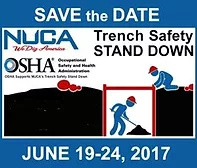
First there was the National Safety Stand-Down to Prevent Falls in Construction. Now, contractors are being asked to stop work at their trenching operations in order to raise awareness of trenching and excavation hazards.
NIOSH has led a research program focused on small business safety and health for more than two decades because we know workers in small businesses are injured and killed on the job at a higher rate than workers in larger businesses. Over the years, we have expanded our research focus from identifying small businesses in high-risk sectors to understanding how community networks affect worker safety and health.
Do Not Pass go: The New York Times reports that “the owner of two Brooklyn construction companies was charged with manslaughter on Wednesday because the authorities said he ignored complaints about a poorly maintained retaining wall that collapsed at a work site in 2015, killing an 18-year-old laborer and injuring two others.”
News that President Trump has slated NIOSH for a 40% cut sends shivers through anyone who thinks that strong, well-funded research plays a crucial role in developing effective programs to prevent workplace injuries and illnesses.
A Florida woman has been convicted of workers’ compensation fraud after footage from a surveillance camera showed her trying to fake a workplace injury.
Sheyla White, an employee of Cinque Terre Energy Partners in Fort Lauderdale, claimed a sprinkler head from a ceiling emergency sprinkler system fell, bounced off her desk and struck her in the head in 2015.
Automotive steel manufacturer Republic Steel faces $279,578 in proposed penalties OSHA after agency investigators found workers at its Canton plant exposed to machine hazards and lead.
OSHA has announced that it is not accepting electronic submissions of injury and illness logs “at this time.” The agency also says it intends to propose extending the July 1, 2017 date by which certain employers are required to submit the information from their completed 2016 Form 300A electronically. The effective date for the new rule was already delayed from January 1, 2017.
Last week wasn’t a good one for New York City’s construction industry, which has come under increasing criticism for taking safety shortcuts under pressure from high-end developers eager to capitalize on the city’s building boom.
National Safety Month – established by the National Safety Council (NSC) – is aimed at preventing injuries and accidental deaths by raising awareness about the leading safety and health risks, like: