Unlike other business metrics, safety can impact our lives both on and off the job. To flourish in the business world, great organizations need to also evolve and elevate their cultures by making safety more than just a metric on a scorecard.
Although confined space rescues comprise a relatively small percentage of the operations performed by fire departments in the U.S., they are among the most challenging and dangerous. In fact, as hazardous as confined spaces are for the people who initially become trapped in them, they are even more deadly for would-be rescuers, who account for nearly 60 percent of all confined space deaths.
Building an organization-wide safety culture is important — making safety a priority for everyone keeps workers safe and spares your organization the consequences of injuries and illnesses. Here are five tips that can help you develop a total safety culture that’s engaging and effective.
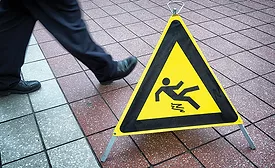
The Walk Zone Safety Report could be a good resource for your next training session on walking-working surface safety. Many organizations underestimate floor safety risks and are unaware of high-risk walk zones in their buildings, according to a survey conducted by New Pig.
The manager had gone on a fishing trip for at-risk behavior. And he “hooked” one of his crew doing “wrong.” He found what he was looking for – at-risk behavior -- and administered discipline, based on this single data point.
Hurricanes, flooding, earthquakes and wildfires: recent headlines prove that even disasters that give us some notice – such as hurricanes – can cause far more destruction than expected, and that effective emergency response depends upon preparedness.
An unmanned, half-mile long train “bomb train” carrying tank-cars full of highly explosive crude oil barrels toward a city where it is doomed to derail on a curve, killing everyone in its wake. Luckily, Denzel Washington and Chris Pine show up to save the city at the last second. Everyone lives happily every after.
Hazardous Materials Instructor Training is now available at no cost in a dozen states to help reduce transportation incidents involving undeclared hazardous materials.
Noise Monitoring specialists Cirrus Research have expanded their product training and CPD programmes, adding an environmental noise measurement workshop to the roster.
OSHA’s regs and enforcement have framed health and safety work for decades. If OSHA reduces its regulatory activity (delaying or reversing current regulations) and moves toward technical assistance, what might the impact be?
 RSS
RSS