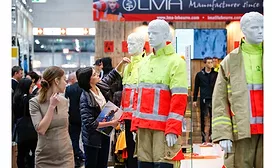
From November 5 – 8, 2019, occupational safety and health take center stage in Düsseldorf, Germany.
The increasing level of international interconnectivity and networking is accompanied by new company structures and production conditions. These in turn mean employees have to master new challenges. To do this successfully, we need modern occupational safety and intelligent concepts.
Interview with Wolfram N. Diener, Managing Director of Messe Düsseldorf
April 23, 2019
A+A 2019, International Trade Fair with Congress for Safety, Security and Health, will be held from November 5 – 8, 2019 at the fairgrounds in Düsseldorf, Germany. Since October 1, 2018, Wolfram Diener has been the new Managing Director of Messe Düsseldorf and responsible for A+A. Diener is enthusiastic about his new job.
Floods, droughts, record-breaking temperatures – the evidence indicates that addressing climate change has become one of the world’s most pressing issues, which is why the publication of two International Organization for Standards (ISO) standards will have a significant part to play in helping to reduce damaging greenhouse gases.
Tackling the effect of greenhouse gas (GHG) emissions on global warming and the subsequent impact on climate change is one of the defining, and intractable, challenges of our time.
A special highlight at A+A 2019, International Trade Fair with Congress for Safety, Security and Health at Work, will be the new international START-UP ZONE in Hall 10 promoting young, creative, future-oriented companies. “From health Apps, VR goggles to high-tech textiles – there are no limits to the potential themes at this zone."
Released as the new safety and health standard in early 2018, ISO 45001 has a range of EHS benefits. But how do companies become ISO 45001 certified? Introduced in March 2018, ISO 45001 replaced OHSAS 18001 to become the new international ISO standard for Occupational Health & Safety Management Systems.
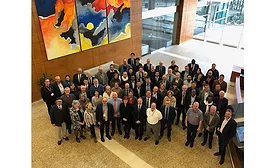
Multinational corporations and experts in the fields of human capital, sustainability and occupational safety and health signed a commitment this week to the safety, health and well-being of people.
Google, Nike, L’Oreal, BNP Paribas, Hermes and AP Moller-Maersk were among companies represented at the Center for Safety and Health Sustainability’s (CSHS) “Human Capital Project – Global Summit: Putting People Back Into Sustainability” at L’Oreal’s Aulnay Campus.
The American Society of Safety Professionals (ASSP) and the Korea Occupational Safety and Health Agency (KOSHA) have formalized a memorandum of understanding that outlines how the organizations will collaborate on advancing workplace safety and health over the next five years.
ASSP President Rixio Medina, CSP, CPP, and KOSHA President Dooyong Park signed the agreement at a global workplace safety and health sustainability event in Paris.
Publication of an ISO 45001 implementation handbook is expected by the end of the year as a follow-up to the global occupational safety and health management system standard released in 2018, according to a working group that recently met as part of a five-day ISO Technical Committee (TC-283) meeting in Dallas.
The handbook will provide small and medium-sized businesses with detailed guidance on how they can apply the voluntary consensus standard to increase employee safety, reduce workplace risks and improve business outcomes.
Health and safety incidents have become the leading financial loss drivers for businesses around the globe, with cumulative losses now outstripping the costs of more high-profile disruptions such as cyber-attacks or IT outages, according to the latest research.
The British Standards Institution (BSI) 2019 Horizon Scan analyzed the risks and threats recognized by 569 organizations worldwide, and compared these against the impact of actual disruptions over the past year.
Currently there are a billion cases of flu worldwide a year
March 12, 2019
The World Health Organization (WHO) has released details of a Global Influenza Strategy for 2019-2030 aimed at protecting people in all countries from the threat of influenza, or flu. The goal is to prevent seasonal flu, control the spread of influenza from animals to humans, and prepare for the next flu pandemic.