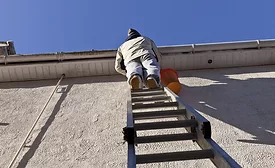
A cause of death amongst construction workers is falls from elevation, of which a third are from ladders. Some of these fatalities could be prevented simply with the implementation of the three-point control technique.
In addition to proper use of horizontal grab bars and the existing horizontal rungs, construction workers should be trained to use the three-point control technique.
Falls are one of the most common causes of death for ironworkers. But they also risk injuries from steel beam or reinforced concrete wall collapses, "struck-by" injuries from falling or swinging objects, and contact with live electrical lines.
That’s a good bit of risk for an average $45,000 salary.
Patients older than 18 years of age who suffered falls from ladders over a five and a half year period were identified for a study. Of 27,155 trauma patients, 340 (1.3%) had suffered falls from ladders. The average age was 55 years, with a male predominance of 89.3%. Average fall height was 9.8 ft. Increasing age was associated with a decrease in the mean fall height, an increase in the mean Injury Severity Score, and higher likelihood of hospital admission.
Analysis of data from three surveillance systems showed that in 2011, work-related ladder fall injuries (LFIs) resulted in 113 fatalities, an estimated 15,460 nonfatal injuries that involved more than one day away from work, and an estimated 34,000 nonfatal injuries treated in emergency departments. Workers who are male, Hispanic, older, self-employed, work in smaller establishments, and work doing construction and extraction or installation, maintenance, and repair experience higher LFI rates.
When you’re 280 feet off the ground, your feet clinging to the deck, the breeze blowing past, you’ve got a clear view of the power of wind energy. This past summer, I experienced it first-hand.
The New York communities of Lowville and Martinsburg are the home of the 195-turbine Maple Ridge Wind Farm. We checked out the wind farm from a range of angles and perspectives. And, yes, we climbed a turbine.
Working around molten metals at temperatures of 1,300 to 1,600 degrees Fahrenheit, employees of T&L Foundry in Glenpool, Oklahoma load metal melting furnaces, form molds for pouring metal into, and finish the final product using grinders and tumble blasters. It is a high-hard industry. The family-owned foundry - which produces non-ferrous castings, ranging from only a few ounces up to 1,000 pounds – was already dedicated to employee safety, but decided to do more.
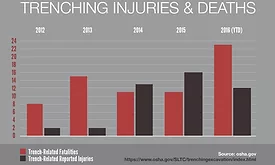
An alarming leap in excavation and trench-related fatalities has made reducing them an Agency Priority Goal for OSHA for 2018.
The agency plans to accomplish this by increasing awareness of trenching hazards in construction, educating employers and workers on safe cave-in prevention solutions, and decreasing the number of trench collapses.
Forcing OSHA to choose between focusing on enforcement or compliance assistance is “a false choice,” according to Dr. David Michaels, former assistant secretary of labor for occupational safety and health and current professor in the Department of Environmental and Occupational Health at the Milken Institute School of Public Health at The George Washington University in Washington.
Although efforts to improve occupational safety often focus on industries like manufacturing, mining and agriculture, the arts can be dangerous, too.
Thus, OSHA, United States Institute for Theatre Technology (USITT), and International Alliance of Theatrical Stage Employees, Moving Picture Technicians, Artists and Allied Crafts of the United States, its Territories and Canada, AFL-CIO, CLC (IATSE) have just renewed their alliance to protect the safety and health of workers in the entertainment industry.
The National Council for Occupational Safety and Health (National COSH), a nationwide training and advocacy organization for workers and families, is accepting nominations for its “Dirty Dozen” list of employers who fail to provide safe conditions for their workers.
 RSS
RSS