“You can’t scare me!”
The problem with scare tactics
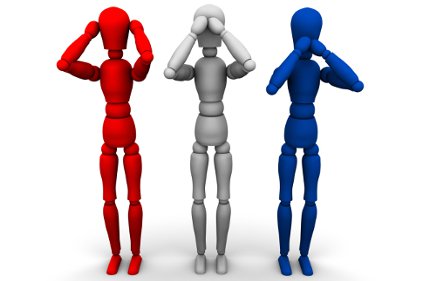 Remember those playground and schoolyard taunts? “Nah, nah, you can’t scare me!” “I ain’t yellow!”
Well, psychologist say those kids were on to something. It turns you can’t often scare people with fear tactics.
You know, tactics like grisly driver training movies showing decapitated bodies lined on the road. Workplace safety training films depicting any number of gruesome calamities: trench cave-ins, electrocutions, falls, forklifts running off loading docks, machinery chewing up fingers and arms, confined space rescues with one man going down after another.
The list is practically endless, and yes, some training companies have stocked their libraries full of scare ‘em flicks. Not as popular as they once were because audiences are more sophisticated and heck, TV is gory enough these days.
Victims of workplace disasters, grotesquely burned to near death, robbed of limbs, can hold vast audiences spellbound as they tell they tales. But a week later, what do those workers in the audience remember? A month gone by?
You see, the reason we – teenagers and adults – don’t scare easy is due to something psychologist call “cognitive bias.” You might also call it “perceptual distortion” or “inaccurate judgment.”
Cognitive has to do with how we see the world and think about what we take in. And most of what we take in passes through filters, or blinders in some sorry cases. These are the biases that shape perceptions and form judgments.
Most of us have formed the personal judgment somewhere along the way that “it can’t happen to me.” “Accidents happen to some unlucky soul, not me, brother!”
It’s a challenge for safety professionals to breakthrough cognitive biases. They’ve been formed over a lifetime, reinforced by years of experience. “This is the way I’ve always done my job. I’ve never, never gotten hurt.”
This past June, after the ASSE meeting in Denver, I took a road trip up to the Badlands National Park in South Dakota. I had my own cognitive biases working. Most of the time we’re not even conscious of them and the filtering and blinding they do.
“Stay on the trail” was a warning sign I saw time and again. Sometimes the warning was accompanied by a pictograph of a stick figure falling off of a cliff.”
I ignored these warnings. See, I have hiked off the trail in many a beautiful spot throughout the west. Nothing bad had ever come of it. Like workers who do the same job for years, I felt confident in ignoring the warnings, competent that I could handle scrambling and improvising beyond the trail, and I felt it was definitely worth taking this risk, which I didn’t “see” or perceive as much of a risk, because the consequences or rewards were so much worth it: beautiful vistas, no crowds, no one blabbing into their cell phone, better chances of seeing animals at play, great photo ops.
Well, like bad karma my years of living by faulty cognitive biases caught up to me in the Badlands. Of course it was a shock. My fall while climbing up a short rise of loose clay shocked me so to this day I cannot remember how it happened. No one was with me – another risk I ignored. I don’t know how far I fell, probably less than ten feet, and I have no memory of how I landed.
I was a bloody mess. A very lucky bloody mess. Yeah, I was bleeding over one eye, had abrasions and contusions on my hands, arms, shoulders, chest, knees. I was somehow in a sitting position wedged between rocks and I couldn’t move. Couldn’t stand up.
I had no cell phone and no water – two more very “inaccurate judgments.” Sitting there waiting for a hiker to come by, I was more embarrassed than scared. I knew I was close to a popular trail, within sight of it, so someone soon would reach me. But how could someone experienced as I was slip up so badly? That was what I was thinking while picking pieces of gravel from my hands and arms and scalp, waiting for help.
Help arrived soon enough, no more than a half hour’s wait. Hikers phoned in my position. Then the real cavalry came: the park EMTs, a National Guard chopper, state and county police. Since my right leg was useless I couldn’t walk out, and I couldn’t be carried out due to a log ladder on the trail. Strapped up on a litter with a neck brace, like a fallen football player who they can’t tell how badly he might be hurt, I was first choppered out of the park to a parking lot. A second, larger chopper then flew me 75 miles to the Rapid City Regional Hospital in western South Dakota.
X-rays showed three fractured ribs, but no broken leg, wrist, elbow, neck or back. Like I said, I am a very lucky dude.
Will this tale “scare” any would-be hikers who might read this into reconsidering going off the beaten path? I doubt it. Most risk-takers are set in their ways. They don’t know me, don’t know anything about my trail skills or experiences. Just another poor bastard in another wire service article about a successful rescue.
The one place I see scare stories working is when one of your coworkers, longtime buddy maybe, gets seriously injured doing the same job you do, or close to it. When he or she tells what happened, how it happened, at a safety meeting, it can resonate because it’s like a shell in combat hitting right outside your foxhole. Hey, that was a close hit. That was a good friend of mine. We did the same job. He’s pretty messed up. I hate to see him busted up like that. I’d hate to see myself that way. Maybe it’s time to think some about how I do this job.
To get folks truly thinking about their safety and how they go about their work – that’s breaking a wall of personal biases and denials. Storytelling can be a potent tool; the closer to home the story hits, the better your chance for a breakthrough.
