Top OSHA violations: Occupational noise exposure
 Noise-related hearing loss has been listed as one of the most prevalent occupational health concerns in the U.S. for more than 25 years. According to the CDC, an estimated 22 million U.S. workers are exposed to hazardous noise levels at work, and 9 million more are exposed to totoxic chemicals.
Penalties for violations of OSHA’s 29 CFR 1910.95 Occupational Noise Exposure Standard totaled $1,396,402 across all industries during the period October 2013 through September 2014. The manufacturing sector generated the largest amount of citations and penalties, followed by wholesale trade; administrative and support and waste management and remediation services; construction; agriculture, forestry, fishing and hunting; retail trade; transportation and warehousing; public administration; other services (except public administration); and mining, quarrying, and oil and gas extraction.
Topping the list of the most cited industries was the fabricated metal product manufacturing group where 89 inspections resulted in 174 citations and $205,766 in fines issued. Wood product manufacturing followed with 62 inspections generating 107 citations and $156,146 in penalties. Next was nonmetallic mineral product manufacturing, which had a total of 33 inspections, 64 citations and $165,549 in fines. Rounding out the remaining top ten industries were: plastics and rubber products manufacturing (29 inspections; 59 citations; $104,445 penalties); transportation equipment manufacturing (21 inspections; 42 citations; $77,425 penalties); primary metal manufacturing (24 inspections; 35 citations; $84,347 penalties); merchant wholesalers, durable goods (17 inspections, 35 citations, $38,812 penalties); food manufacturing (19 inspections, 30 citations, $77,425 penalties); administrative and support services (12 inspections, 28 citations, $41,358 penalties); and machinery manufacturing (14 inspections, 20 citations, $29,352 penalties).
Steps to protect hearing
According to the Bureau of Labor Statistics, occupational hearing loss is the most commonly recorded occupational illness in manufacturing (17,700 cases out of 59,100 cases), accounting for 1 in 9 recordable illnesses. Employers must take steps to protect employees against work-related hearing loss.
Engineering controls involve modifying or replacing equipment, or making related physical changes at the noise source or along the transmission path to reduce the noise level at the worker’s ear. Examples of inexpensive, effective engineering controls include:
- Choosing low-noise tools and machinery.
- Maintaining and lubricate machinery and equipment (e.g., oil bearings).
- Placing a barrier between the noise source and employee (e.g., sound walls or curtains).
- Enclosing or isolating the noise source.
Administrative controls are changes in the workplace that reduce or eliminate worker exposure to noise. Examples include:
- Operating noisy machines during shifts when fewer people are exposed.
- Limiting the amount of time a person spends at a noise source.
- Providing quiet areas where workers can get relief from hazardous noise sources.
- Restricting worker presence to a suitable distance away from noisy equipment.
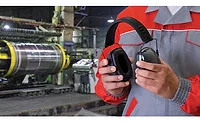
Hearing protection devices (HPDs), such as earmuffs and plugs, are generally used during the time necessary to implement engineering or controls, when such controls are not feasible, or when worker’s hearing tests indicate significant hearing damage.
Hearing conservation program
Employers in general industry must implement a hearing conservation program whenever worker noise exposure is equal to or greater than 85 dBA for an 8-hour exposure. Employers in the construction industry need to put a program in place when exposures exceed 90 dBA for an 8-hour exposure. Key elements of an effective hearing conservation program should include:
- Workplace noise sampling including personal noise monitoring that identifies which employees are at risk from hazardous levels of noise.
- Informing workers at risk from hazardous levels of noise exposure of the results of their noise monitoring.
- Providing affected workers or their authorized representatives with an opportunity to observe any noise measurements conducted.
- Maintaining a worker audiometric testing program (hearing tests), which is a professional evaluation of the health effects of noise upon an individual worker's hearing.
- Implementing comprehensive hearing protection follow-up procedures for workers who show a loss of hearing (standard threshold shift) after completing baseline (first) and yearly audiometric testing.
- Proper selection of hearing protection based upon individual fit and manufacturer’s quality testing indicating the likely protection that they will provide to a properly trained wearer.
- Evaluate the hearing protector’s attenuation and effectiveness for the specific workplace noise.
- Training and information that ensure workers are aware of the hazard from excessive noise exposures and how to properly use the protective equipment provided.
- Data management of and worker access to records regarding monitoring and noise sampling.
Looking for a reprint of this article?
From high-res PDFs to custom plaques, order your copy today!