Back-of-hand protection
Sonic welding, heat pressing & foam tech are latest trends
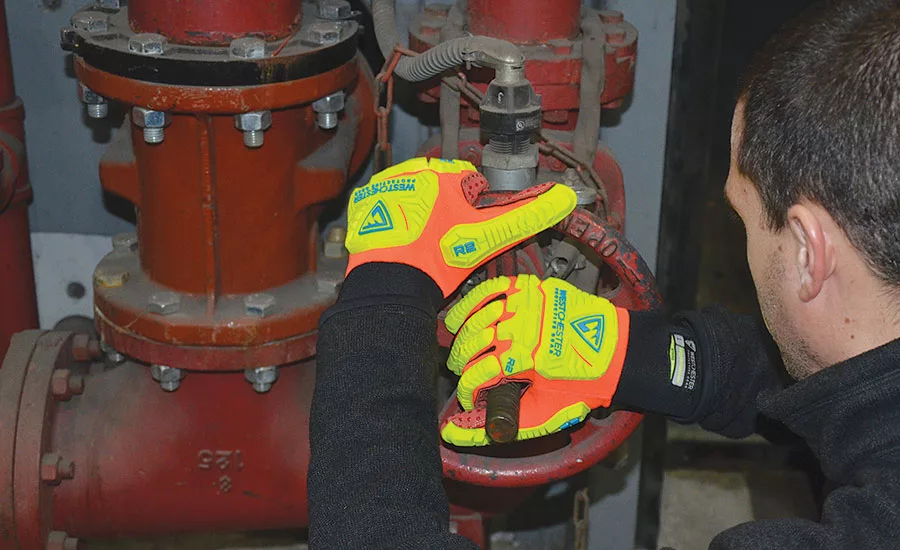
About eight years ago, thermoplastic rubber (also known as TPR) revolutionized the hand safety industry. For the first time, this sturdy yet lightweight and flexible material was adhered to gloves to protect the back of the hand from impact. It was a groundbreaking step forward in safety.
We’ve come a long way since then, with continued innovations and improvements in the way that gloves protect hands from impact hazards, pinch points and crush zones. In this article, we will discuss some of the recent trends in back-of-hand protection, and the impact they are having in the marketplace.
Heat pressing enhances comfort
Originally, TPR was added to cut-and-sew gloves and sold primarily to the oil and gas industry. The TPRs are stitched on using high-calibration machines and skilled workers to make sure the thread doesn’t go through the shell of the glove. More recently, TPR was added to seamless dipped/coated gloves. Because these gloves are more form fitting and are made from an unknitted material, the stitching can be felt on the inside and cause chaffing and irritation.
One advancement in the past few years has been the use of sonic welding or heat pressing to attach TPR to dipped/coated gloves. The benefit of sonic welding and heat pressing is that there is no stitching to cause irritation; workers can comfortably wear the same glove all day long. For workers in many industries, such as mining, where workers don’t swap out gloves frequently, this improvement in comfort is a benefit.
Sonic welding uses high-frequency acoustic vibrations to join dissimilar materials without stitching or other adhesives. The high-frequency sound waves vibrate the seams of the plastic and cause friction and high, focused heat. This heat adheres the properties of the TPR onto the shell of the glove. The process is clean and allows for a strong, nearly unbreakable bond. Because sonic welding requires expensive equipment and a highly skilled workforce, not all manufacturers employ it. Heat pressing is a similar technology where heat-activated adhesives are used to fuse the TPR onto the glove without stitching.
Available for more industries
Today, we see TPRs being added to other materials as well, including leather, Lycra/spandex, and even engineered yarns like HPPE. In most cases, the ability to adhere the TPR to different materials is a process of trial and error to figure out the most effective adhesive solutions.
The benefit of adding TPR to other types of gloves is that back-of-hand protection is available for all sorts of applications. No longer is TPR relegated to heavy duty work on rigs. Gloves with back-of-hand protection are becoming increasingly common in the electrical, automotive and construction industries. Even multi-purpose gloves are available with TPR today. Workers in all kinds of industries are faced with being struck by a stationary or falling object, being caught in/under an object, or being bumped in tight confined spaces – now comfortable back-of-hand protection is contributing to enhanced compliance and improved safety.
TPR is getting thicker, yet more supple
TPR used to come in one size fits all. They were all about 4-5 mm and were all considered to be heavy-duty. Today, we can find TPRs in various thicknesses, from a low-profile TPR that is 4 mm to a high-profile TPR that is 7 mm. The thicker the TPR, the greater the protection from impact, within limits.
You might think that thicker TPRs would be less flexible, but that is not necessarily so. Some manufacturers have developed proprietary formulations to make them suppler and softer, while not diminishing the level of protection. The noticeable difference is weight. Thicker TPR is heavier. You might not even notice the thinner TPRs on your glove. The shape of the TPRs, too, can make a difference in the bendability and flexibility of the glove. You can now select the level of protection and flexibility that is right for the job, and the budget.
Extending coverage for greater protection
Originally, TPR was designed to provide knuckle padding and some finger padding. Today, TPRs are created that provide full coverage for the back of the hand. There are TPRs on the back of hand to protect the metacarpals, as well as TPRs going all the way down the fingertips. Fingertips are especially at risk for pinching; this extended coverage promises a great step forward in protection. It also allows you to select the appropriate coverage needed.
Using air-infused foam for chemical gloves
One new innovation in back-of-hand protection is a new air-infused foam technology employed in chemical gloves. In this application, the foam is injected directly into the glove and becomes an integral part of the glove. The impact protection lasts the life of the glove, even in the harshest chemical and biohazard environments. This is one of the first non-TPR technologies to be introduced to the market for back-of-hand protection in quite a while.
A win-win: Comfort leads to compliance culture
The Journal of Occupational and Environment Hygiene reported 80 percent of workers who experienced hand injuries weren’t wearing gloves, and that wearing gloves lowers the risk of injury by 60 percent. Companies are learning when gloves are more comfortable and effective, it is easier to improve the safety culture and compliance.
For instance, one major oil company established a zero-hand-injuries initiative that reduced hand injuries 84 percent between 2008 and 2012. An aerospace company also established a similar program with an initial goal to reduce hand injuries by 75 percent by 2018 through the use of the right glove for the job.
New advances and gloves are making back-of-hand protection benefits available in more industries for more workers than ever, with greater flexibility in the type of protection offered – and at lower price points. With these changes and others, establishing lofty “no injury” safety goals is a reality in the present, not only science fiction.
Looking for a reprint of this article?
From high-res PDFs to custom plaques, order your copy today!