OSHA Permit-required confined space 1910.146
History
The Final Rule for Permit-Required Confined Spaces was published in the Federal Register on January 14, 1993, and became effective on April 15, 1993.
Scope
The standard applies to all general industry places of employment. Among them are Agricultural services, Manufacturing, Transportation and Utilities, Wholesale Trade, Food Stores, Hotels and Other Lodging, Health Services, Museums, Botanical Gardens and Zoos to name a few.
On May 4, 2015, OSHA published a separate standard for confined spaces in construction.
Why this standard is important
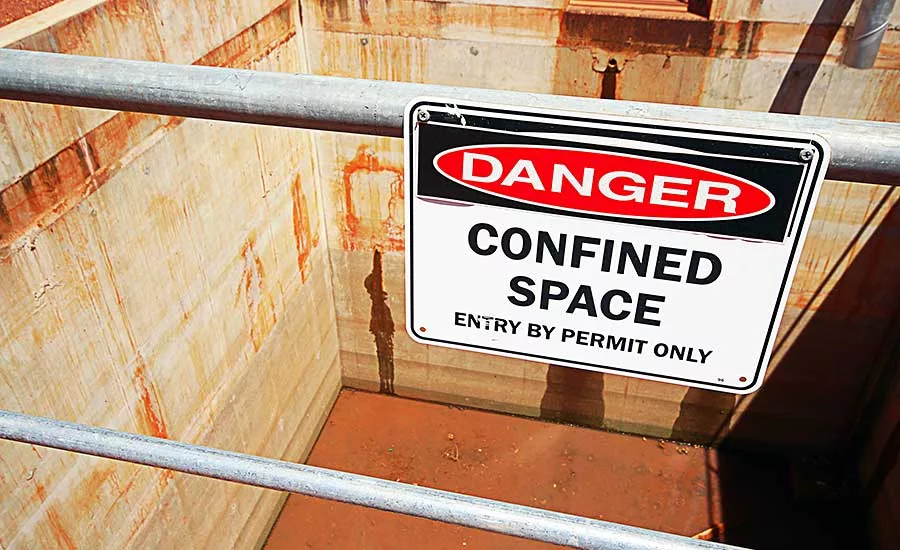
Many workplaces contain spaces which are considered "confined" because their configurations hinder the activities of any employees who must enter, work in, and exit them. For example, employees who work in process vessels generally must squeeze in and out through narrow openings and perform their tasks while cramped or contorted. For the purposes of this rulemaking, OSHA is using the term "confined space" to describe such spaces.
In addition, there are many instances where employees who work in confined spaces face increased risk of exposure to serious hazards. In some cases, confinement itself poses entrapment hazards. In other cases, confined space work keeps employees closer to hazards, such as asphyxiating atmospheres or the moving parts of a mixer, than they would be otherwise.
Hazards
Asphyxiation is the leading cause of death in confined spaces. The asphyxiations that have occurred in permit spaces have generally resulted from oxygen deficiency or from exposure to toxic atmospheres.
The failure to take proper precautions for permit space entry operations has resulted in fatalities, as opposed to injuries, more frequently than would be predicted using the applicable Bureau of Labor Statistics models. Many confined spaces are poorly ventilated — a condition that is favorable to the creation of an oxygen-deficient atmosphere and to the accumulation of toxic gases.
Key Definitions
Permit-required confined spaces are confined spaces that:
- May contain a hazardous or potentially hazardous atmosphere.
- May contain a material which can engulf an entrant.
- May contain walls that converge inward or floors that slope downward and taper into a smaller area which could trap or asphyxiate an entrant.
- May contain other serious physical hazards such as unguarded machines or exposed live wires.
- Must be identified by the employer who must inform exposed employees of the existence and location of such spaces and their hazards.
You may be able to reclassify a permit-required confined space to non-permit space status if you can permanently eliminate the hazards affecting the space.
General Requirements
In general, the Permit-Required Confined Spaces Standard requires that you, the employer, evaluate the workplace to determine if any spaces are permit-required confined spaces. If permit spaces are present, and your workers ever are authorized to enter such spaces, you must develop and implement a comprehensive permit spaces program, which is an overall plan/policy for protecting employees from permit space hazards and for regulating employee entry into permit spaces.
Enforcement Statistics (October 2015 – September 2016)
Citations: 386
Inspections: 174
Penalties: $1,092,443
Most cited industries
- Food Manufacturing
- Merchant Wholesalers, Nondurable Goods
- Nonmetallic Mineral Product Mfg.
- Fabricated Metal Product Mfg.
- Electrical Equipment, Appliance and
- Component Mfg.
Procedures for Atmospheric Testing in Confined Spaces
Evaluation testing: The atmosphere within a confined space must be tested using equipment that is designed to detect the chemicals that may be present at levels that are well below the defined exposure limits. Evaluation testing is done to:
- determine what chemical hazards are or may become present in the space's atmosphere, and
- identify what steps must be followed and what conditions must be met to ensure that atmospheric conditions are safe for a worker to enter the space.
The testing results and the decisions about what steps must be followed before entry must be evaluated by, or reviewed by, a technically qualified professional like an OSHA consultation service, a certified industrial hygienist, a registered safety engineer, or a certified safety professional. The technically qualified professional must consider all of the serious hazards in his/her evaluation or review.
A permit space is a confined space that has one or more of the following features: it has or may contain a hazardous atmosphere; it contains a material that can engulf a person who enters; it has an inside design that could trap or asphyxiate a person who enters (inwardly converging walls, or a floor that slopes downward to a smaller section); or it has any other serious safety or health hazards.
Verification Testing: Before a permit space that may have a hazardous atmosphere can be entered, the atmosphere must be tested using the steps identified on the permit (developed during evaluation testing). Verification testing is done to make sure that the chemical hazards that may be present are below the levels necessary for safe entry, and that they meet the conditions identified on the permit. Test the atmosphere in the following order: (1) for oxygen, (2) for combustible gases, and then (3) for toxic gases and vapors. The testing results -- the actual test concentrations -- must be recorded on the permit near the levels identified for safe entry.
Duration of Testing: For each test required on the permit, you must allow enough time for the air from the space to be drawn into the equipment and for the sensor (or other detection device) to react to the chemical if it is present. This is considered the "minimum response time" and it will be noted by the manufacturer in the operator's manual. Be aware that you will need to add time to this "minimum response time" if you have attached hosing or a probe extension to the inlet. The additional time is needed to allow the air from the different depths of the space to be pulled into the equipment inlet.
Testing Conditions in Spaces that May Have Layered Atmosphere: For permit spaces that are deep or have areas leading away from the entry point, the atmosphere may be layered or may be different in remote areas. For these spaces, testing must be done in the area surrounding the worker, which is considered four feet in the direction of travel and to each side. If a sample probe is used to do the testing, then the worker must move slowly enough so that testing is completed, keeping the equipment "response time" in mind, before he/she moves into the new area.
Retesting the Space During Entry or Before Re-Entry: Test the permit space routinely to make sure that the atmospheric conditions continue to be safe for entry.
Compliance Assistance
- Confined Spaces Advisor. OSHA. Provides an interactive expert help for the Permit-Required Confined Spaces Standard (29 CFR 1910.146). Assists users in identifying confined spaces and deal with permit-required confined spaces.
- Permit-required Confined Spaces. OSHA QuickCard™ 3214, (2006). Also available in Spanish.
- Procedures for Atmospheric Testing in Confined Spaces. OSHA Fact Sheet, (September 2005).
- Confined Spaces. National Institute for Occupational Safety and Health (NIOSH) Workplace Safety and Health Topic.
Sponsor: www.indsci.com, 1-800-DETECTS (338-3287)

Looking for a reprint of this article?
From high-res PDFs to custom plaques, order your copy today!