ISHN logo
search
cart
facebook twitter linkedin youtube
  • Sign In
  • Create Account
  • Sign Out
  • My Account
ISHN logo
  • NEWS
    • Today's News
    • Global Safety News
    • Government Regulations
  • PRODUCTS
    • Product Innovations
    • Featured Products
  • TOPICS
    • Environmental Health and Safety
    • Facility Safety
    • Workplace Health
    • Occupational Safety
    • PPE
    • More Topics
  • CONSTRUCTION
  • TECHNOLOGY
  • COLUMNS
    • Best Practices
    • Dave Johnson: What’s going on
    • Editorial Comments
    • Leading Safety
  • MULTIMEDIA
    • ISHN Podcast
    • Videos
    • Cold Stress Education Quiz
    • Webinars
    • White Papers
  • MORE
    • Buyer's Guide
    • Newsletters
    • Convention Companion
    • Polls
    • Events
    • ISHN Store
    • Sponsor Insights
  • EMAGAZINE
    • eMagazine
    • Archived Issues
    • Contact
    • Advertise
  • JOIN TODAY!

It’s important to evaluate COF to determine footwear’s slip resistance
By Robert Petersen
It’s important to evaluate COF to determine footwear’s slip resistance
January 25, 2017

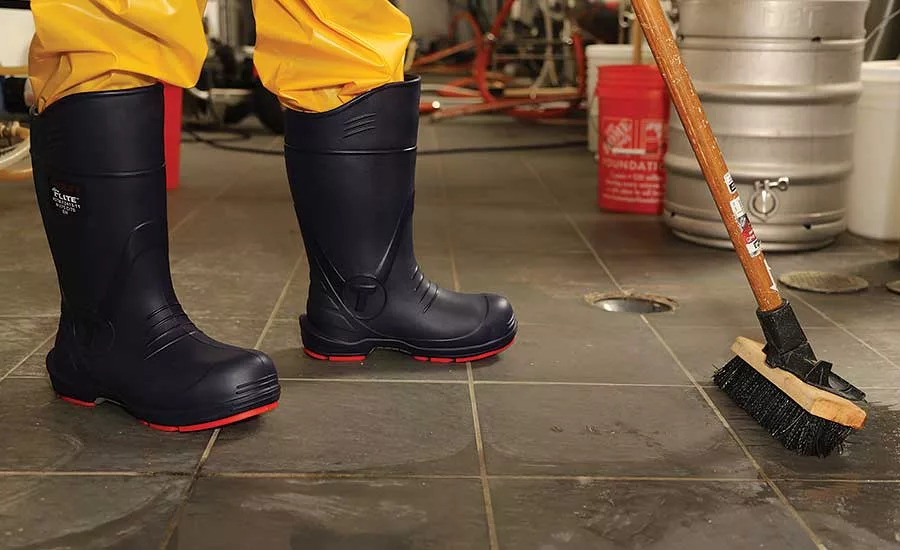
Designing safety footwear that reduces the risk of slips, trips and falls should be a key objective for footwear manufacturers. At the time of this writing, no U.S. government agency mandates performance specifications, nor is there any industry consensus defining slip resistance for PPE footwear in the US. That’s astonishing when one considers that OSHA states that slips, trips, and falls constitute the majority of general industry accidents, cause 15 percent of all accidental deaths, and are second only to motor vehicle accidents as a cause of fatalities. Because there are so many factors that affect slips, trips, and falls, a major area of developmental focus for manufacturers is to assess the coefficient of friction (COF) for footwear under laboratory settings for several different conditions.

Determining a COF

To be clear, a coefficient of friction is not technically the same as slip resistance, although the terms are frequently used interchangeably. Slip resistance is defined in ASTM (American Society for Testing and Materials) F1646, a terminology standard, as “the relative force that resists the tendency of the shoe or foot to slide along the walkway surface.”

A COF, on the other hand, is the ratio of the frictional force between two bodies and the force pressing them together. At the risk of oversimplification, a COF can be calculated under controlled laboratory conditions; slip resistance involves a complex interplay of factors including the walkway surface conditions and pitch, the footwear tread pattern, the walking gait of the individual, and the presence of foreign materials on the floor surface, to name a few. The focus on coefficients of friction to assess slip resistance stems from the fact that the COF and the force required to slide an object are directly proportional -- the greater the COF the greater the resistance to sliding.

Determining a COF means calculating the ratio of the frictional force between two objects and the force pressing them together. Coefficients of friction can be determined for either static or dynamic friction. Static coefficients of friction are a measure of how much force is required to move a stationary object; dynamic or kinetic coefficients of friction are a measure of how much force is required to keep a sliding object sliding. Because most slips occur during walking, a key factor in designing slip-resistant footwear is testing that can accurately measure the dynamic COF under a variety of conditions.

The historical lack of a performance specification establishing a minimum COF for footwear has not been due to the inability to calculate a COF or for lack of trying, given that the ASTM has introduced (and then withdrawn) test methods that attempted to standardize the process and ensure reproducibility. Rather the problem has been the inability to assess a dynamic COF, accurately and precisely, with repeatability from one laboratory to another.

2011 ASTM standard

In 2011 the ASTM published F2913-11, Standard Test Method for Measuring the Coefficient of Friction for Evaluation of Slip Performance of Footwear and Test Surfaces/Flooring Using a Whole Shoe Tester. It is the latest standard test method on this topic and provides an excellent means of assessing dynamic coefficients of friction, and by extension, for ultimately producing slip resistant footwear.

Unlike prior methodologies, ASTM F2913-11 determines the dynamic COF between footwear and floor contaminants under reproducible laboratory conditions. It is applicable to all types of footwear, to most types of indoor floorings, and it allows testing of various flooring surface contaminants. Plus, the testing must involve three separate modes to determine the dynamic COF in three specific areas that attempt to mimic a walking gait. The three modes are:

  • Forward Heel Slip: Assess the COF at the critical “heal strike” of the gait
  • Forward Flat Slip: Assess the COF at the midstance of the gait
  • Backward Slip on the Forepart: Assesses the COF at the “toe off” of the gait

Clear direction

The science of producing slip-resistant footwear continues to advance with new materials and innovative outsole tread patterns. A defined, reproducible test method of assessing the dynamic coefficient of friction for the whole shoe under a variety of conditions and in modes that simulate a walking gait exists in ASTM F2913-11. Future steps in the right direction would be to recognize the ASTM F2913 standard test method in the establishment of minimum coefficient of friction values for defined conditions and the incorporation of those COF minimums into an ASTM standard performance specification for safety footwear. Such actions would establish a clear direction for manufacturers to assess the use of materials and designs to give consumers the highest probability of avoiding costly slip and fall injuries. 

KEYWORDS: Fall Protection Foot Protection slips, trips and falls

Share This Story

Looking for a reprint of this article?
From high-res PDFs to custom plaques, order your copy today!

Robert Petersen is the Footwear Product Manager for Tingley Rubber Corporation, a company where footwear and apparel of superior quality, comfort and durability has been a passion since 1896. Today, Tingley offers a full line of products for work, casual, and outdoor lifestyles. .

For more information visit tingleyrubber.com.

Recommended Content

JOIN TODAY
to unlock your recommendations.

Already have an account? Sign In

  • forklift safety

    Exploring the latest technologies in forklift safety

    With more staff and more stock in warehousing now more...
    Facility Safety
    By: Josh Cramer
  • welding

    All about welder’s flash or arc eye

    A flash burn is a painful inflammation of the cornea,...
    Environmental Health and Safety
  • dangerous jobs

    The 10 most dangerous jobs in the U.S.

    On-the-job deaths have been rising — hitting the highest...
    Transportation Safety
    By: Benita Mehta
Manage My Account
  • eMagazine Subscriptions
  • ISHN Newsletter & Other Newsletter Alerts
  • Online Registration
  • Manage My Preferences
  • Subscription Customer Service

More Videos

Sponsored Content

Sponsored Content is a special paid section where industry companies provide high quality, objective, non-commercial content around topics of interest to the ISHN audience. All Sponsored Content is supplied by the advertising company and any opinions expressed in this article are those of the author and not necessarily reflect the views of ISHN or its parent company, BNP Media. Interested in participating in our Sponsored Content section? Contact your local rep!

close
  • man wearing the the Sundström SR200 Full Face Mask Respirator
    Sponsored byOHD

    5 Fit Testing Mistakes That Could Cost You

  • This image shows Magid AcuSpex polarized blue mirrored safety glasses.
    Sponsored byMagid Glove and Safety

    Construction PPE Guide: What Crews Need for Each Task

  • lone worker in confined space
    Sponsored byAlphasense Ltd.

    GET THE LEAD OUT of your Safety Oxygen Sensors!

Popular Stories

SpaceX 7 launch

OSHA Investigating Fatal Fall at SpaceX Starbase

dust explosion

Tennessee OSHA Issues Record $3.1M Fine After Deadly Explosion at Munitions Plant

Worker Impairment

How to Tell When a Co-Worker is Impaired? A Safety Pro’s Challenge

top 10 most dangerous jobs

Poll

Seasonal Readiness

With the federal heat stress prevention rule on the horizon, which area of your safety program needs the most attention?
View Results Poll Archive

Products

Surviving an OSHA Audit A Management Guide, 2nd Edition

Surviving an OSHA Audit A Management Guide, 2nd Edition

See More Products

ISHN Podcasts

Related Articles

  • It’s important to evaluate COF to determine footwear’s slip resistance

    It’s important to evaluate COF to determine footwear’s slip resistance

    See More
  • ISHN0417_F7_pic.jpg

    It’s important to be hands-free when climbing to at-heights work

    See More
  • 06107_F23_pic.jpg

    Climate control PPE: It’s important to prevent heat-related illness

    See More
×

Become a Leader in Safety Culture

Build your knowledge with ISHN, covering key safety, health and industrial hygiene news, products, and trends.

JOIN TODAY
  • RESOURCES
    • Advertise
    • Contact Us
    • Directories
    • Manufacturing Division
    • Store
    • Want More
  • SIGN UP TODAY
    • Create Account
    • eMagazine
    • Newsletters
    • Customer Service
    • Manage Preferences
  • SERVICES
    • Marketing Services
    • Reprints
    • Market Research
    • List Rental
    • Survey/Respondent Access
  • STAY CONNECTED
    • LinkedIn
    • Facebook
    • YouTube
    • X (Twitter)
  • PRIVACY
    • PRIVACY POLICY
    • TERMS & CONDITIONS
    • DO NOT SELL MY PERSONAL INFORMATION
    • PRIVACY REQUEST
    • ACCESSIBILITY

Copyright ©2026. All Rights Reserved BNP Media, Inc. and BNP Media II, LLC.

Design, CMS, Hosting & Web Development :: ePublishing