Traumatic machinery accidents carry a heavy price tag
Machine guarding math
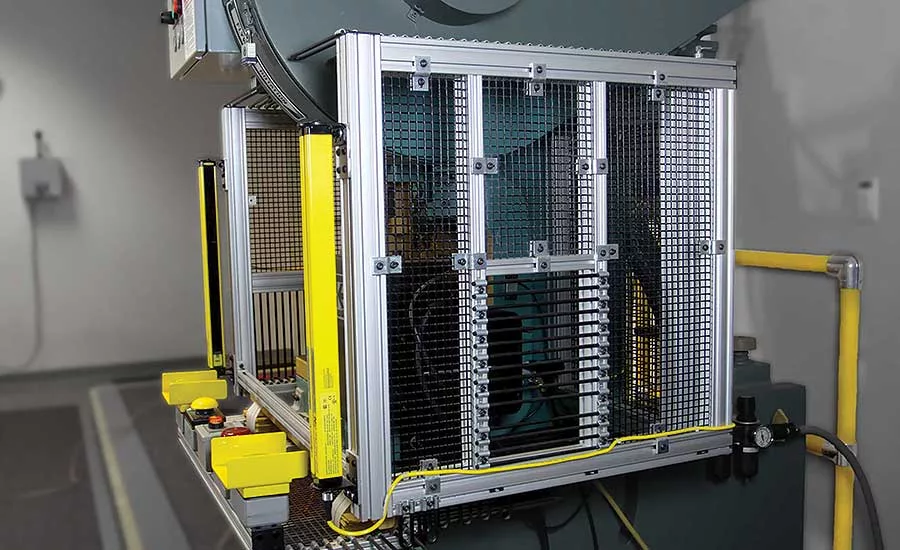
In the United States, workers operating or maintaining industrial machinery suffer more than 18,000 amputations, crushed fingers and other traumatic injuries each year. While these injuries vary greatly, the majority of cases do have one thing in common: the injury was largely preventable if machine safeguarding equipment had been in-place, or would have been far less severe.
Many employees, unions and worker advocates may well ask, “Why do we need a safeguarding business case at all?” Don’t employers have a responsibility for providing a safe and healthful workplace for their employees? Although U.S. organizations understand that machine safeguarding is the law and that protecting human life is socially responsible, each company must answer the return on investment question their own way. Where does safeguarding fit into a business strategy? Can safeguarding be quantified by using cost-benefit financial analysis? To get to those answers we need to look at both sides of the ledger, comparing the cost of an accident versus the cost of preventing it.
What does a machine accident cost?
Insurance studies indicate machine safeguarding provides an opportunity for businesses to reduce bottom-line operating costs by eliminating both the direct and indirect costs of an accident, while improving productivity and employee morale. But just how much can be saved? Liberty Mutual reported in its annual Workplace Safety Index that U.S. employers spend $48.6 billion for wage and productivity losses, medical expenses and administrative expenses for workers hurt on the job. This is roughly equivalent to the annual sales of Cisco, Pfizer or FedEx. A study by Colorado State University set the total direct and indirect cost of workplace injuries at a staggering $128 billion.
Direct costs of an accident refer to out-of-pocket expenses like hospital and medical bills. They also include the loss of a worker's time because of the accident, the lost productivity by the machine involved in the accident being idled or requiring repairs, as well as the other machines further down the production line being shut down. Costs continue to cascade throughout the company with overtime required to make up the lost productivity and new workers who need to be hired and trained. The National Safety Council (NSC) estimates that lost-time alone associated with the average injury costs nearly $30,000.
Analysis of most accidents reveal that the actual total cost can range from four to ten times the visible, direct cost stated by an insurance company. For example, a single accident can result in OSHA fines up to $100,000 per machine or more if the violation is found to be willful. In 2010, 24 percent of OSHA's Top 10 citations for manufacturing dealt with machine guarding violations, resulting in more than $6 million in proposed penalties. In addition, insurance rates can rise dramatically or coverage can be dropped entirely. Investments targeted for company growth may need to be diverted to cover the costs of the accident. Finally, there are the legal fees, plus management time spent dealing with regulators and attorneys.
And while it is not calculated as an indirect cost, a poor safety record can make the difference between a company winning and losing bids, especially with government contracts. A plant with a singularly bad reputation for safety may also find itself unable to attract workers at all or may have to pay wages well above market value to do so.
Do the math
OSHA’s $afety Pays website (www.osha.gov/dcsp/smallbusiness/safetypays) makes it easy for organizations to calculate direct and indirect costs of an accident. As an example, let's assume a fictional company with annual sales of $5 million and an 8 percent pre-tax profit margin has an accident involving an employee whose hand got entangled in a drill press.
By using insurance company claims data, $afety Pays can calculate that the crushing accident will cost that company, on average:
- Direct Cost: $56,557
- Indirect Cost: $62,212
- Estimated Total Cost: $118,769
By entering profit margin information, $afety Pays will also project the additional sales required to recover the costs of the injury. In this instance, additional sales revenue necessary to cover costs is $1,484,612 based on the 8% profit margin or approximately one third of annual sales. If pre-tax margins are less, the sales impact is even greater.
On the other side of the ledger is the cost to safeguard the machine involved in the accident. For the purpose of this discussion, let’s assume that the same fictional company had an onsite risk assessment performed by a reputable firm that surveyed ten machines on the plant floor at a cost of $5,000, or $500 per machine. Next, assume that the drill press had been safeguarded per ANSI standards at a total cost of $1,000. Adding in its prorated share of the risk assessment, total cost to safeguard the drill press would be $1,500, a figure that compares very favorably to the estimated $118,769 cost of the accident.
Human capital as ROI
A poll by Liberty Mutual Group insurance showed that the majority of executives surveyed (61 percent) reported that for every one dollar spent on safety, three dollars is saved. And nearly all (95 percent) said workplace safety had a positive effect on financial performance. OSHA estimates a 6:1 ratio for saved dollars for every one dollar invested in safety, twice Liberty Mutual's 3:1 ratio.
Of course, if a company could be guaranteed a huge return on their safety investment, more than half the machines in the United States today would not be operating unprotected. Convincing upper management to commit tens of thousands of dollars on machine safeguarding when a return may not be seen for years can be a hard sell. In this situation, safety professionals should stress that although cost savings are a motivator, safety’s biggest ROI comes in the form of human capital. Money savings from fewer injuries, increased productivity, and higher morale are all additional benefits.
Conclusion
Whether driven by the law or social responsibility or a positive ROI, most organizations embark on a quest to make their workplaces safe. Considering all decision criteria, the business case for machine safeguarding is solid. By comparing the installation cost of safeguarding over the productive life of a machine versus the direct and indirect costs of even a single accident, it becomes clear that safeguarding makes sound business sense and should be a cornerstone of an organization's safety goals and objectives.
Looking for a reprint of this article?
From high-res PDFs to custom plaques, order your copy today!