Robotic welding issues and challenges
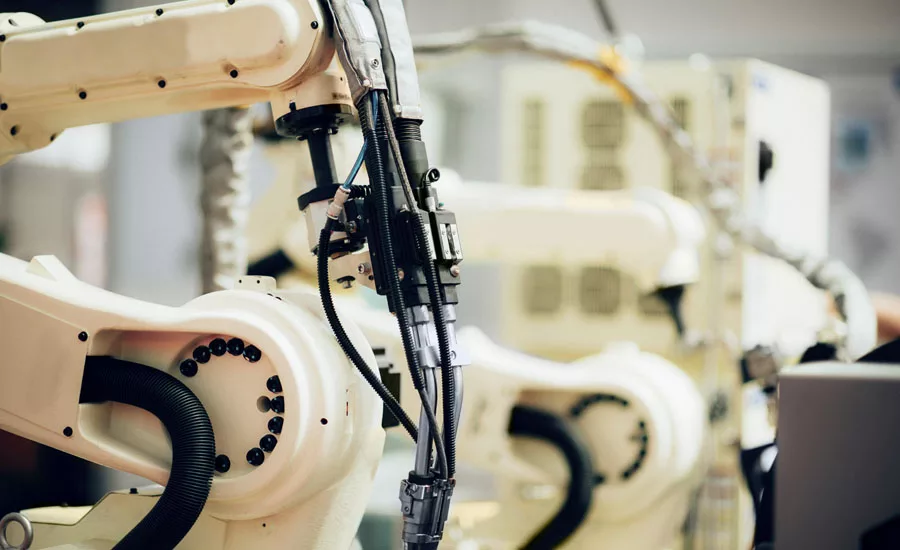
Robotic welding is been a complex process that requires four key factors to be profitable for a company:
- A high volume of parts
- A highly repetitive welding task
- An in-house programming expert to set the application
- In-house welding knowledge to fine-tune the robot welding settings
Although robotic welding applications have been profitable for large manufacturers that produce a high volume of parts, things are different for medium-size and job shop businesses. Frequently these manufacturers lack the four factors to make robotic welding effective and profitable.
Small-scale manufacturers often say that programming a welding robot takes longer than the time needed to produce the parts. Automating welding for low-volume production runs does not necessarily give the best immediate return on investment, but it becomes crucial when they are looking at industry and labor trends.
The skilled-employee shortage is a major problem for industrial manufacturing. According to the American Welding Society, 40 percent of manufacturing companies declined new contracts because not enough skilled workers were available.
Lack of flexibility is cited as the major reason 90 percent of all manufacturing companies do not have robotic systems. (Source: National Institute of Standards and Technology)
When skilled employees are hard to recruit and retain, it is essential to automate welding processes. As labor costs rise, the investment in automation accelerates ROI and improves a company’s competitive position.
Intuitive teaching was developed to simplify the process of programming a robot to weld, which makes it easier for job shops to justify purchasing a robotic welding cell. It also reduces the time to program a part, making it practical to automate smaller lot sizes typical of job shop production.
Traditionally, programming a robot involves one of two possible approaches, teach pendant and offline programming.
Teach pendant programming involves moving the robot to each point of its trajectory using 12 of the teach pendant buttons (one per direction and per axis). This requires the operator to select the appropriate coordinate frame (joint, robot, tool, or user), which defines the direction in which the robot will move when a button is pressed. He manually sets the speed, for example when moving the robot from one point to the other and when the position needs to be set precisely.
It is important to verify that the frame, direction, and speed are set appropriately before moving the robot, especially when the tool is located near a rigidly fixed object (which is always the case in welding applications). Moving in the wrong direction often leads to tool-damaging collisions.
In addition to moving the robot through the points defining the trajectory, the operator must learn a robot brand-specific programming language and enter these instructions in a text file using the teach pendant. If positioning the robot presents a challenge, navigating through all the possible instructions within the teach pendant also can be a difficult, time-consuming task.
Offline programming consists of loading specialized software, the robot cell, and the parts that need to be welded. The programmer can generate the robot trajectory on the computer and may have the aid of some automatically generated paths. Weld instructions must be inserted to produce the program to load in the robot controller.
This approach requires extreme precision in the definition of the robot cell (robot position, tool geometry, worktable shape and position), as well as the manufactured part and the jigs used to fix the part to the table. Any error in these definitions could result in a bad trajectory or a collision during run-time. This often means having to make modifications in the field with the teach pendant (the first approach described). Also, a CAD file is required to detect all possible obstacles in the robot cell to foresee possible collisions.
These two teaching methods require a high level of expertise and expensive programming tools. Even for expert users, the time required for programming the path makes these approaches cost-efficient only for producing approximately 100 units or more. The consequence of these limitations is that very few job shops that produce low volumes have robotic applications.
Intuitive teaching is a new method that builds on a welder’s knowledge by greatly reducing the programming acumen required to teach a task to a robot. Through an add-on, welders or operators can hand-guide the robot and program welding tasks by selecting sequence options via an icon-based touchscreen interface on the teach pendant.
With this technology, the operator moves the robotic welding tip next to a workpiece by physically hand-guiding the robot. Once the welding point is reached, he selects a procedure through a touchscreen interface. After all the points are recorded, the welder can review the programmed trajectory, modify it as needed, and proceed to weld.
Experienced welders can set welding jobs and oversee more than one robotic welder at a time. They also can train less-skilled personnel to program the welding robot and act as a technical adviser and a quality assurance resource. They can quickly program the robot for simple jobs, while using their expertise on the more complex tasks.
Source: The Fabricator www.thefabricator.com
Looking for a reprint of this article?
From high-res PDFs to custom plaques, order your copy today!