Dusts, fumes & mist: How to control beryllium exposures
OSHA has issued a final rule that updates regulation established 40 years ago to prevent chronic beryllium disease and lung cancer in American workers by limiting their exposure to beryllium and beryllium compounds. The new rule will reduce the permissible exposure limit and establish a new short-term exposure limit. It will also require employers to use engineering and work practice controls to limit exposure.
The new rule, which currently has an effective date of May 20, 2017, contains standards for general industry, construction and shipyards. This article focuses on the standard for general industry and highlights the most important aspects of the new standard; means of exposure and hazardous health effects; how to determine risk; and the use of high efficiency dust, fume and mist collection as a recognized engineering control to achieve compliance and keep workers safe.
What is beryllium and how it is used in industry?
Beryllium is a lightweight but extremely strong metal used in the aerospace, defense, telecommunications, automotive, electronics and medical specialty industries. Beryllium-copper alloys are widely used because of their electrical and thermal conductivity, hardness and good corrosion resistance. Welding provides the highest strength bond when joining copper beryllium to itself or to other metals.
Another form is beryllium oxide, which provides heat conductivity, high strength and hardness and electrical insulation. Pure beryllium metal is used in a range of products such as X-ray transmission windows, nuclear reactor neutron reflectors, precision instruments and computers.
How are workers exposed to beryllium?
Exposures occur when beryllium and beryllium-containing materials are processed in a way that releases airborne beryllium dust, fume or mist into the workplace air. Occupational exposure to beryllium can also occur from skin, eye and mucous membrane contact with beryllium particulate or solutions.
What are the health risks of beryllium?
Inhaling or contacting beryllium can cause an immune response that results in an individual becoming sensitized to beryllium. Individuals with beryllium sensitization are at risk for developing a debilitating disease of the lungs called chronic beryllium disease (CBD) if they inhale airborne beryllium after becoming sensitized. Beryllium-exposed workers may also develop lung cancer.
Key provisions and significant aspects
Facilities affected by the standard must comply with most of the requirements by March 12, 2018, which is one year from the original effective date. They have two years to provide any required change rooms and showers and three years to implement engineering controls.
Requirements of the standard: The new rule reduces the OSHA permissible exposure limit (PEL) for beryllium to 0.2 micrograms per cubic meter of air (µg/m3) over an eight-hour time-weighted average (TWA) work shift. It establishes a short-term exposure limit (STEL) for beryllium of 2.0 µg/m3 over a 15-minute sampling period. Employers must use engineering and work practice controls to prevent excessive beryllium from becoming airborne where workers can breathe it in.
In addition, they must limit access to high-exposure areas, provide respiratory protection when necessary and provide personal protective clothing when high exposures or skin contact is possible. Employers will also be required to assess exposures, develop and implement written exposure control plans and provide workers with training specific to beryllium. Medical examinations must be available to certain exposed workers.
How to determine if you are compliant
Wherever a process releases airborne beryllium dust, fume or mist into the workplace air, OSHA states employers must assess the airborne exposure of each employee who is or may reasonably be expected to be exposed to airborne beryllium. The rule provides two assessment methods:
Performance option: Employer to assess the eight-hour TWA exposure and the 15-minute short-term exposure for each employee on the basis of any combination of air monitoring data and objective data sufficient to accurately characterize airborne exposure to beryllium.
Scheduled monitoring option: Employer to perform initial monitoring to assess the eight-hour TWA exposure and 15-minute short-term exposure for each employee on the basis of one or more personal breathing zone air samples that reflect the airborne exposure of employees on each shift, for each job classification and in each work area.
Collection systems
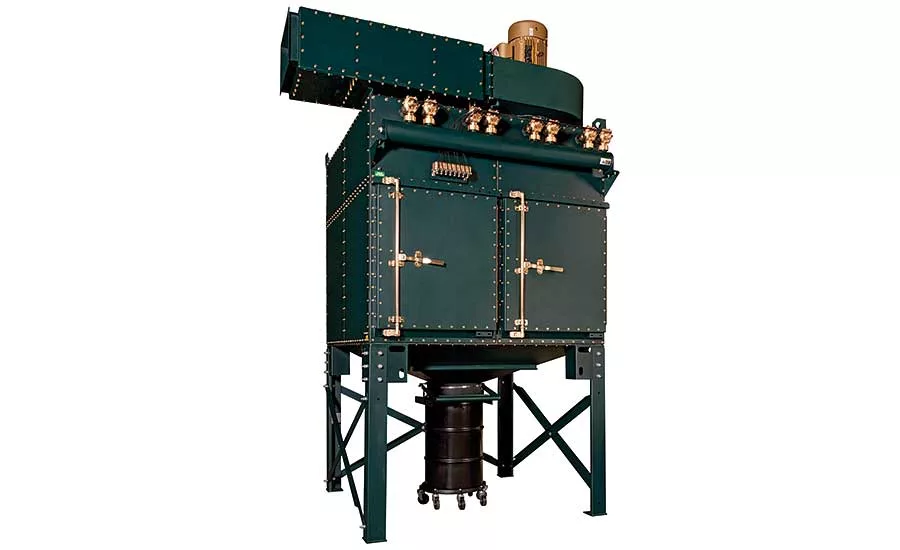
Dry cartridge filtration collection system: A dry cartridge filtration collection system is a recommended engineering control for operations where beryllium dust or beryllium fume is created. Because OSHA's beryllium PEL of 0.2 micrograms per cubic meter of air is an extremely low acceptable level, reaching compliance will include using higher efficiency primary cartridge filter media and a secondary HEPA filter system. Applications that include light loading dry dust can utilize PTFE membrane coated filter media (EN filter class E10/85 percent on MPPS) for the primary filters. For applications with heavier loading, a high efficiency nanofiber media (EN filter class F9) can be a good option.
Secondary filters are recommended for use downstream of the primary filtration system utilizing HEPA filters (EN filter class H13). They are used when handling hazardous dusts, preventing them from discharging to the atmosphere. Currently, designs are available in which the safety filter is mounted on top of the collector, reducing installation costs and saving floor space.
Fume control in welding operations: A well-designed cartridge system will properly filter welding fumes and other hazardous contaminants. These systems use self-cleaning mechanisms that pulse dirt off the filters, allowing units to run for extended periods between changing filters.
Mist collectors: Operations that use metalworking fluids (MWFs) where beryllium is present can cause exposure through mist. There are two general categories of MWFs used in machining processes: water-based (emulsion) and oil-based coolants/lubricants. A high-efficiency mist collector designed especially for removal of wet coolants uses two stages of long-life coarse and fine filter demisters followed by a HEPA secondary filter.
When designing equipment for mist removal, the best solution is a source capture collection system that will contain mist at the machine to keep workers safe from hazardous beryllium emissions and to comply with OSHA's new standard.
References
OSHA National News Release: https://www.osha.gov/pls/oshaweb/owadisp.show_document?p_table=NEWS_RELEASES&p_id=33780
OSHA Final Rule to Protect Workers from Beryllium Exposure: https://www.osha.gov/berylliumrule/index.html
OSHA Final Rule: Occupational Exposure to Beryllium: https://www.osha.gov/pls/oshaweb/owadisp.show_document?p_table=FEDERAL_REGISTER&p_id=27623
OSHA Fact Sheet: Protecting Workers from Exposure to Beryllium and Beryllium Compounds: Final Rule Overview: https://www.osha.gov/Publications/OSHA3821.pdf
OSHA Safety & Health: Beryllium: https://www.osha.gov/SLTC/beryllium/index.html
OSHA Beryllium Rule General Industry Standard: https://www.osha.gov/berylliumrule/GeneralIndustry_Beryllium_Regulatory_text.pdf
OSHA: Medical Surveillance for Beryllium-Exposed Workers: https://www.osha.gov/Publications/OSHA3822.pdf
American Welding Society: Welding Copper and Copper Alloys: https://www.copper.org/publications/pub_list/pdf/a1050.pdf
Looking for a reprint of this article?
From high-res PDFs to custom plaques, order your copy today!