Low-level lifts & aerial platforms: a safe alternative
As safety continues to be a focus on jobsites, companies are turning their attention to low-level access lifts and other aerial work platforms. In addition to offering a safer alternative to ladders, scaffolding and other forms of access, these versatile machines may also enhance productivity, ergonomics, and even green benefits that are increasingly of interest to building owners, facility managers, and machine operators. The following article provides an overview of types of aerial work platforms and some tips on what to consider when selecting a unit to suit the application at hand.
Growing popularity
Low-level access represents a growing category of access equipment, whose popularity rests in the fact that operator hands are free to do work safely at height. This is not the case with ladders, where workers are required to maintain three points of contact, leaving just one hand free to perform a task.
These same pieces of equipment also offer portability benefits. Unlike scaffolding, which takes time to assemble and disassemble, low-level access equipment can be lowered and moved simply from one location to another, making it easy to perform multiple tasks throughout a facility in less time.
Easy to move and store
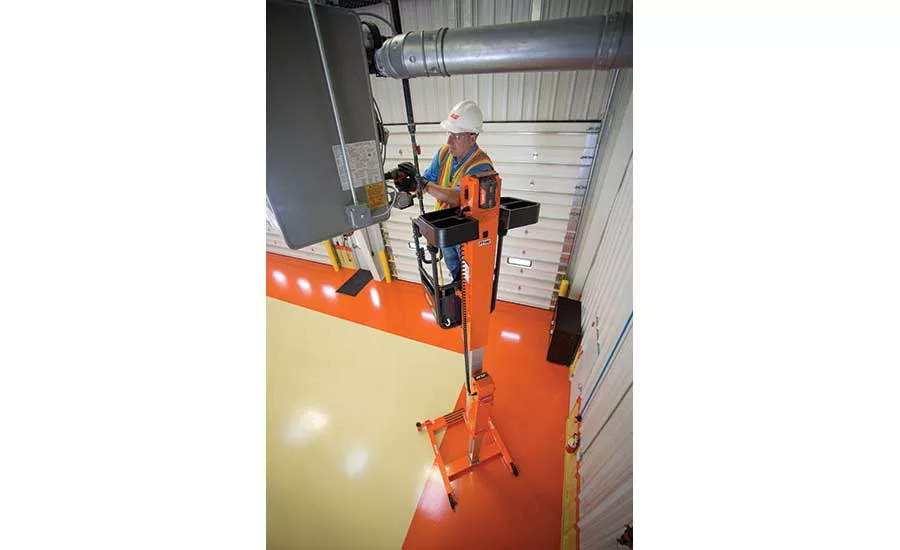
And unlike scaffolding, low-level access equipment is available in a variety of shapes and sizes to maneuver through doorways. Personal portable lifts can allow the operator to work as high as 20 feet and provides a 360-degree range of motion, thanks to an enclosed work platform that allows the operator to work with two hands. Easy to move from one task to another, these lifts can be assembled and disassembled in less than 30 seconds and require very little storage space when not in use.
Non-powered low-level access lifts
The non-powered realm of low-level access lifts includes models that feature a patented stored power lift system that requires no batteries, hydraulics, oil, or controls. Because there are no hydraulics or motors involved, these eco-friendly lifts operate quietly, making them a preferred piece of equipment for finish work in schools, hospitals, and other institutions. In the interest of reduced environmental influence, these units also include non-marking wheels that minimize the impact on sensitive flooring.
Mast-style boom lifts offer over-and-around reach
When additional reach is required, operators may choose from multiple options, beginning with push-around electric mast lifts. These lifts use a jib to reach up, over, and around shelving, ductwork, and other obstacles to perform maintenance, repair, and inspection tasks. The machines have a lifting capacity as high as 500 pounds and a platform height of over 32 feet. They are powered by an environmentally friendly electric-drive system and feature non-marking rubber tires ideal for indoor use. In addition, these models are equipped with a 360-degree rotating mast.
Another option, the articulating boom lift, provides up-and-over access at heights from about 50 feet to as high as 135 feet. These lifts employ a joint or knuckle that enables the boom to bend and reach up, over, and around obstacles. The work platforms on these machines can typically carry up to 500 pounds to accommodate multiple workers, tools, and equipment. They are available in electric-, gas-, and diesel-powered models, as well as a hybrid model that uses electric and diesel or gas, making it suitable for work indoors or outside.
Scissor lifts offer additional capacity
Another option — the scissor lift — is a portable lift with a larger enclosed platform that can be raised straight up. These units are equipped with extensions that typically range from 36 to 50 inches in length for additional work space and the ability to work above an obstacle. With a working height of 21 to 46 feet, which goes beyond that of typical low-level access equipment, and a lift capacity up to 1,000 pounds, these machines are still compact enough to use indoors or outside without having to engage a much larger piece of equipment. For indoor use, electric-powered models ensure a quieter work area, less dependency on hydraulic oils, and zero emissions.
Compact crawler booms move inside and out
Compact crawler booms offer additional reach and a wide range of working heights. Like the scissor lift, the compact crawler lift is larger than true low-level access equipment. But it is compact enough — some models measure just 2 feet 7 inches across — to easily fit through most standard commercial doorways, narrow aisles and hallways, gates, and other tight spaces. The compact crawler boom also uses non-marking treads and rechargeable batteries, making it a good choice for work indoors. Some models offer an optional Lithium-ion electrical system that does not produce emissions, increasing its value as an indoor machine.
Making the right choice
With so many options, the choice of which machine to use for a particular task can be a difficult one for a building owner or facility manager to make. Asking and answering the following questions about the task(s) to be performed and jobsite conditions can help narrow the choices:
- Will the work be performed indoors or outside?
- What is the task, and will it require more than one worker?
- What materials and tools will the lift need to hold?
- What is the working height of the job?
- Does the machine need to go up steps or into an elevator to reach the jobsite?
- Does it need to fit through doorways or another narrow opening?
- What are the conditions at the jobsite? Is the surface uneven? Are there obstacles to work around?
Having answered these questions, it makes sense to explore the capabilities of each machine under consideration. Asking the following questions will help determine which machine is best equipped to handle the task at hand:
- What is the machine’s vertical and horizontal reach?
- Does the lift offer up-and-over capabilities?
- What are the platform’s dimensions and weight capacity?
- Is the machine self-propelled to maneuver around the job site?
- Is the machine available in electric or hybrid models for indoor use?
- Is the machine accessible in enclosed spaces? Can it fit through doorways and other narrow openings?
- Is the machine able to climb stairs? Can it fit in an elevator?
- What accessories are available to equip the machine for the task?
Those who are assigned a task that once required a ladder or scaffolding to complete today have multiple options available to them, whether the work is to be performed inside or outdoors. A variety of low-level access lifts, along with larger scissor lifts and compact crawler booms, are designed to safely put operators in hard-to-reach spaces to accomplish simple assignments, like changing light bulbs and cleaning windows, or more complicated repair and inspections tasks. Selecting the right machine, will go a long way toward ensuring these tasks are accomplished safety, more
efficiently and in ways that support sustainability goals.
Looking for a reprint of this article?
From high-res PDFs to custom plaques, order your copy today!