ISHN logo
search
cart
facebook twitter linkedin youtube
  • Sign In
  • Create Account
  • Sign Out
  • My Account
ISHN logo
  • NEWS
    • Today's News
    • Global Safety News
    • Government Regulations
  • PRODUCTS
    • Product Innovations
    • Featured Products
  • TOPICS
    • Environmental Health and Safety
    • Facility Safety
    • Workplace Health
    • Occupational Safety
    • PPE
    • More Topics
  • CONSTRUCTION
  • TECHNOLOGY
  • COLUMNS
    • Best Practices
    • Dave Johnson: What’s going on
    • Editorial Comments
    • Leading Safety
  • MULTIMEDIA
    • ISHN Podcast
    • Videos
    • Cold Stress Education Quiz
    • Webinars
    • White Papers
  • MORE
    • Buyer's Guide
    • Newsletters
    • Convention Companion
    • Polls
    • Events
    • ISHN Store
    • Sponsor Insights
  • EMAGAZINE
    • eMagazine
    • Archived Issues
    • Contact
    • Advertise
  • JOIN TODAY!
Facility SafetySafety Technology

Here are key confined space training requirements

Prepare for entry

By John Raimondi
Key confined space training requirements
February 1, 2018

Confined spaces in construction are a potentially hazardous but unavoidable part of the job. Confined spaces can be large or small and come in any shape,1 but they must meet three OSHA criteria: “work areas that (1) are large enough for an employee to enter;  (2) have limited means of entry or exit; and (3) are not designed for continuous occupancy.”2 Examples include tanks, sewers, pipelines, manholes, crawl spaces, furnaces or boilers, and mixers.1,2 To optimize safety, anyone working in the construction industry should treat any unknown area as a potential confined space.2

Work in confined spaces carries risks like physical and atmospheric hazards and “toxic substances, electrocutions, explosions, and asphyxiation.”1,2 (When hazards are identified in advance, that space is a permit space, meaning it is a known hazardous environment.1) With the right preparation and training, though, the danger of confined space hazards can be reduced.2

What does training involve?

OSHA’s 1993 confined space standard protected general industry workers.3 In 2015, OSHA set a construction-specific standard due to unique confined space hazards and spaces subject to constant flux within construction sites .3,4

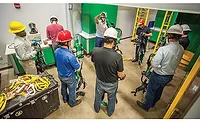
OSHA mandates that industrial hygienists or other health and safety experts provide training and equipment for those working in confined spaces before entry.1 Entrants and attendants must show comprehension, knowledge, and skill as a result of training.5

Training prior to confined space entry involves all members of the team.1 Anyone in charge of authorizing entry must be aware of everything inside the space including any hazards. Authorizing individuals must ensure all workers know what awaits them inside as well as their specific duties. Attendants, supervisors, and the rescue team all must be trained along with any worker entering the confined space.

Training must be complimentary to workers; presented in a language and vocabulary level each worker understands; and documented.5

Entrant training

Employers are responsible for training confined space entrants to:1

  • Recognize hazards.
  • Communicate with attendants beyond the designated confined space.
  • Recognize and alert attendants to warning signs of risk.
  • Use appropriate PPE and instruments and know where to obtain and how to use equipment.
  • Know self-rescue techniques.

Attendant training

Attendants stationed outside the confined space must be trained in their role. All confined space workers also must receive training on attendants’ responsibilities. Attendants need to:

  • Keep an accurate count of number of entrants.
  • Identify hazards, and monitor conditions.
  • Oversee and coordinate rescues.
  • Maintain constant communication during entry and when ordering evacuation if workers encounter conditions not covered by the entry permit; workers’ behaviour changes; workers cannot control a hazard; outside conditions could harm entrants; or the attendant must leave to tend to an emergency at another site he or she monitors.
  • Permit only authorized personnel to enter.

If company procedure allows, attendants may take part in rescues that do not involve entry, but they can never enter confined space work areas.

General training

With the exception of rescue personnel, all other workers are trained on the risks of helping to rescue a team member themselves.6 More than half of deaths related to confined spaces occur among people entering to rescue a member of their team.7


References

  1. http://www.bicmagazine.com/downloads/6610/download/Closing_In_On_Confined_Spaces.pdf?cb=b8197317125d504f575e80993ee47f97
  2. https://www.osha.gov/confinedspaces/
  3. https://www.osha.gov/confinedspaces/faq.html
  4. http://s7d9.scene7.com/is/content/minesafetyappliances/5500-015-MC%20OSHA%201926.1200%20CS%20for%20Const%20Ind_F
  5. https://www.ecfr.gov/cgi-bin/text-idx?SID=0fcd3bb8fd0fdaacebbf69327c4aa84f&mc=true&node=sp29.8.1926.aa&rgn=div6#se29.8.1926_11207
  6. https://www.osha.gov/Publications/OSHA3825.pdf
  7. http://us.msasafety.com/applications/confined-space
KEYWORDS: confined space

Share This Story

Looking for a reprint of this article?
From high-res PDFs to custom plaques, order your copy today!

John Raimondi is product marketing manager – gas detection for MSA. For more information on MSA’s safety products, please visit www.MSAsafety.com or call (800) 672-9010.

Recommended Content

JOIN TODAY
to unlock your recommendations.

Already have an account? Sign In

  • forklift safety

    Exploring the latest technologies in forklift safety

    With more staff and more stock in warehousing now more...
    Facility Safety
    By: Josh Cramer
  • welding

    All about welder’s flash or arc eye

    A flash burn is a painful inflammation of the cornea,...
    Environmental Health and Safety
  • dangerous jobs

    The 10 most dangerous jobs in the U.S.

    On-the-job deaths have been rising — hitting the highest...
    Occupational Safety
    By: Benita Mehta
Manage My Account
  • eMagazine Subscriptions
  • ISHN Newsletter & Other Newsletter Alerts
  • Online Registration
  • Manage My Preferences
  • Subscription Customer Service

More Videos

Sponsored Content

Sponsored Content is a special paid section where industry companies provide high quality, objective, non-commercial content around topics of interest to the ISHN audience. All Sponsored Content is supplied by the advertising company and any opinions expressed in this article are those of the author and not necessarily reflect the views of ISHN or its parent company, BNP Media. Interested in participating in our Sponsored Content section? Contact your local rep!

close
  • man wearing the the Sundström SR200 Full Face Mask Respirator
    Sponsored byOHD

    5 Fit Testing Mistakes That Could Cost You

  • This image shows Magid AcuSpex polarized blue mirrored safety glasses.
    Sponsored byMagid Glove and Safety

    Construction PPE Guide: What Crews Need for Each Task

  • lone worker in confined space
    Sponsored byAlphasense Ltd.

    GET THE LEAD OUT of your Safety Oxygen Sensors!

Popular Stories

SpaceX 7 launch

OSHA Investigating Fatal Fall at SpaceX Starbase

Automated loading dock equipment

After March 2026 Rivian Death, Safety Managers Reassess Loading Dock Systems Under OSHA's Warehouse Emphasis Program

psychology in the workplace

Most Workplaces Measure Psychological Safety, Ignoring Psychosocial Risks

top 10 most dangerous jobs

Poll

Seasonal Readiness

With the federal heat stress prevention rule on the horizon, which area of your safety program needs the most attention?
View Results Poll Archive

Products

Surviving an OSHA Audit A Management Guide, 2nd Edition

Surviving an OSHA Audit A Management Guide, 2nd Edition

See More Products

ISHN Podcasts

Related Articles

  • Confined space training

    Confined space training’s high stakes

    See More
  • Confined space training

    See More
  • ISHN0417_C5_pic.jpg

    Make your confined space training healthy & robust

    See More
×

Become a Leader in Safety Culture

Build your knowledge with ISHN, covering key safety, health and industrial hygiene news, products, and trends.

JOIN TODAY
  • RESOURCES
    • Advertise
    • Contact Us
    • Directories
    • Manufacturing Division
    • Store
    • Want More
  • SIGN UP TODAY
    • Create Account
    • eMagazine
    • Newsletters
    • Customer Service
    • Manage Preferences
  • SERVICES
    • Marketing Services
    • Reprints
    • Market Research
    • List Rental
    • Survey/Respondent Access
  • STAY CONNECTED
    • LinkedIn
    • Facebook
    • YouTube
    • X (Twitter)
  • PRIVACY
    • PRIVACY POLICY
    • TERMS & CONDITIONS
    • DO NOT SELL MY PERSONAL INFORMATION
    • PRIVACY REQUEST
    • ACCESSIBILITY

Copyright ©2026. All Rights Reserved BNP Media, Inc. and BNP Media II, LLC.

Design, CMS, Hosting & Web Development :: ePublishing