ISHN logo
search
cart
facebook twitter linkedin youtube
  • Sign In
  • Create Account
  • Sign Out
  • My Account
ISHN logo
  • NEWS
    • Today's News
    • Global Safety News
    • Government Regulations
  • PRODUCTS
    • Product Innovations
    • Featured Products
  • TOPICS
    • Environmental Health and Safety
    • Facility Safety
    • Workplace Health
    • Occupational Safety
    • PPE
    • More Topics
  • CONSTRUCTION
  • TECHNOLOGY
  • COLUMNS
    • Best Practices
    • Dave Johnson: What’s going on
    • Editorial Comments
    • Leading Safety
  • MULTIMEDIA
    • ISHN Podcast
    • Videos
    • Cold Stress Education Quiz
    • Webinars
    • White Papers
  • MORE
    • Buyer's Guide
    • Newsletters
    • Convention Companion
    • Polls
    • Events
    • ISHN Store
    • Sponsor Insights
  • EMAGAZINE
    • eMagazine
    • Archived Issues
    • Contact
    • Advertise
  • JOIN TODAY!
Facility Safety

Combustible nano-dust: Smaller particle sizes lead to faster, stronger explosions

By Timothy Cullina
August 20, 2018

Credit for launching the nanotechnology revolution frequently goes to Richard Feynman’s 1959 talk to the American Physical Society, “There’s Plenty of Room at the Bottom,” And even if you disagree with this credit, I hope you can agree that Feynman’s enthusiasm for “small science” certainly fed the imaginations of scientists, philosophers, and deep thinkers about a future built upon nanotechnologies.

Others, maybe Eric Drexler, or was it Omni Magazine, forecast a darker future for nanotechnology with predictions of self-replicating nanobots gone rogue, consuming nearly all resources, and leaving only a dark, dead, world composed of nothing but useless nanobots forming endless piles of “grey goo,”

More than a half century later, the nano engines of creation are quietly humming away, the alarms over grey goo have gone nearly silent, and many of today’s industries move steadily toward producing smaller particulate, even if most are still quite a ways from true nanometer particle size.

Particle size is the dominant physical parameter that affects explosion severity and ease of ignition for combustible dusts. And particulate size is trending down in many industries. This is true for pigment, toners, electronics, cosmetics, pharmaceuticals, specialty chemicals, additive manufacturing, food and many more. As with toner, the reason may be improved quality and new transfer technologies. Other advantages may be related to improving mixing efficiencies and reducing production times.

Of course, some particle size reductions may go unnoticed if your management of change (MOC) program is blind to particle size considerations. While there are advantages to working with a smaller particle size that is specific to each application, there is also an increased combustible dust risk associated with smaller particle sizes that needs to be managed.

For example, 10 years ago printer toner particulate sizes averaged 30 to 50 microns. To improve the appearance of type, manufacturers have worked to produce finer and finer toner particulate. Today, toner manufacturers are pushing the size boundaries to, and even below, 10 microns. Ten years ago, KSt values for many toners were in the Class II range, that is 200 to 300 bar-meter per second. Today’s smaller toner particulates have KSt values well over 300 bar-m/s. In some cases the protection strategies employed 10 years ago are no longer adequate. Explosion vent sizes may be too small or suppression reaction times too slow.

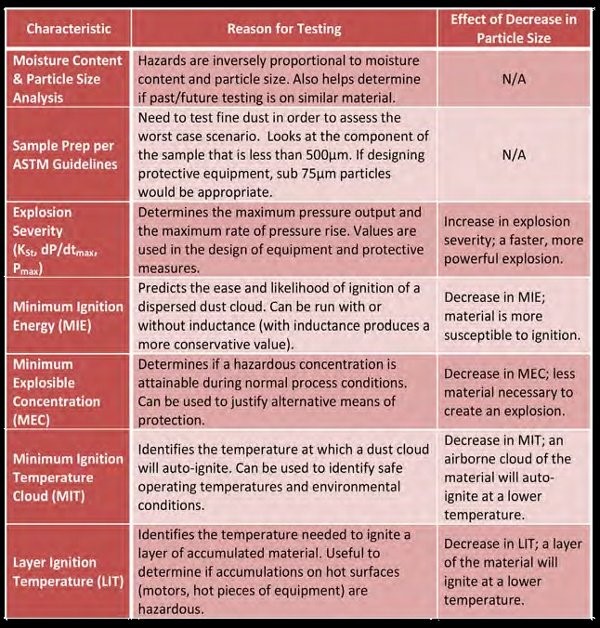
The decrease in particle size reduces the required energy to initiate a deflagration. It is easier to meet the conditions necessary for a deflagration or explosion by decreasing the minimum explosible concentration (MEC) decreasing the minimum ignition energy (MIE) needed to ignite the material, and decreasing the temperature at which the material may autoignite (AIT). A smaller particulate also creates a faster and stronger explosion since this greatly increases the maximum rate of pressure rise (dP/dt)max. It may also result in a more powerful pressure wave. All of which makes the material more hazardous.

Particle size may also “unexpectedly” or inadvertently be decreased by process changes or improvements, some even as inconspicuous as replacing mill components or suppliers. For these reasons it is important to understand the impact that smaller sizes will have on your material. A summary of the recommended testing campaign and the effects of particle size on the results are provided in Table 1.

 Table 1 – Recommended Tests for Material Hazard Characterization
nano

For more information regarding hazardous or combustible dust, dust hazard analysis (DHA) testing or other process safety concerns, please contact info@fauske.com. 630-323-8750, www.fauske.com. 

KEYWORDS: Combustible dust workplace safety

Share This Story

Looking for a reprint of this article?
From high-res PDFs to custom plaques, order your copy today!

Timothy Cullina is Senior Consulting Engineer, Fauske & Associates, LLC.

Recommended Content

JOIN TODAY
to unlock your recommendations.

Already have an account? Sign In

  • forklift safety

    Exploring the latest technologies in forklift safety

    With more staff and more stock in warehousing now more...
    Facility Safety
    By: Josh Cramer
  • welding

    All about welder’s flash or arc eye

    A flash burn is a painful inflammation of the cornea,...
    Environmental Health and Safety
  • dangerous jobs

    The 10 most dangerous jobs in the U.S.

    On-the-job deaths have been rising — hitting the highest...
    Occupational Safety
    By: Benita Mehta
Manage My Account
  • eMagazine Subscriptions
  • ISHN Newsletter & Other Newsletter Alerts
  • Online Registration
  • Manage My Preferences
  • Subscription Customer Service

More Videos

Sponsored Content

Sponsored Content is a special paid section where industry companies provide high quality, objective, non-commercial content around topics of interest to the ISHN audience. All Sponsored Content is supplied by the advertising company and any opinions expressed in this article are those of the author and not necessarily reflect the views of ISHN or its parent company, BNP Media. Interested in participating in our Sponsored Content section? Contact your local rep!

close
  • man wearing the the Sundström SR200 Full Face Mask Respirator
    Sponsored byOHD

    5 Fit Testing Mistakes That Could Cost You

  • This image shows Magid AcuSpex polarized blue mirrored safety glasses.
    Sponsored byMagid Glove and Safety

    Construction PPE Guide: What Crews Need for Each Task

  • lone worker in confined space
    Sponsored byAlphasense Ltd.

    GET THE LEAD OUT of your Safety Oxygen Sensors!

Popular Stories

SpaceX 7 launch

OSHA Investigating Fatal Fall at SpaceX Starbase

Automated loading dock equipment

After March 2026 Rivian Death, Safety Managers Reassess Loading Dock Systems Under OSHA's Warehouse Emphasis Program

psychology in the workplace

Most Workplaces Measure Psychological Safety, Ignoring Psychosocial Risks

top 10 most dangerous jobs

Poll

Seasonal Readiness

With the federal heat stress prevention rule on the horizon, which area of your safety program needs the most attention?
View Results Poll Archive

Products

Surviving an OSHA Audit A Management Guide, 2nd Edition

Surviving an OSHA Audit A Management Guide, 2nd Edition

See More Products

ISHN Podcasts

Related Articles

  • Work gloves: lighter, faster, stronger

    See More
  • Four worker fatalities lead to $1M+ fine for Ill. company

    See More
  • Machine guarding hazards lead to finger amputations at Texas company

    See More

Related Products

See More Products
  • 1119010160.jpg

    Guidelines for Combustible Dust Hazard Analysis

  • 9780367861148.jpg

    LEAD Safety A Practical Handbook for Frontline Supervisors and Safety Practitioners

See More Products

Related Directories

  • Scientific Dust Collectors

    Scientific Dust Collectors (SDC) began in 1981 when our first patent for improving filter cleaning was issued. Our patented UniFlow Supersonic Nozzle -based cleaning system is where it all starts. Combined with our High Side Inlets, Wide Filter Spacing, and Inlet Baffling, we are able to guarantee performance, efficiency, and filter life. ASHRAE 199 Test Lab on site.
×

Become a Leader in Safety Culture

Build your knowledge with ISHN, covering key safety, health and industrial hygiene news, products, and trends.

JOIN TODAY
  • RESOURCES
    • Advertise
    • Contact Us
    • Directories
    • Manufacturing Division
    • Store
    • Want More
  • SIGN UP TODAY
    • Create Account
    • eMagazine
    • Newsletters
    • Customer Service
    • Manage Preferences
  • SERVICES
    • Marketing Services
    • Reprints
    • Market Research
    • List Rental
    • Survey/Respondent Access
  • STAY CONNECTED
    • LinkedIn
    • Facebook
    • YouTube
    • X (Twitter)
  • PRIVACY
    • PRIVACY POLICY
    • TERMS & CONDITIONS
    • DO NOT SELL MY PERSONAL INFORMATION
    • PRIVACY REQUEST
    • ACCESSIBILITY

Copyright ©2026. All Rights Reserved BNP Media, Inc. and BNP Media II, LLC.

Design, CMS, Hosting & Web Development :: ePublishing