Selecting the right chemical-resistant glove requires trial & error
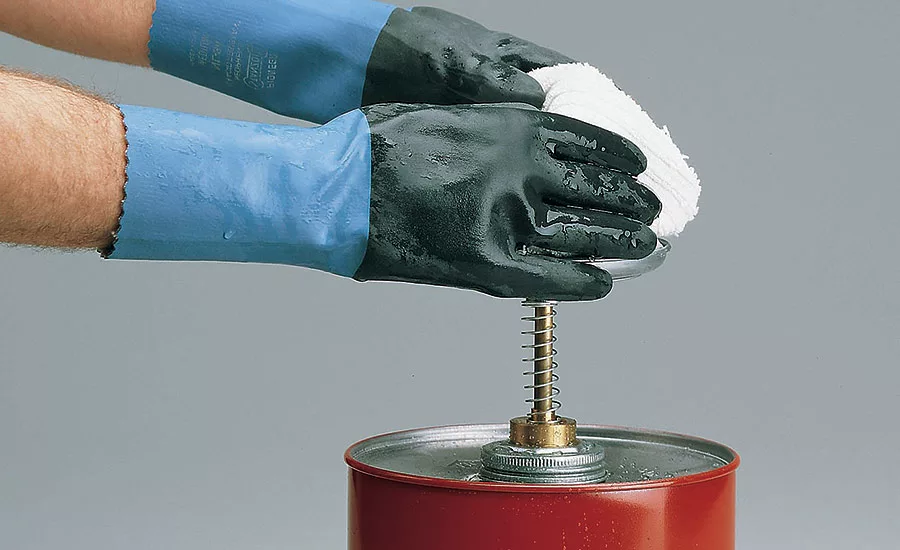
As the Safety Services Manager for a safety supply company, I am commonly asked by customers to help determine which chemical resistant gloves are appropriate for a given work application. Most glove manufacturers supply a simple chemical resistant chart that helps show compatibility of their gloves to certain chemicals, but just how accurate are those charts?
Since OSHA expects employers to evaluate which PPE to use when working with different chemicals, customers are typically left with two choices in making this determination: 1) review the Safety Data Sheet (SDS) or; 2) review with their safety supplier/glove manufacturer.
You will probably find that most SDSs are quite vague in their PPE recommendation. Many SDSs simply say to “use a chemical resistant glove when handling this product.” Obviously, this statement is of little value to the customer trying to document which glove their employees should use for a specific work application. While SDSs are very helpful in identifying percentages of ingredients found in chemical mixtures, it still makes sense to review chemical compatibility charts when needing to select a proper glove.
Treat it as an experiment
Any time you select a new chemical glove to use for a new or existing work process, you must treat it as an experiment. Put yourself in the mindset that using that new glove in your specific work scenario has never been done before anywhere in the world. While this may seem a little extreme, remember that your employees are using these gloves in a unique manner that other companies do not exactly duplicate.
Degradation
This is the reduction in one or more physical properties of a glove material due to contact with a specific chemical. In essence, degradation charts assist employers in determining how quickly a given chemical will “eat away” at the glove material that is protecting your hand. Exposed glove materials may get harder, stiffer, and more brittle, or they may get softer, weaker, and swell to several times their original size. Degradation ratings are not precise and time limits are difficult to judge, but this can be a helpful tool in determining compatibility of a glove material with a certain chemical.
Permeation
This is the process by which a chemical moves through a glove material on a molecular level and begins to contact the skin.
Manufacturers typically test their glove film material by using a small swatch which has been completely immersed with a chemical on one side and with a sensor probe on the other side timing exactly when the sensor “sniffs” or senses the chemical beginning to breakthrough. This is referred to as “Permeation Breakthrough Time.”
Just because a particular glove has a listed breakthrough time for a specific chemical at 60 minutes, that does not automatically mean the gloves must be thrown out exactly after one hour of use. First of all, most chemical glove applications are not completely immersed for such a long time frame. Secondly, just because permeation breakthrough occurs at a specific time, this does not mean the chemical is “gushing” through the glove.
When chemical resistance testing is done on gloves, all manufacturers perform this testing at 72 degrees F (room temperature). In general, for every 17-degree rise in temperature, the breakthrough time is reduced by half, and the permeation rate will double.
Permeation Rate
This is the average constant rate of permeation that occurs after breakthrough when the chemical is continuous and all forces affecting permeation have reached equilibrium. To put it in more simplistic terms, it means that after permeation takes place, does the chemical leak through the glove very slowly or does it gush through?
This actually is important, because you can typically continue to use a glove after permeation breakthrough occurs (for a limited period of time), provided the permeation rate is very slow (and you are not dealing with a very toxic product). Yes, this can be a bit of a guessing game, so be careful with this experiment in glove longevity.
Glove Thickness
When referring to a glove thickness, you will always see the term mil being used. A “mil” is equal to 1/1,000 of an inch (or .001”). Glove thickness can only be measured on unsupported gloves (which do not have a fabric liner). It can be very helpful to know the thickness of unsupported gloves since it gives you a point of comparison for longevity of gloves from a chemical permeation viewpoint.
Care of Gloves
Even the most appropriate chemical glove for a given application will wear out quicker if the employees don’t take proper care of the glove. Provided that it is appropriate to do so, rinsing/cleaning/wiping the gloves off after chemical contact will almost always lengthen the life of the glove. By leaving chemical residue on a glove to simply “evaporate” off over time, you are giving the chemical residue a chance to both permeate and degrade the glove material. After repeated exposure to specific chemicals, the glove film allows the chemical to permeate that barrier a little easier each time.
Conclusion
We must remember that chemical compatibility charts are only used as a guide in making a decision on proper glove use. A new selection of a chemical glove can be a trial and error scenario that must be treated as an "experiment.”
We need to remember that our hands are our “living gloves” and we must do everything we can to keep that pair clean and healthy throughout our life.
Looking for a reprint of this article?
From high-res PDFs to custom plaques, order your copy today!