ISHN logo
search
cart
facebook twitter linkedin youtube
  • Sign In
  • Create Account
  • Sign Out
  • My Account
ISHN logo
  • NEWS
    • Today's News
    • Global Safety News
    • Government Regulations
  • PRODUCTS
    • Product Innovations
    • Featured Products
  • TOPICS
    • Environmental Health and Safety
    • Facility Safety
    • Workplace Health
    • Occupational Safety
    • PPE
    • More Topics
  • CONSTRUCTION
  • TECHNOLOGY
  • COLUMNS
    • Best Practices
    • Dave Johnson: What’s going on
    • Editorial Comments
    • Leading Safety
  • MULTIMEDIA
    • ISHN Podcast
    • Videos
    • Cold Stress Education Quiz
    • Webinars
    • White Papers
  • MORE
    • Buyer's Guide
    • Newsletters
    • Convention Companion
    • Polls
    • Events
    • ISHN Store
    • Sponsor Insights
  • EMAGAZINE
    • eMagazine
    • Archived Issues
    • Contact
    • Advertise
  • JOIN TODAY!
Government Safety RegulationsColumnsRisk Management

FR Protection

Assessing arc flash risk
By Dave Johnson
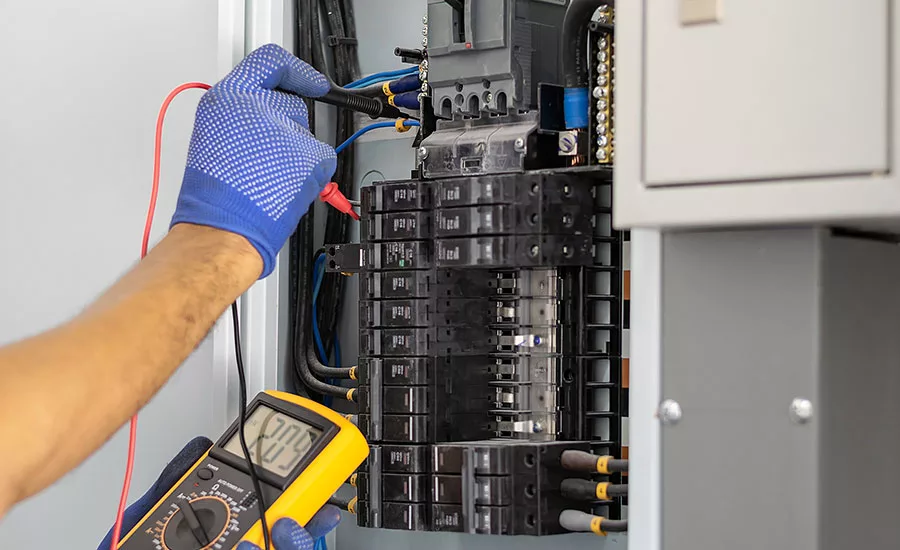
ISHN_FRCol0620_pic.jpg
June 5, 2020

ISHN spoke to Colin Duncan, CEO of the SEAM Group, and Jay Smith, SEAM Group director safety services, about arc flash hazard analyses (AFHA).

Why do many companies misunderstand the level to which AFHA should optimally be done?  Companies who have not kept up with the changes in NFPA 70E are typically not versed in the requirements.   

Many companies rely on local resources they have trusted with electrical repairs, or contractors who help them with facility construction to guide them in how to approach electrical safety. Often times the resources they trust are not electrical safety experts. We often see that it is merely lack of education on what is required to protect employees from electrical hazards that can cause varying levels of AFHA.

Why does this misunderstanding lead to assets being overlooked and not properly assessed?  

Again, lack of education on the capability of equipment to produce an arc. We see many companies adopting the notion that only 480V equipment can cause a significant arc and thus only that type of equipment needs assessed. This leads to the belief that any downstream items cannot have a higher hazard than their upstream feed.  This is simply not true and something of a myth.

How common is it for workplaces to be unaware of an AF risk?  

Very common. Although it's not that workplaces assume there isn't a risk, it's just to what level could it be. With shock hazards it is easy, if you can reach in and touch the "shiny parts" you can get shocked. With arc flash its more difficult to determine what equipment has higher arc flash hazards.

Why do arc flashes often occur from minor oversights?  

Typically minor oversights can be common equipment, or equipment that is serviced or interacted with frequently. It can often be that this frequent interaction/exposure increases the likelihood that an arc flash may occur.

Why do companies fail to effectively identify and inventory AF risk factors?  

This gets back to relying on local resources that are not electrical experts, and the lack of education and awareness on the capability of equipment to product an arc. And again, a company needs someone qualified to do the work, which requires technical knowledge that is often lacking

What hazards are most typically often overlooked?  

Branch circuits, downstream items like disconnects, RTUs on roof tops, even control cabinets. We see many times that facilities will assess the main gear and even down to the MCC level and then stop. It's the assumption that a downstream little 30A disconnect can't have a hazard greater than its upstream feed. This is just not true and often leads to a misguided approach to an arc flash. Dust can be a big hazard and even cause arc flash when equipment is operated where "fugitive" dust is present. Rusted doors, hinges, missing knock-outs, screws, etc. are all signs of deteriorating equipment that cause additional hazards.

Do most companies have qualified personnel to assess the likelihood that an adverse event may occur, and the severity of the injury if it does?  

Not typically.

What to assess

Arc flashes often occur from minor oversights, so an ideal arc flash hazard assessment should consider a number of risk factors that might not be immediately obvious. These include: the presence of dust and condensation within or on an electrical asset; accidental contact with an asset due to poor training or lack of signage; the mishandling of tools resulting in conductive items left near live assets; the presence of condensation within electrical assets; and electrical asset corrosion and faulty installation.


Steps to complete an arc flash analysis

From a blog post by Jeson Pitt on the Voluntary Protection Programs Participants Association website

Data collection: Collect necessary data about the facility’s power distribution system. Data includes the details of the arrangement of components on a one-line drawing and nameplate specifications of every device. The lengths and cross-section of all cables are also included.

Engineering analysis of the data: Perform a short circuit analysis followed by a coordination study. Feed the resultant data into the equations described by NFPA 70E-2000 or IEEE Standard 1584-2002. These equations produce the necessary flash protection boundary distances and incident energy to determine the minimum PPE requirement.

Protective device coordination: Perform protective device coordination to ensure selection and arrangement of protective devices to limit the effects of an overcurrent situation to the smallest area. Use results to make recommendations for mitigating arc flash hazards.

Arc flash calculations: Determine the incident energies and flash protection boundaries for all equipment. Incident energy is the energy needed for an arc flash to cause second-degree burns and flash protection boundary is the distance where the incident energy or second-degree burns are caused.

Arc flash study and analysis report: Prepare the arc flash report, which provides a short review period during which your team can evaluate modifications.

Label installation: Create and install arc flash warning labels which pinpoint incident energy and working distance, arc flash boundary, and nominal system voltage.

Source:

1. https://www.vpppa.org/symposium/blog-entry/conducting-arc-flash-risk-assessment-for-employee-safety

KEYWORDS: Arc flash hazard analysis standards

Share This Story

Looking for a reprint of this article?
From high-res PDFs to custom plaques, order your copy today!

Djohnson new pic 7.10.22

Dave Johnson was chief editor of ISHN from 1980 until early 2020. He uses his decades of expertise to write on hot topics and current events in the world of safety. He also writes and edits at Dave Johnson’s Writing Shop LLC and is editor-at-large for ISHN. Find him at https://www.facebook.com/Dave-Johnsons-Writing-Shop-101316571547263/, and on LinkedIn at https://www.linkedin.com/in/daveljohnsoneditor/.

Recommended Content

JOIN TODAY
to unlock your recommendations.

Already have an account? Sign In

  • forklift safety

    Exploring the latest technologies in forklift safety

    With more staff and more stock in warehousing now more...
    Facility Safety
    By: Josh Cramer
  • welding

    All about welder’s flash or arc eye

    A flash burn is a painful inflammation of the cornea,...
    Environmental Health and Safety
  • dangerous jobs

    The 10 most dangerous jobs in the U.S.

    On-the-job deaths have been rising — hitting the highest...
    Construction Industry Safety and Health
    By: Benita Mehta
Manage My Account
  • eMagazine Subscriptions
  • ISHN Newsletter & Other Newsletter Alerts
  • Online Registration
  • Manage My Preferences
  • Subscription Customer Service

More Videos

Sponsored Content

Sponsored Content is a special paid section where industry companies provide high quality, objective, non-commercial content around topics of interest to the ISHN audience. All Sponsored Content is supplied by the advertising company and any opinions expressed in this article are those of the author and not necessarily reflect the views of ISHN or its parent company, BNP Media. Interested in participating in our Sponsored Content section? Contact your local rep!

close
  • man wearing the the Sundström SR200 Full Face Mask Respirator
    Sponsored byOHD

    5 Fit Testing Mistakes That Could Cost You

  • This image shows Magid AcuSpex polarized blue mirrored safety glasses.
    Sponsored byMagid Glove and Safety

    Construction PPE Guide: What Crews Need for Each Task

  • lone worker in confined space
    Sponsored byAlphasense Ltd.

    GET THE LEAD OUT of your Safety Oxygen Sensors!

Popular Stories

SpaceX 7 launch

OSHA Investigating Fatal Fall at SpaceX Starbase

Automated loading dock equipment

After March 2026 Rivian Death, Safety Managers Reassess Loading Dock Systems Under OSHA's Warehouse Emphasis Program

psychology in the workplace

Most Workplaces Measure Psychological Safety, Ignoring Psychosocial Risks

top 10 most dangerous jobs

Poll

Seasonal Readiness

With the federal heat stress prevention rule on the horizon, which area of your safety program needs the most attention?
View Results Poll Archive

Products

Surviving an OSHA Audit A Management Guide, 2nd Edition

Surviving an OSHA Audit A Management Guide, 2nd Edition

See More Products

ISHN Podcasts

Related Articles

  • NFPA 70E arc flash risk assessment is a safety study

    See More
  • Selecting PPE for arc flash protection

    See More
  • ISHN0517_C3_pic.jpg

    Protecting hands from shock & arc flash

    See More

Related Products

See More Products
  • 1118911040.jpg

    Risk Assessment: A Practical Guide to Assessing Operational Risks

  • industrial hy.jpg

    Industrial Hygiene: Improving Worker Health through an Operational Risk Approach

See More Products

Related Directories

  • e-Hazard

    E-Hazard is dedicated to building an electrical safety culture with you. Our electrical engineering services and training will prepare your team for any electrical safety needs or concerns. E-Hazard can help with electrical training, arc flash studies, electrical audits, electrical safety programs, LOTO, infrared scanning, NFPA 70B, consulting and much more.
  • NASCO Industries Inc.

    NASCO manufactures rainwear for the multi-hazard workplace. Our employee-owners are proud to manufacture products that will protect against Electric Arc Flash (AR), Flash Fire (FR), Chemical Splash, Steam, Hot Water and High Visibility.
×

Become a Leader in Safety Culture

Build your knowledge with ISHN, covering key safety, health and industrial hygiene news, products, and trends.

JOIN TODAY
  • RESOURCES
    • Advertise
    • Contact Us
    • Directories
    • Manufacturing Division
    • Store
    • Want More
  • SIGN UP TODAY
    • Create Account
    • eMagazine
    • Newsletters
    • Customer Service
    • Manage Preferences
  • SERVICES
    • Marketing Services
    • Reprints
    • Market Research
    • List Rental
    • Survey/Respondent Access
  • STAY CONNECTED
    • LinkedIn
    • Facebook
    • YouTube
    • X (Twitter)
  • PRIVACY
    • PRIVACY POLICY
    • TERMS & CONDITIONS
    • DO NOT SELL MY PERSONAL INFORMATION
    • PRIVACY REQUEST
    • ACCESSIBILITY

Copyright ©2026. All Rights Reserved BNP Media, Inc. and BNP Media II, LLC.

Design, CMS, Hosting & Web Development :: ePublishing