Industrial vacuum cleaners could help mitigate confined space hazards
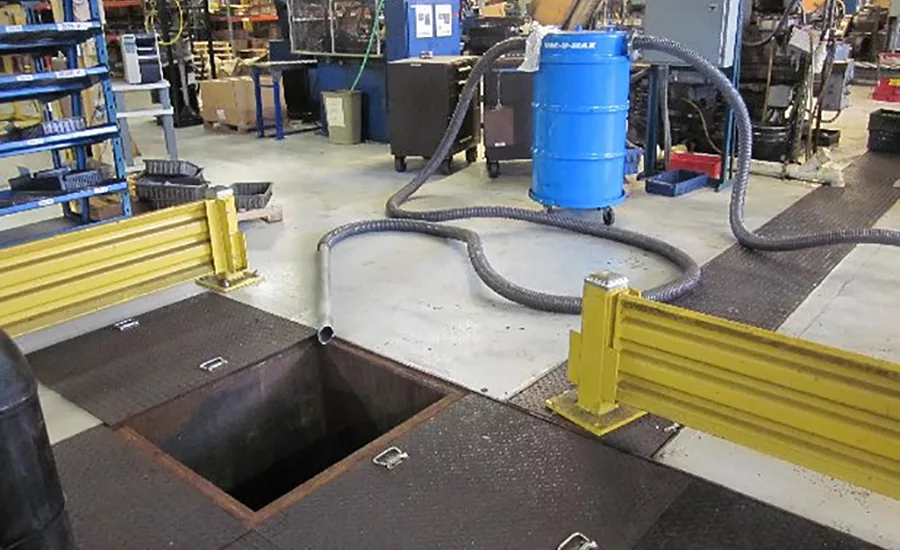
From grain handling operations to heavy blast material, pit cleaning with vacuums allows workers to clean outside of confined space.
Two workers died this week and two will die next week, statistically speaking, in confined space-related accidents, according to OSHA data that documents an average of 92 deaths and nearly 11,000 injuries per year. Of those 92 annual deaths, one-quarter of them occur during repair, maintenance, cleaning, and inspection activities that occur in enclosed spaces.
Despite OSHA's spotlight on confined spaces, the number of deaths remains relatively the same as 23 years ago. The National Fire Protection Association released NFPA 350: Guide for Safe Confined Space Entry and Work to provide extended guidance and best practices to fill in gaps or confusion in relation to OSHA standard 29 CFR 1910.146.
Working in septic tanks, silos, reaction vessels, vats, boilers, holding tanks, pits, or similar structures or enclosures qualifies as working in a confined space. OSHA defines a confined space as one that is large enough for an employee to enter fully and perform assigned work; is not designed for continuous occupancy by the employee; and has a limited or restricted means of entry or exit.
According to NFPA 350, "all confined spaces have the potential to become OSHA-defined permit-required confined spaces, depending on the work to be performed and the inherent, potential, or introduced hazards in the space at the time of the entry."
OSHA standards designate a permit-required confined space when it has a hazard to health or life associated with it, such as containing a hazardous atmosphere; material with the potential to engulf someone who enters the space; an internal configuration that might cause an entrant to be trapped or asphyxiated by inwardly converging walls or by a floor that slopes downward and tapers to a smaller cross section; and/or contains any other recognized serious safety or health hazards.
Confined space procedures are costly in terms of evaluation, training, and additional manpower needed to monitor confined space entry. Unfortunately, this safety procedure of providing a monitor frequently ends up putting additional workers at risk because anywhere between 40 and 60 percent of all confined space deaths include would-be rescue workers.
Hazard abatement
Whether it is a confined space or a permit-only confined space, the same health and safety hazards that typically exist on the shop floor, such as ergonomic hazards, slips and falls, overexertion, explosion, and uncontrolled release of energy also exist in confined spaces; however, in confined spaces, there is a smaller margin for error.
Anytime organizations can engineer out or minimize health and safety hazards with controls, it reduces risk and therefore it is the preferred method of handling hazards — so much so that the NFPA dedicated an entire chapter in NFPA 350 to hazard elimination and control. Because 25 percent of confined space deaths occur during cleaning, NFPA 350 8.4.2.1 states, “whenever possible, workers should clean the confined space from the outside, without the need for entry.”
Some of the more common areas in manufacturing and production facilities where entering a confined space to clean can be eliminated, or exposure can be severely limited, with the use of industrial vacuum cleaners include elevator pits, blast recovery pits, and sludge pits and bucket elevator pits. Just as each operation has proprietary processes and each enclosed space application is unique, each industrial vacuum cleaning system is different and selected to fit the application. In some cases, small air- and electric-powered drum-style units will suffice, while others require larger units to accommodate multiple users and filtration systems capable of capturing particles that are invisible to the naked eye. Some of course, will also need to be intrinsically safe.
The restriction of combustible dust in an enclosed space increases the likelihood of an explosion. In areas where combustible dust is present in an enclosed area, NFPA 350 8.4.3 addresses the need for intrinsically safe equipment and procedures, stating that "entry supervisors should ensure that combustible dust residue should be removed using intrinsically safe vacuums" and "confirm that vacuum equipment is grounded and bonded to the space being cleaned."
Elevator boot pits are common enclosed spaces that need regular cleaning. According to the National Grain and Feed Association, many boot pits occupy "priority housekeeping areas" under OSHA's Grain Handling standard, 29 CFR 1910.272, and must be cleaned immediately when accumulations reach 1/8 inch.
Eliminating contamination
In feed and grain mills, keeping the area clean not only eliminates organic combustible dust accumulations, but also prevents pest infestations and product contamination. Using an industrial vacuum cleaner with wands and attachments often eliminates the need to enter a boot pit for cleaning, freeing up valuable resources and eliminating risk of death in enclosed spaces.
Other areas where pit clean-out can pose serious health hazards are abrasive blasting operations and sump pit cleaning. According to the NIOSH publication "Industrial Health and Safety Criteria for Abrasive Blast Cleaning Operations," "there are general safety problems inherent to working in confined spaces" in abrasive blasting operations. Abrasive blasting is taxing on machinery, causing substantial wear and tear on components, which results in regularly servicing equipment to maintain operation. Often when maintenance is necessary, media must be removed from blast pit areas to accommodate those repairs. Some blast media pits are shallow and narrow, creating hazards, but are not technically designated as enclosed space hazards. Some facilities have deeper pits that do qualify as enclosed spaces.
To eliminate the need for workers to descend into an enclosed space in order to shovel and scoop tons of heavy blast media out of the pits, a metal fabricator sought out a vacuum designed for high volume recovery in an industrial setting. The fabricator utilized the same type of portable vacuum used in the breakaway vacuum system at the feed mill, but rather than rolling the vacuum to various tubing networks, the facility decided to move the 15HP vacuum, capable of recovering up to 5 tons per hour, via forklift to the pit area to remove the material, eliminating the need for workers to enter a confined space to clean blast material from the pit.
Eliminating or shortening entries
Sometimes it is not possible to completely eliminate the need to enter into confined spaces to clean an area. When that is the case, keeping the time spent in that space to a minimum may be the best possible outcome.
In the metalworking industry, under-the-floor sump pits, where sand-like semi-solid material forms when residual particulates and chips settle in the bottom of a sump, are a common area where confined space standards apply. These pits are ideal breeding grounds for harmful bacteria and fungus that endanger workers' health, shorten the life of metalworking fluids, interfere with machine function, and can eventually plug fluid lines.
Today's industrial vacuum cleaners are powerful tools that can be equipped for wet or dry applications, suitable for Class II Div 2 areas and designed to render explosives inert. Most likely, if it isn't possible to completely eliminate a confined space cleaning hazard, working with a vacuum cleaning expert can at least minimize employee exposure in enclosed spaces.
Looking for a reprint of this article?
From high-res PDFs to custom plaques, order your copy today!


