ISHN logo
search
cart
facebook twitter linkedin youtube
  • Sign In
  • Create Account
  • Sign Out
  • My Account
ISHN logo
  • NEWS
    • Today's News
    • Global Safety News
    • Government Regulations
  • PRODUCTS
    • Product Innovations
    • Featured Products
  • TOPICS
    • Environmental Health and Safety
    • Facility Safety
    • Workplace Health
    • Occupational Safety
    • PPE
    • More Topics
  • CONSTRUCTION
  • TECHNOLOGY
  • COLUMNS
    • Best Practices
    • Dave Johnson: What’s going on
    • Editorial Comments
    • Leading Safety
  • MULTIMEDIA
    • ISHN Podcast
    • Videos
    • Cold Stress Education Quiz
    • Webinars
    • White Papers
  • MORE
    • Buyer's Guide
    • Newsletters
    • Convention Companion
    • Polls
    • Events
    • ISHN Store
    • Sponsor Insights
  • EMAGAZINE
    • eMagazine
    • Archived Issues
    • Contact
    • Advertise
  • JOIN TODAY!
Occupational SafetyEnvironmental Health and SafetyFacility SafetySafety Technology

How industrial automation can improve workers' safety
By Bryan Christiansen
Industrial Automation

Credit: Getty Images

October 4, 2021

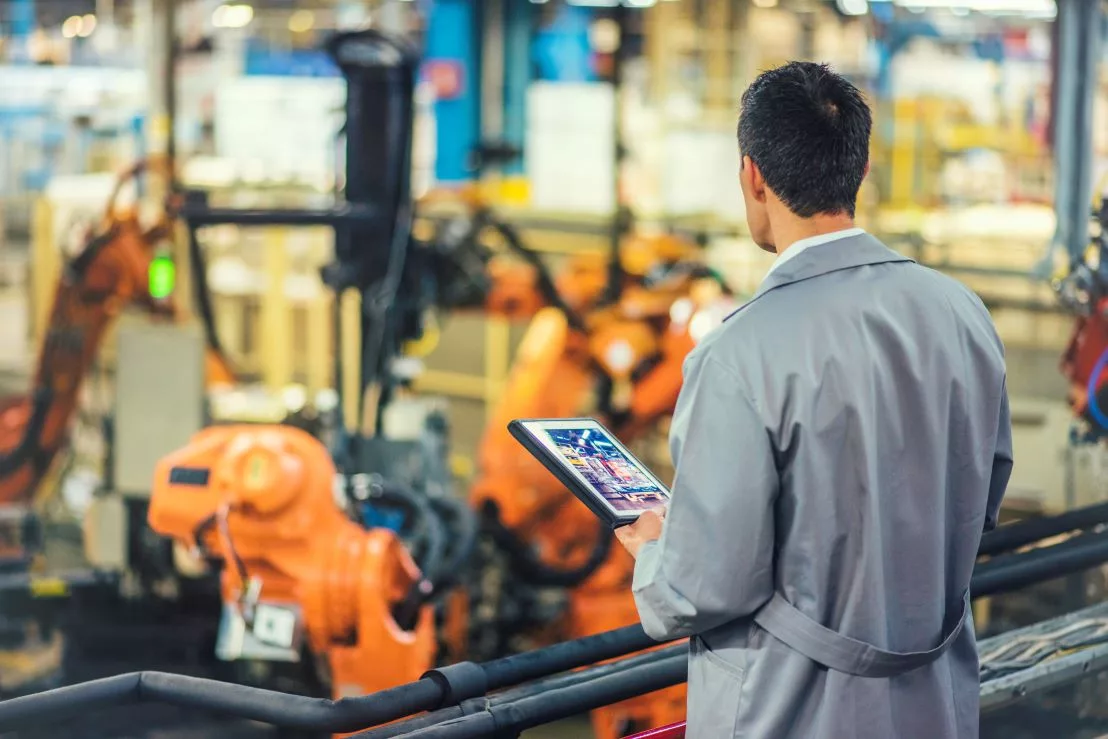
We credit industrial automation with productivity, efficiency, and safety gains, citing manual handling reduction and a reduction in musculoskeletal injury as a first-stage safety benefit. Yet, advanced technologies bring new opportunities for improved worker safety beyond manual handling, requiring an adaptation in our safety thinking.

The evolution in technology and safety provides an ever-greater ability to remove workers from dangerous workplaces, provide advanced safety monitoring and enforcement, and use automation in safe design. These advances are on the back of the rise in the capabilities of artificial intelligence (AI), machine learning (ML), and computer vision (CV).

In the medium term, the focus on manual handling must continue. The Liberty Mutual Insurance Workplace Safety Index for 2021 cites manual handling, awkward postures, and repetitive motions in the top ten causes of disabling injuries. The cost estimates to businesses of these three workplace injuries exceed 19.5 billion dollars each year. As automation improves, new ways of assisting workers in reducing manual handling injuries will continue to emerge.


Removal of workers from dangerous places

Yet, four of the top ten in the safety index involve falls on the same level, falls to a lower level, caught in equipment or machines, and struck by an object or equipment. The costs from these injuries total 24.46 billion dollars. At a simplistic level, the next level benefit of automation is to exclude workers from hazardous areas by using robotic equipment, particularly when working at heights or in confined spaces. Yet, hazard reduction through automation offers another less recognized opportunity regarding maintenance interventions.

The complicated nature of maintenance operations has health and safety implications for workers. Therefore, reductions in equipment breakdowns exclude maintenance workers from dangerous situations as much as a robot working at heights does for a stock picker. When automation replaced humans, businesses began losing between 5% and 20% of their new productivity due to equipment failure, requiring frequent maintenance intervention. In effect, we removed one significant safety risk and replaced it with another, although arguably much reduced.

With the latest automated equipment using AI and ML combined with a maintenance philosophy called predictive maintenance, operators of automated systems now have the tools they need to maintain maximum equipment optimization. In prolonging equipment uptime, reducing unscheduled breakdowns provides an exciting opportunity for a commensurate improvement in maintenance personnel safety through planned, scheduled, and controlled intervention rather than an emergency response under production pressure.


Safety monitoring and enforcement

The next stage of evolution in safety technology involves advanced safety monitoring and enforcement. While comprehensive strategies exist that include machine guarding and lockout-tag out (LOTO) processes, both are subject to override or mistakes. While not a panacea, AI, ML, and CV present another layer of safety monitoring and enforcement, providing productivity and safety benefits. Products exist today that provide industry-grade, enterprise-ready computer vision systems linked to AI and ML algorithms. These systems provide automated monitoring, object detection, and activity recognition. When used in a safety application, they recognize activity and predict risky behaviors, activating remedial or preventative actions ranging from alerts or energy isolation to machine shutdown to prevent harm.


Automation in design

One of the latest stages of safety benefits provided by automation is the use of hardware-driven design support. As data complexity has increased exponentially, AI allows design engineers to analyze multiple options affecting safety. Combining robotics with mobile platforms and predictive maintenance requires designers to incorporate multiple, complex safety standards. The use of AI to model predictive failure modes in safety-related control systems while maintaining standard conformity to a high level of confidence is an advance not previously available to designers.

Similarly, software-driven design automation is assisting in rapidly changing automated environments. Once largely static and guarded, today's automated machines are self-propelled and multi-tasked. The variables within such an environment are constantly changing, requiring constant rapid analysis and action. Only AL and ML can provide the real-time predictive response to changed circumstances to protect workers from harm.


Conclusion

As industrial automation has increased worldwide, it has long since moved past providing simple manual handling solutions. Now, a complex, evolving, automated threat landscape presents itself for safety consideration. In design today, we have automation using a convergence of AI, ML, CV and AI informed design to adapt automation to humans. Recognizing a worker's height, whether left or right-handed, and any physical constraints, the automated device will adjust its physical characteristics or task management to suit. As we adapt the way we think about safety, the capabilities of technology provide us with the modern tools and techniques needed to provide exciting advances in the welfare of workers.

KEYWORDS: automation manufacturing musculoskeletal disorders (MSDs)

Share This Story

Looking for a reprint of this article?
From high-res PDFs to custom plaques, order your copy today!

Bryan Christiansen is the founder and CEO at Limble CMMS. Limble is a modern, easy to use mobile CMMS software that takes the stress and chaos out of maintenance by helping managers organize, automate, and streamline their maintenance operations.

Recommended Content

JOIN TODAY
to unlock your recommendations.

Already have an account? Sign In

  • forklift safety

    Exploring the latest technologies in forklift safety

    With more staff and more stock in warehousing now more...
    Workplace Training Strategies
    By: Josh Cramer
  • welding

    All about welder’s flash or arc eye

    A flash burn is a painful inflammation of the cornea,...
    Environmental Health and Safety
  • dangerous jobs

    The 10 most dangerous jobs in the U.S.

    On-the-job deaths have been rising — hitting the highest...
    Transportation Safety
    By: Benita Mehta
Manage My Account
  • eMagazine Subscriptions
  • ISHN Newsletter & Other Newsletter Alerts
  • Online Registration
  • Manage My Preferences
  • Subscription Customer Service

More Videos

Sponsored Content

Sponsored Content is a special paid section where industry companies provide high quality, objective, non-commercial content around topics of interest to the ISHN audience. All Sponsored Content is supplied by the advertising company and any opinions expressed in this article are those of the author and not necessarily reflect the views of ISHN or its parent company, BNP Media. Interested in participating in our Sponsored Content section? Contact your local rep!

close
  • man wearing the the Sundström SR200 Full Face Mask Respirator
    Sponsored byOHD

    5 Fit Testing Mistakes That Could Cost You

  • This image shows Magid AcuSpex polarized blue mirrored safety glasses.
    Sponsored byMagid Glove and Safety

    Construction PPE Guide: What Crews Need for Each Task

  • lone worker in confined space
    Sponsored byAlphasense Ltd.

    GET THE LEAD OUT of your Safety Oxygen Sensors!

Popular Stories

SpaceX 7 launch

OSHA Investigating Fatal Fall at SpaceX Starbase

Automated loading dock equipment

After March 2026 Rivian Death, Safety Managers Reassess Loading Dock Systems Under OSHA's Warehouse Emphasis Program

chemical safety

It Was Just Sugar: Catastrophic Safety Failures in Louisville

top 10 most dangerous jobs

Poll

Seasonal Readiness

With the federal heat stress prevention rule on the horizon, which area of your safety program needs the most attention?
View Results Poll Archive

Products

Surviving an OSHA Audit A Management Guide, 2nd Edition

Surviving an OSHA Audit A Management Guide, 2nd Edition

See More Products

ISHN Podcasts

Related Articles

  • Internet of Things

    How industrial IoT can improve work environment safety

    See More
  • connected worker

    Industry 5.0 introduces technologies that partner with workers to improve safety

    See More
  • Communication industrial workers

    How digitizing processes can improve your safety culture

    See More

Related Products

See More Products
  • 9781498773416.jpg

    The Legal Aspects of Industrial Hygiene and Safety

See More Products

Related Directories

  • SafetyLine Lone Worker

    SafetyLine Lone Worker helps companies monitor the status of workers who are remote, alone, or working in hazardous situations. We are an automated check-in monitoring and emergency notification service. SafetyLine uses its communications infrastructure to ensure that workers have comprehensive monitoring, 24/7, without the need for costly monitoring centers.
  • AutomationDirect

    AutomationDirect is a well-known distributor offering tens of thousands of in-stock products for industrial automation such as programmable logic controllers, sensors, drives, motors, electrical enclosures, pneumatic fittings, actuators, cut-to-length wire, and much more. Free shipping is offered on in-stock items with few limitations. For more information, check our their online store or call 1-800-633-0405.
×

Become a Leader in Safety Culture

Build your knowledge with ISHN, covering key safety, health and industrial hygiene news, products, and trends.

JOIN TODAY
  • RESOURCES
    • Advertise
    • Contact Us
    • Directories
    • Manufacturing Division
    • Store
    • Want More
  • SIGN UP TODAY
    • Create Account
    • eMagazine
    • Newsletters
    • Customer Service
    • Manage Preferences
  • SERVICES
    • Marketing Services
    • Reprints
    • Market Research
    • List Rental
    • Survey/Respondent Access
  • STAY CONNECTED
    • LinkedIn
    • Facebook
    • YouTube
    • X (Twitter)
  • PRIVACY
    • PRIVACY POLICY
    • TERMS & CONDITIONS
    • DO NOT SELL MY PERSONAL INFORMATION
    • PRIVACY REQUEST
    • ACCESSIBILITY

Copyright ©2026. All Rights Reserved BNP Media, Inc. and BNP Media II, LLC.

Design, CMS, Hosting & Web Development :: ePublishing