A new industrial revolution on the horizon
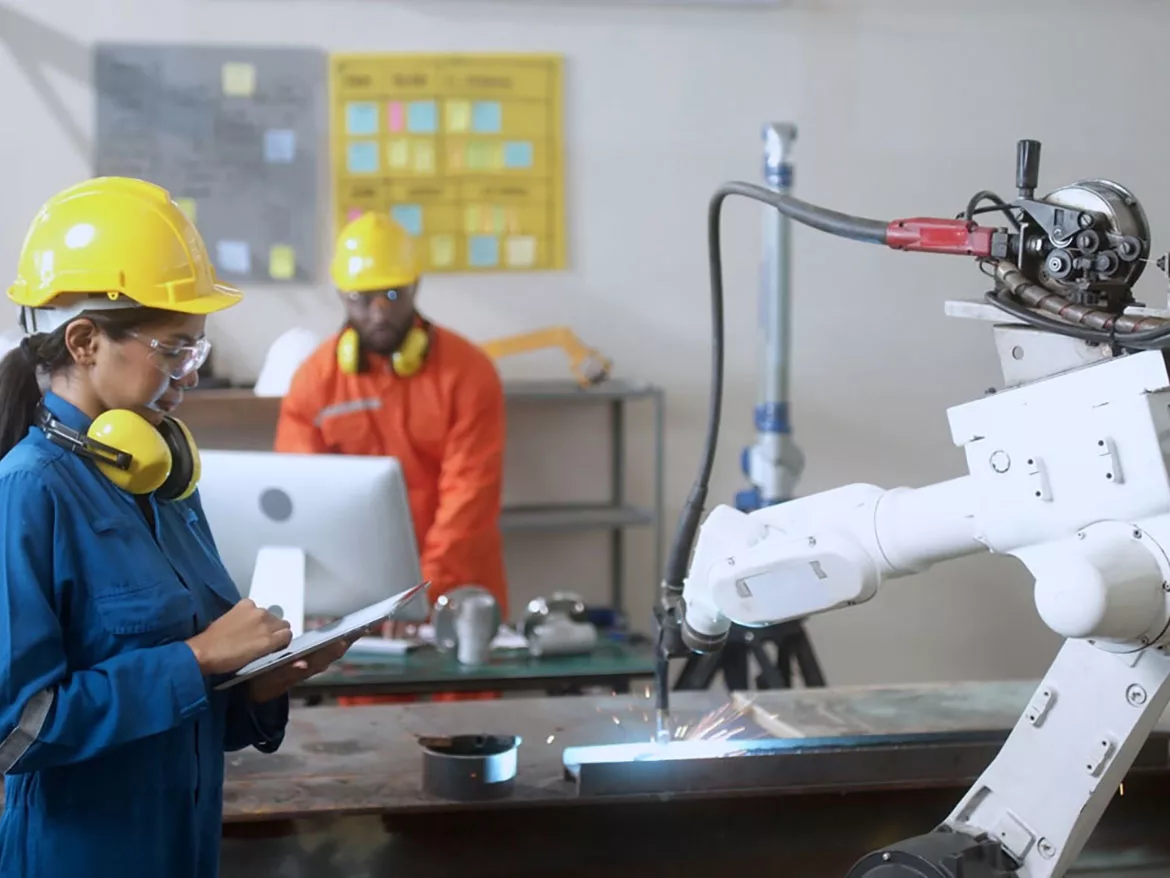
Even as companies are just now realizing the full array of benefits provided by Industry 4.0, there is a new industrial revolution on the horizon that integrates mankind and machine in ways only sci-fi movies once imagined. Industry 5.0 promises a workforce of human and machine collaborators capable of lightning fast efficiency with reduced risk.
If Industry 4.0 allows people to work smarter, then Industry 5.0 is going to let facilities work harder. And that’s a good thing.
While technology will never come back down from the cloud created by Industry 4.0, this new wave of tech is poised to make a huge transformation to all those robots in manufacturing plants and material handling warehouses.
The ubiquity of robots in industrial facilities isn’t just an anecdotal observation; it is a statistically demonstrable fact. The International Federation of Robotics reports that 422,271 new industrial robots were installed in 2018. A total of 55,212 of those robots were installed in the U.S., which was a 20% increase from 2017. The IFR also estimates that more than 3 million robots are operating across the planet in 2020, which is double the number of robots on Earth in 2014. Looking deeper into the data, these robots are becoming more involved in material handling operations; representing 42% of the increase, according to the IFR.
While it’s exciting to harness the potential of adding robots to a team of skilled workers, there are important factors to consider before making a major purchase. It’s critical for facility managers of manufacturing facilities, processing plants, warehouses, and distribution centers to remain up-to-date on robotics standards to ensure safety for workers and compliance with governing organizations.
Key robotic standards
The development and implementation of industrial machine guarding systems has always been an exercise in assessing risk. And risk assessments have become even more important in recent years thanks to the passage of Robotics Industry Association’s R15.06 and R15.08.
These regulations cover operations that some facility managers might easily overlook, such as automated stretch-wrapping. While automated stretch wrapping processes have become commonplace at loading docks across the country, there aren’t many safety regulations specifically governing them in the United States.
RIA R15.06: machine guarding risk assessments
Every machine guarding application has its own set of unique challenges and associated risk. The choices a facility manager makes for one application might not be the same or appropriate for the next. In most cases, safety-conscious managers would not guard an industrial robot the same way they would guard other equipment, because the risk associated with each differs greatly. Risk may even vary between similar operations, depending upon employee exposure and other factors.
This is where RIA R15.06 comes into play. Although most safety managers already practiced risk assessments before this standard, R15.06 mandates that a risk assessment be performed.
Some of the biggest changes with the RIA R15.06 industrial robot standard have to do with safety-rated motion and allowing for advanced programmable safety devices to be utilized. This means software is allowed “safety-rated” control of various aspects of the robot’s function, limiting the area in which the robot operates and the speed of robot motion.
Point-of-operation danger
When performing a proper risk assessment, point-of-operation guarding is probably the most involved aspect. It is relatively easy to place perimeter guarding around the entire process. However, in most situations a machine operator needs to interact with the operation by loading or unloading materials (such as metals to be welded) and running the machine.
This point-of-operation is where things get tricky. It also becomes clear why risk assessments must be completed.
Many details must be considered when it comes to point-of-operation areas, including the layout or design of the process, the limits of the system and properly identifying all associated hazards, as well as devising methods for hazard elimination and risk reduction.
Once the severity of the potential hazard has been determined, the frequency or duration of exposure and the possibility of eliminating or limiting exposure should be considered before any machine guarding decisions are made.
Point-of-interaction safety options
When it comes to satisfying the requirements of R15.06, presence-sensing devices such as light curtains and laser scanners are potential solutions for point-of-interaction safety near potentially dangerous operations. However, automated barrier doors may provide an even better option, as they have many of the same benefits as presence sensors, but with several additional advantages.
Most notably, automated barrier doors provide a physical barrier that can protect an employee and contain the process while at the same time restricting access to dangerous machine movement. This is particularly important for processes such as stretch wrapping in which inertia keeps machinery in motion even after it has shut down. Additionally, automated barrier doors aren’t held up against OSHA’s safety distance formula because there is no depth penetration factor – allowing the safeguard to be placed much closer to the hazardous area.
RIA R15.08: mobile robots
Recognizing how robotic procedures continue to advance at a rapid pace and seeing their surface mobility improve, the RIA developed a subcommittee in 2016 to develop standards for these new legions of mobile robots and passed the new RIA R15.08 in 2020. It is important to understand what robots will be covered under these new rules and what kinds of safety precautions should be considered as collaborative robots enter the workforce and Industry 5.0 becomes reality.
The initial draft of R15.08 is being ratified, but one of the first things that found a consensus is the scope of the new standard. The committee defined mobile robots as ground-based devices used in an industrial environment that possess a degree of autonomy sufficient to plan their own routes to a destination and re-plan if an obstacle is encountered.
Included in this description are:
Any ground-based device or system regardless of mode of mobility (e.g. wheeled, tracked, legged, etc…) operating in a structured or semi-structured industrial or commercial environment in which personnel who encounter the mobile robot can be trained in its safe use.
Devices and systems excluded from the R15.08 description are ones that are:
- Airborne or waterborne;
- Vehicles intended to carry people;
- Tele-operated; or
- Restricted to a pre-defined path (e.g. traditional automated guided vehicle [AGV]).
Many of these types of excluded devices are already under the jurisdiction of existing regulations. Notable regulations include:
- EN 1525: Safety of industrial trucks – Driverless trucks and their systems;
- EN 1526: Safety of industrial trucks – Additional requirement for automated functions on trucks;
- ISO 3691-4: Driverless industrial trucks and their systems; and
- ANSI B56.5: Safety standard for driverless, automatic guided industrial vehicles.
In contrast, R15.08 will help govern mobile robots with increased autonomy derived from their own pre-programmed circuitry. Additionally, R15.08 attempts to resolve conflicts between standards that preceded the rise in industrial mobile robots.
For instance, R15.06 requires that an industrial robot be restarted by a human operator from outside the robot cell, unless it’s in a collaborative application. The robot is not allowed to restart automatically. This is to ensure the operator has exited the hazardous area before restart. However, U.S. standard B56.5, which covers AGVs, allows an AGV to restart after it encounters a human obstacle in its path. While it will not directly stipulate direction for AGVs, R15.08 will reconcile this possible difference in safety protocols for mobile robots.
Protect employees while remaining efficient
As new technology is adopted to increase efficiency, it’s important for facility managers to simultaneously keep up with safety surrounding these advanced systems. Before specifying or implementing new safety devices for new automated operations, it’s critical to perform a proper risk assessment to discover the best solution for today’s and tomorrow’s processes.
The information herein is provided as a general reference regarding the use of the applicable product(s) in specific applications. This information is provided without warranty. It is your responsibility to ensure that you are using all mentioned products properly in your specific application and in accordance with all laws and regulations.
Looking for a reprint of this article?
From high-res PDFs to custom plaques, order your copy today!