Focus on ASHRAE standards for dust collection and indoor air quality

Photo credit: Camfil APC
Many industrial and manufacturing processes generate airborne dust particles that can reduce indoor air quality and pose health risks to workers. Employers are legally required to protect their workers from “recognized hazards that are causing or are likely to cause death or serious physical harm” under the General Duty Clause of the OSHA Act of 1970.
Facilities that create large volumes of dust need systems to collect this dust. These dust collectors work by using suction to pull in nuisance and hazardous dust and fume particles from the air. This helps prevent people from breathing them in and keeps them from settling on surfaces. Each minute, a dust collector draws in large quantities of dust-laden air from the processing area, filters out the dust and returns clean air to the work area or outside the facility.
Industrial dust collectors protect workers from toxic and combustible dusts. This protection is mandated by the National Fire Protection Agency, the U.S. Environmental Protection Agency and OSHA. Facility operators must find ways to maintain compliance, and dust collection systems are often the most effective and cost-efficient solution.
This article presents information on two specific air filtration and dust collection standards set by the American Society of Heating, Refrigerating and Air-Conditioning Engineers (ASHRAE). This information can guide you in establishing the best air quality program at your facility.
Standards for testing air filters and dust collector performance
ASHRAE develops standards and guidelines to provide uniform methods of testing for rating purposes, to recommend practices in designing and installing equipment, and to deliver additional information on industry best practices. ASHRAE has 87 active standards and guideline project committees to address indoor air quality, thermal comfort, energy conservation in buildings, reducing refrigerant emissions, and the designation and safety classification of refrigerants.
ASHRAE standards 52.2 on air filter performance
ASHRAE Standards 52.2 provides guidance on testing the performance of air filters and a method to measure their efficiency in removing different sized airborne particles. This standard determines an air filter’s performance by measuring the particle counts both upstream and downstream of the air filter device. The results indicate capture efficiency values throughout a range of particle sizes, which enables facility operators to be specific in selecting a filter that has the best efficiency for the contaminant they want to remove.
MERV air filter efficiency rating
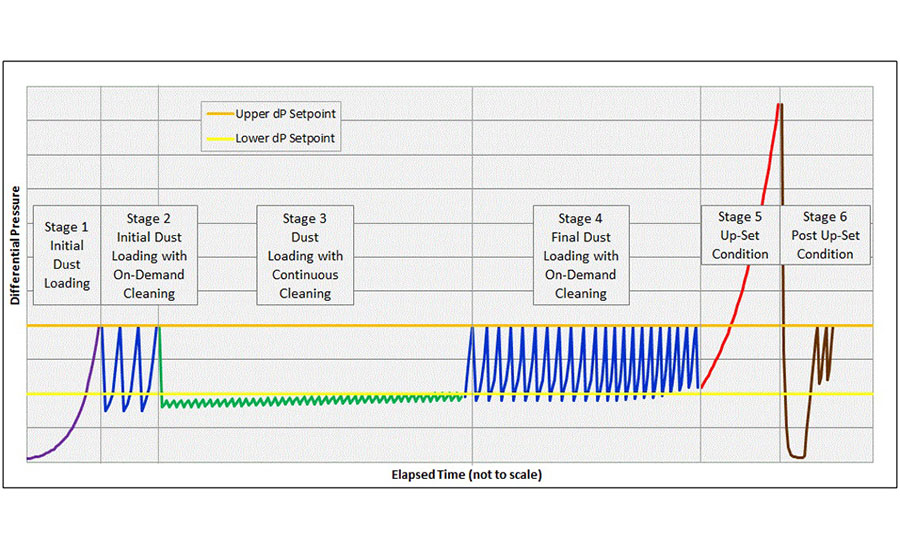
To simplify filter selection, the standard defines a minimum efficiency reporting value (MERV) that is used to distinguish how well an air filter removes different-sized particulates. The higher an air filter’s MERV value, the greater percentage of particles it can capture on each pass. The scale goes from 1 to 16 and corresponds to an air filter’s ability to capture particles in the range of 0.3 to 10 microns. A filter rated as a MERV 14/14A filter, for example, should remove at least 75 percent of all particles larger than 0.3 microns, while a MERV 16/16A should remove 95 percent.
Be aware that many air filters do not sustain their original MERV efficiency throughout their lifespan. For instance, a filter with a MERV-13 rating can drop capture efficiency to that of a MERV-8 filter over a short period of time. When this occurs, personnel and equipment are unintentionally less protected from airborne pollutants.
To address this efficiency reduction, ASHRAE designates certain filters with a MERV-A rating. These filters undergo additional testing to validate that their original rated efficiency will last throughout their life cycle.
MERV ratings: Useful for evaluating HVAC filters but not dust collector filters
While MERV ratings are helpful in selecting HVAC air filters, they are not as useful for evaluating industrial dust collector filters, even though many replacement dust collector filters provide MERV ratings. This is because MERV ratings apply to the initial filtration levels of new filters in a static environment. Typically, these filters are not designed to release dust and are replaced when they become loaded with particulates. However, dust collector filters are used over a long period of time in a very active system. They also handle more challenging dust types and loads than HVAC filters. In addition, they undergo repeating cycles of dust accumulation and pulse cleaning. Because of these aggressive factors, the efficiency of dust collector filters fluctuates.
These dynamics are not considered in a MERV rating. Although MERV identifies pressure drop of an air filter (resistance to airflow caused by dust accumulation), it does not address overall energy usage that significantly changes throughout filter life. With higher airflow restriction, more energy and compressed air are needed to maintain the proper airflow/pressure drop in the dust collector.
A better standard to test dust collectors
In 2016, ASHRAE released Standard 199 Method of Testing the Performance of Industrial Pulse Cleaned Dust Collectors to specifically address the dynamics of dust collectors versus HVAC systems. Prior to Standard 199, Standard 52.2 was the only filtration test available for dust collection.
The Standard 199 test method calculates the performance of the entire industrial pulse cleaned dust collector, including filtration performance and energy consumption. It assesses the unit from inlet to outlet and how well the filters clean. Results from Standard 199 testing indicate if the dust is releasing properly from the filters and longevity of filter life and should be used to determine system design and filter media selection.
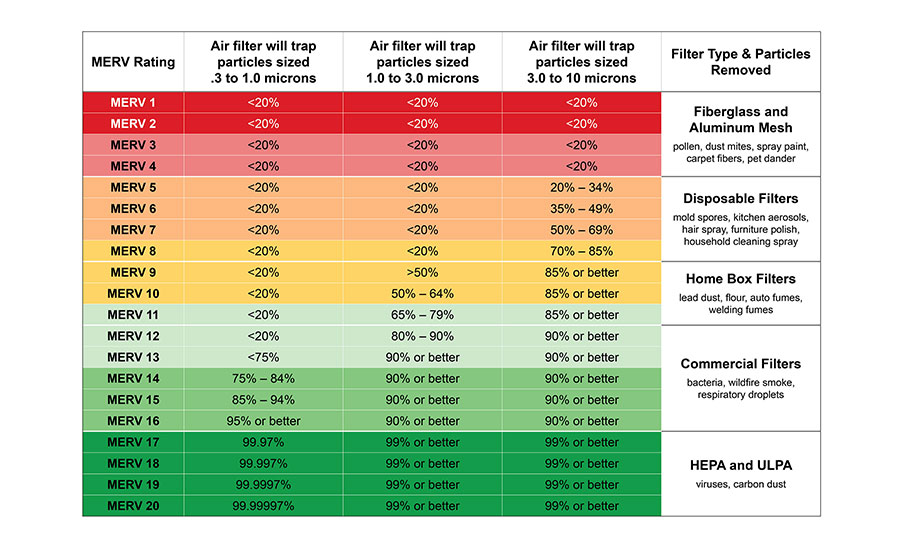
Testing challenges the dust collector to replicate real-life use. The test uses calcium-carbonate dust with specific particle size, bulk density, and moisture content, as stipulated in the standard. The methodology includes six stages:
Stage 1: Initial dust loading. Dust is fed into the collector at the specified rate, without pulse cleaning, until the system reaches the required differential pressure.
Stage 2: Initial dust loading with on-demand cleaning. On-demand pulse cleaning is initiated while dust continues to be fed into the collector at the same airflow. The high and low differential-pressure set points determine the cleaning interval.
Stage 3: Dust loading with continuous cleaning. Airflow and dust feed are maintained, and pulse cleaning of the filters continues at regular intervals for 24 hours or until the system reaches the specified maximum differential pressure.
Stage 4: Final dust loading with on-demand cleaning. The final dust loading is tested with on-demand cleaning and airflow and dust feed are maintained. As with Stage 2, the high and low differential-pressure set points trigger the filter cleaning. The frequency of cleaning varies depending on the system’s performance and pressure buildup.
Stage 5: Upset condition. Dust feed is maintained, and pulse cleaning is stopped to simulate how the dust collector would perform in an upset condition.
Stage 6: Post-upset condition. The cleaning process downtime is replicated to imitate a post-upset situation and return to normal system operation.
Bottom Line
Many replacement filters for dust collectors come with MERV ratings, but the relevance of these ratings to dust collection systems is debatable. Although MERV ratings are quite important to the HVAC industry, they do not accurately reflect the active environment of a dust collection system.
ASHRAE Standard 199 testing provides a more realistic comparison between different dust collector and filter cartridge combinations. It does this by using operating conditions that simulate real-world operation, making Standard 199 a more accurate gauge of how a dust collection system will perform throughout its life.
If facility operators are looking to buy a dust collection system, they can use the data from Standard 199 testing to determine how efficiently the filters clean and how the collector performs as a whole. Empowered with specific information on operation performance, energy costs and particle emissions based on dust collector operating conditions, you can make educated decisions in selecting a system that will perform efficiently over time.
Looking for a reprint of this article?
From high-res PDFs to custom plaques, order your copy today!