Reversing the normalization of performance deviations can be difficult

Photo credit: cofotoisme / iStock / Getty Images Plus
Many organizations suffer from performance deviation despite their best efforts. This could occur in production, efficiency, quality, profitability, customer service, safety, or any other goal or measurement standard. Failures are usually due to systems or humans. Prior to World War II, most aviation accidents were attributable to mechanical (system) failure. During WWII manufacturing, technology and design improved such that more accidents became attributable to pilot (human) error than to mechanical failure.
To counter this fact, human factors were incorporated into the design process, and standard operating procedures were developed for crews. This helped to some extent. The next watershed factor was the adaptation of crew/cockpit resource management in 1980, which helped further reduce accidents so much that flying is safer than most other modes of transportation today. This approach aligned systems and people to garner the best results.
Management intervention and worker's role
In industry, when failure to perform (achieve a goal) occurs, employees (worker) face management intervention. In safety, workers may also suffer physical harm. For accident prevention interventions, organizations develop programs, establish policies, provide training, furnish information, post signage, supervise, inspect, offer feedback, rewards, and/or punishment to ensure management's expectations are met. Post-accident or annually, after studying loss data specific pre-accident interventions may be given to the workforce.
The implemented interventions usually have some effect (see the Hawthorne effect study), but unfortunately, are not sustainable. Post failure findings usually point to some error or decision on the worker's part. So, this begs the question as to why reasonably intelligent workers would do things that lead to unacceptable performance or accidents and injuries.
Deviating standards of performance
Some time ago, I attended a conference where Mike Mullane, a former astronaut, was the keynote speaker. He, spoke of his experience at NASA involving leadership and performance standards focusing on "normalization of deviance". This is equally applicable to other industries, especially construction. This concept was developed by Diane Vaughan in her exceptional study of the space shuttle Challenger accident. Mr. Mullane stressed the need to guard against the insidious effect of this.
Normalization of deviance is a phenomenon by which individuals, groups, or organizations come to accept a lower standard of performance replacing their original one with the firm belief they will go back to the original standard. The process occurs when they find themselves under pressure to meet performance requirements and not enough time. So, to meet obligations they relax their standards experiencing no adverse effect. So, when they find themselves facing another challenging situation they defer to their past solution. After a few successful times without any adverse effects, the lower standard becomes the norm or the "new" standard for performance and they stop seeing the action as deviant.
The NASA example
A classic example of normalization of deviation is the two NASA space shuttle accidents involving the Challenger and the Columbia vehicles. Four different vehicles flew 24 successful missions experiencing some O-ring seal failure. The Challenger accident was the 25th flight. The Rogers Commission investigation determined that NASA personnel were aware of the faulty O-ring design, and the temperature’s impact on the ring’s integrity, yet failed to address engineers and other staff’s warnings about potential failure.
NASA had a major stand-down, implementing some changes to the vehicles as well as processes, practices, and procedures. Yet, seventeen years later, another normalization of deviation caused the loss of the Columbia space shuttle. Most previous shuttle launches had experienced minor damage from foam shedding by the external tanks, hitting the vehicles with no serious consequence to the vehicle integrity, During the 28th Columbia launch a broken piece of foam impacted the leading edge of the shuttle wing dislodging some of the heat deflecting tiles. This allowed super-heated air to enter the wing and caused it to fail, destroying the vehicle. The program has ended, but it was not clear if the safety culture at NASA had really changed to actively and effectively address the deviation in performance.
Turning to the construction industry
Production pressures are common in construction, and it is easy to see the normalization of deviance taking root. If a worker needs to use a stepladder to perform a task, but one long enough is not readily available, the worker is faced with a choice to take the time to find a longer one and possibly fail to meet the production goal or use the shorter one and get the job done. If the supervisor stresses production goals and the worker feel that his or her job might be in jeopardy, the logical choice will be to use the shorter ladder and meet the production goal.
If the worker chooses to bring up the lack of proper equipment being available for the task, the supervisor too is faced with a choice of accepting a delay or reduction in production while the appropriate equipment is secured or asking the worker to make do with what they have and get the job done. Underlying this decision is the knowledge that work has been successfully completed in the past with less-than-optimal equipment or procedures with little or no adverse effect.
So, in order to solve the immediate conundrum, the supervisor may ask the worker to proceed anyway but to be extra careful. The worker does so successfully. On the next day, they still don't have longer ladders, and the worker proceeds working on the top step of the shorter ladder. After a few days, the worker does not even think about the safety coordinator's admonitions. Working this way becomes accepted practice, and the deviation becomes normal practice.
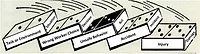
The underlying result is that the worker no longer focuses on being extra careful as the work becomes routine. This increases the risk associated with the work. Most serious accidents are caused by small errors in judgment that are magnified through a cumulative sequence of decisions and actions by workers, supervisors, and other management personnel.
There are other effects as well. Other workers who witness this see a worker not following rules, and incurring no negative consequences. They also see the supervisor condoning breaking the rules. They now see working in this manner (unsafely) as accepted practice. More importantly, if they see the supervisor thanking the worker for completing the task in that manner, it institutionalizes unsafe work habits, thereby creating a culture of ignoring prescribed safe task execution and engaging in unsafe production practices. It is also important to note the fact that the proper equipment (ladder) was not available due to a failure on the part of supervision (management) to properly plan the work, so solving it by relaxing a safety rule also covers up the supervisor's error, thus fostering a more insidious deviance in supervisory performance standards.
The schedule is a powerful driver of production. When supervisors succeed in overcoming barriers through deviations from "good" work practices without adverse effects, they reinforce the use of performance discrepancies and deviant practices. After repeating this a few times, solving performance pressures by deviation becomes institutionalized, forming a culture of production, which leads to acceptance of deviations from good work practices. So, the reasons for a future failure become actually conforming to accepted deviant practice and the prevailing unsafe work culture rather than the violation of the original "good" performance standards.
Changing the culture
Reversing the normalization of deviance is difficult unless there is a structural change in the organization. This is not easy to do, as it is the culture that allows these deviations to occur and become accepted. According to James Reason, a poor safety culture has three overriding factors:
- Normalization of deviance is discussed at length above.
- Complacency results in accepting risk or underestimating the exposure of the act due to past experience. Complacency turns people into observers or passive participants rather than actively contributing stakeholders.
- Tolerance of inadequate systems has numerous fundamental cultural, leadership, and organizational causes, which will be addressed in a future article.
Conclusion
Organizations generally have an expected "conduct of operations." This is how they would ideally want to operate. This may involve meeting or beating the project schedule and/or budget, operating at a high level of efficiency, meeting or exceeding expectations, treating partners fairly, and operating ethically while being profitable. In short, "conduct of operations" represents a system of policies, practices, and procedures that ensure requirements are being met. Unfortunately, no organization is immune to the normalization of deviance, regardless of how robust its conduct of operations system may be. People erroneously come to believe that a minor departure from defined procedures is acceptable, when in fact they have started down the road that eventually will result in some sort of catastrophe.
A practical approach to combating this subversive phenomenon requires actively guarding against it. People, teams, and organizations must appreciate their vulnerability to this. There needs to be acute situational awareness. The climate has to make it safe for people to "speak up" and voice their concerns. There should be a forum where their insights are welcomed and even encouraged. They should receive feedback on their suggestions and participate in follow-up discussions.
Everyone diligently guarding against accepting lower standards in the organization requires a culture where doing the "right" thing every time — no exceptions — is the only way to do it. Management plays a critical role in the success of avoiding succumbing to this normalization of performance deviations.
Looking for a reprint of this article?
From high-res PDFs to custom plaques, order your copy today!