Ask a Medic: 911 Skills for Safety
Stay on Scene or Load and Go: Safety Considerations for Emergency Response Pros
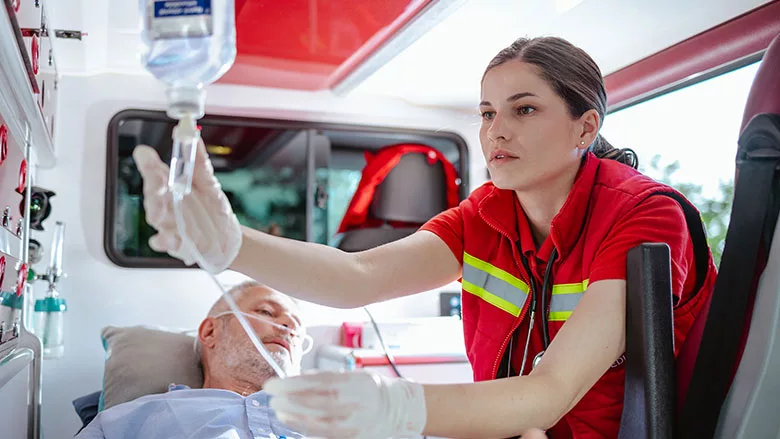
Photo credit: blackCAT / E+ / Getty Images Plus
Recently, we had the opportunity to teach an Industrial Emergency Medical Responder (IEMR) course for a high-performing response team at a large industrial facility. During the course, one question came up again and again, in various forms: Should we treat the patient on scene, or should we prepare them for transport?
This is a question I’ve spent years answering for new EMTs and paramedics. And while it seems simple at first glance, there is no one-size-fits-all answer. In fact, the best answer depends on the situation at hand — and, more importantly, on the information we give responders to make the right call in the heat of the moment.
The Dilemma: Stay and Play vs. Load and Go
In emergency medical services (EMS), mobility is our specialty. We can bring a critical 30 minutes of emergency room care to the scene. But this also places EMS providers in a tricky position: Do we stay and play, offering immediate care on scene, or do we load and go, rushing to the hospital for further treatment?
The answer often boils down to one simple question I teach all my new paramedics and EMT students: What is the next step in the patient’s care? If they can figure that out, they’re already on the path to making the right treatment and transport decision.
The challenge is that many responders get caught up in their part of the process and forget to consider what comes next. It’s easy to focus on what we can do in the moment, without thinking about what happens once the patient leaves our care. And for those dealing with critical patients, there’s always the pressure to get moving — delaying care makes many responders nervous. But in some situations, trading immediate transport for immediate treatment results in the best patient outcomes.
The Bigger Picture
The decision of whether to stay and play or load and go requires a broad understanding of patient care that goes beyond just rescue and transport. Responders need to remember that patient care doesn’t end when they pass the patient off — it continues all the way through to recovery.
To make truly informed transport decisions, it’s not enough to know our role in the process. We also need to have a basic understanding of what happens next in the patient’s care. Training and protocols often focus only on our part, but a deeper knowledge of the next step can be crucial to making the right call.
The Next Step in Care: Why It Matters
Understanding what comes next in patient care helps responders make decisions that are truly in the best interest of the patient. Let’s consider a few examples from a paramedic’s perspective.
Cardiac Arrest: Stay and Play for Better Outcomes
Cardiac arrest is often seen as a “load and go” scenario. But the reality is that staying on scene and providing care on-site can actually lead to better outcomes. If we ask ourselves what the next step in care is, we realize it’s Advanced Cardiac Life Support (ACLS) — the kind of equipment and expertise found in an ALS ambulance, including medications, airway tools, and cardiac monitoring.
Here’s the crucial part: ACLS treatments are incredibly time-sensitive. Delaying these treatments to package and transport a patient can reduce their effectiveness. While excellent Basic Life Support (BLS) can help slow down the clock, it doesn’t stop it. Medications used in cardiac arrest, for example, actually lose their effectiveness after just 15-20 minutes of downtime. Some data suggest they actually harm the patient after 20 minutes. Even electrical therapy becomes less effective as time passes. So, with this knowledge in hand, it’s clear that patients may benefit more from staying on scene for immediate care rather than being rushed to the hospital.
Stroke Care: The Path to a CT Scan
Let’s take a look at stroke care as another example. When a paramedic suspects a patient may be having a stroke, the next step is obvious: they need a CT scan at a stroke center. However, this doesn’t mean taking them to the nearest hospital with a CT scanner. The goal is to transport them to the facility that can provide the most effective stroke care.
What’s critical here is recognizing that the paramedic’s role is largely supportive. We can treat symptoms — such as providing respiratory support or managing blood pressure — but we can’t reverse the stroke itself. The best course of action is to get the patient to a facility where they can receive definitive care, including the CT scan that will help determine the exact type of stroke. Whether it’s hemorrhagic, a large vessel occlusion, or a small vessel occlusion, understanding the next step is key to making a timely and effective transport decision. But aside from addressing airway, breathing, and circulation, any delays in transport are detrimental to the patient.
The Decision-Making Model: A Simple Approach
Both of these examples highlight the importance of considering the next step in care when making decisions on the scene. The decision to stay and play or load and go isn’t about doing XYZ for every patient, every time. It’s about understanding what happens after we do our part — and making sure the patient is set up for the best possible outcome.
Leaders in response teams should encourage training that goes beyond basic certification. It’s important to develop protocols that help responders determine whether a patient needs immediate transport or if staying on scene for further treatment is the best option.
Teamwork Makes Us Better Providers
Every emergency call, every organization, and every EMS service is different. Your team’s capabilities—and those of your community — can be major variables in the decision-making process. That’s why it’s so important to build training and protocols around the specific needs and resources of your organization. Companies like the one I operate provide training and consulting work developing protocols for industrial and commercial organizations, but we are not the only subject matter experts out there.
Emergency responders, whether in a 911 setting or in industrial environments, often focus heavily on how quickly we can respond. And while speed can be crucial, it’s also important to recognize that we’re part of a larger team — one that extends beyond just the response team or even the hospital. Understanding how that team functions and how emergency responders fit into the bigger picture ultimately makes us better providers, improving outcomes for the patients who depend on us.
Looking for a reprint of this article?
From high-res PDFs to custom plaques, order your copy today!