Guidelines for managing construction contractors
Although a myriad of factors contributes to relatively high rates of safety mishaps on construction projects, collaborative efforts between safety managers and construction contractors could help improve safety and profitability significantly. The key for a safety manager is managing construction contractors.
Falls from height, dropped objects, electrocution, crane mishaps, and collapse of trench or machinery are among the major causes of construction accidents. Construction injuries and fatalities are enormously dreadful events for any manager. These events expose safety and construction management to potential litigations. Drawn out litigations put a heavy toll on worker morale, safety, profitability and public image. Although proximate causes of accidents are numerous, thoughtful analysis will show that poor communication and coordination between safety and construction contractors are the root causes of many accidents. So, how can we resolve this?
Before we get into details, it is worth noting that priorities or perception of construction contractors tend to be different (sometimes significantly different) from those of safety managers. Construction managers are under intense pressure of budgets and project schedules, while safety managers focus on accident minimization. This apparently slow and methodical approach tends to stretch patience of construction contractors. This is not to suggest that construction contractors do not care about safety. Of course, they do. Construction contractors are the linchpin of successful construction projects. Seemingly different objectives of construction and safety need to be aligned into a cohesive framework.
Guidelines
System’s view coupled with linear programming (project objectives and constraints) and hierarchy of risk management offers an effective tool for managing contractors and minimizing construction accidents through collaborative framework between contractors and safety managers (see graphic).
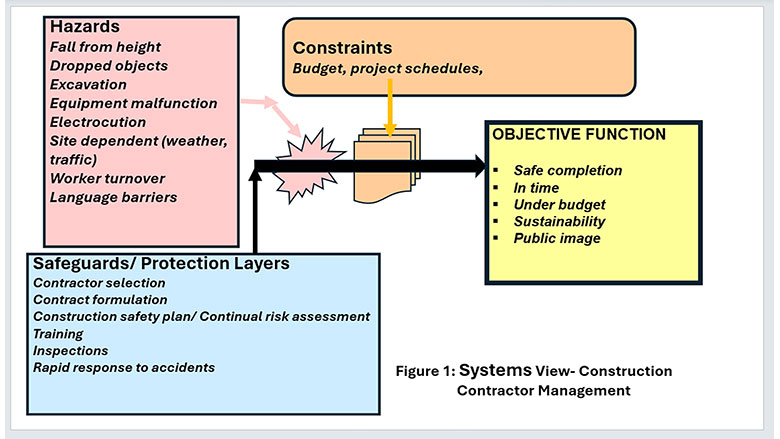
Figure courtesy of GC Shah
Briefly, it shows major safeguards (protection layers) along with construction hazards, constraints, and major objectives (objective function) of a construction project. In order to achieve objectives, the safeguards must prevail over hazards and work under constrains, as shown in the figure. A construction project must have a well-defined management system to ensure project is progressing safely, under budget and per-schedule.1
Contractor selection
For major construction projects, contractor selection is the singularly most pivotal step for achieving project objectives. Contractor selection and framing of contract language and clauses is best approached jointly by your company’s legal counsel and safety group. Typically, on large projects, a general contractor is selected, who in turn (in accordance with contact clauses) selects trade contractors (e.g. HVAC, electrical, civil, soil analysis, plumbing, excavation). Although sub-contractor selection is largely made by the general contractor, the owner should minimize any potential liability arising from the sub-contractor selection process. Discussion below applies principally to the selection of the general contractor.
Of course, first you need to define scope and time requirements of the project and invite bids from eligible contractors. In selecting a contractor from bids, you can rely on your experience with preferred contractor/contractors — however, things change and performance from the distant past may not be a helpful guide. Develop a weighted checklist of items including:
- Contractor’s technical, financial and workforce capabilities to do the job. Records of previous similar projects performed by the contractor, and its safety, health, and environmental performance.1
- Safety records, safety training records, and trend — including incident rates, records of injuries, illnesses, days of reduce work or days away from work.
- Records of regulatory inspections and records of compliance or lack thereof.
- In Canada, consider Experience Modifier (EM) and in the US, consider EMR-Experience Modifier Rating (EMR) assigned by insurance companies.
- Compatibility of contractor’s database and communication systems with your systems. If it is not totally identical, what would be required to align the systems. The key is communication between your company and contractor should be swift, uninterrupted and reliable.
- Safety manuals and procedures.
- Cost, of course, is a consideration, but not a primary one.
After narrowing your selection, if practicable, consider a brief visit to the constructor’s site with a focus on safety culture, not only at management level, but also at the worker level, their competence and work attitude.
Ensure a good rapport with neighboring community. Keep it periodically apprised on major non-proprietary issues.
Contract formulation
Your company’s core objective in contract structuring is to minimize all types of risk/liability — safety, legal and actual liability — and this requires careful phrasing of the causes and sub-clauses. Safety managers work closely with the lead from legal counsel and the contractor’s representatives in formulating the contract. There are several different forms of construction contacts, however, owner (your company) could be held liable even if the accident/injury occurred by a sub-contractor. Safety regulations for multi-contractor sites in Canada and the US, and likely many other countries, require the owner to provide a workplace that is free of recognizable hazards. Contracts should define responsibilities and rights of your company (owner), general contractor, and sub-contractors with a fine degree of granularity.
Construction safety plan
Safety regulations which require contractor coordination, written programs, training, and qualifications must be reviewed with the contractor(s) at the time of contract formulation.1 Relevant regulations depend on the country and project location. In Canada, relevant regulations include, for example, National Building Code of Canada, Fire Code standards, and standards from Canadian Standards Association (CSA).2 In the US, NFPA (fire standards) and numerous OSHA standards (29 CFR 1926 and 1910) need to be included. Broadly put, standards include those for slips and falls, excavation, crane safety, electrical safety, fire protection, hazard communication (HAZCOM), confined space, LOTO, steel erection, waste management (EPA), and others. In addition, consider local standards as well. Prior to signing contract, conduct a detailed review of all applicable federal, state, and local standards. Critical importance of this review cannot be overstated since their completeness and clarity of the plan could prove valuable in the event of litigation, albeit main goal is safety and not contentious litigation.
Training and documentation
All workers must have completed training and certifications for doing the job — for example, crane safety, LOTO, HAZWOPER, HAZCOM and others. In view of diverse workforce at many locations, make sure training modules are easy-to-understand by ALL workers. Documentation is crucial for regulatory inspections; it should be accurate, updated and quickly available
Inspections
How often should you (owner) conduct inspections — daily, weekly, monthly? There is no single best answer. Too frequently, inspections could hinder work progress and on the other hand, total lack of inspections could make you vulnerable to liability arising from lack of supervision. Frequency and content of inspections are typically discussed at the time of the contract. All inspections and results must be logged accurately and timely. Records should be available quickly.
Communications and rapid response
Even with well-crafted detailed contracts and procedures, you and contractors need to be prepared for contingencies. Effective and cyber-attack-protected communications are a must for rapid resolution of problems. Emergencies arising from a myriad of sources including accidents, injuries, absences, supply chain disruptions, and severe weather events must be addressed promptly. In the event of an accident, make sure the general contractor along with sub-contractors work in cohesion to take corrective action. Do not neglect the need for timely briefing of neighbors and your team.
The key takeaways are that safety manager plays a pivotal role in conjunction with the company’s legal counsel, IT, other groups, and contractors to ensure safe, profitable, and timely completion of construction projects.
References
Looking for a reprint of this article?
From high-res PDFs to custom plaques, order your copy today!